


The first notes of a piano echo hauntingly as, in an ode to the introduction of Hitchcock’s Psycho, the frame fills with a sea of high-rise buildings. The curling, feminine pink of the title cards settles over the sprawling and endless New York skyline, evoking the loneliness that-
despite being surrounded by people-comes with living in a big city.


These concrete mountains stand in contrast to the imposing, lofty darkness of the Bramford, the place where Rosemary and Guy Woodhouse will soon call home. As we take in its majestic and dramatic form, it makes a firm and foreboding impression. If we peer closely enough, we can spot a doll-sized Rosemary and Guy holding hands as they approach, seemingly lured in by the hypnotic dreaminess of the lullaby score. The energy of the Bramford stirs and swallows them whole in an instant as they disappear into its recesses- Rosemary’s story has begun.
Inherited Misfortune
When the real estate agent shows Rosemary and Guy their new home, his description of its layout and geography adds to the sense of mystique and ambiguity that pervades the film: “originally the smallest apartment was a nine. They’ve been broken up into four, fives, and sixes/ 7-E is a four.”
Tragedy certainly occurs with regularity at the Bramford as early on we learn that the previous tenant, Mrs Gardenia has recently passed away. As a bright-eyed Rosemary flutters between the rooms, she comes across a herbarium. Tucked away from clear view, it is only Rosemary (and the audience) who are granted the privilege of seeing the note “I can no longer associate myself,” assumedly written by Mrs Gardenia. Not only does this act as a foreshadowing of the note and death of Rosemary’s one time acquaintance and pet project to the Casstavetes, Terri-but it telegraphs Rosemary’s own forthcoming sense of alienation.

When Rosemary and Guy purchase the apartment, they are also the benefactors of its mysterious and death-filled history. Communing around the table at Rosemary’s friend Hutch’s for dinner, he takes the couple through a whistle stop tour of the misfortunes and horrors of ‘Black Bramford’, admitting that he wishes he could “talk them out of it.” The couple listen as Hutch beguiles them with the blighted history of Victorian cannibals, dead infants and devil worshippers. Death and terror stalk the shadowy corridors of the Bramford at every turn and the joyous mood evoked by the couple settling in is soon met with the grotesque when they arrive home one evening to a blood-soaked pavement outside the building. Although she has only met her once-the impact of seeing the lifeless body of a young and carefree Terri comes as a cold, sharp shock to the naïve and innocent Rosemary. The death of Terri also acts as an early warning sign that if we peel back the veneer of the idyll, we will find that violence and fear are lurking underneath.
Interiors
The interior living spaces of Hutch, the Woodhouses’s and the Casstavetes reveals much about their characters. Rosemary and Guy’s apartment begins life as a dark space but she injects this with colour and light by redecorating it in shades of yellow and white. Despite her best efforts to turn this into a space full of love and optimism, she cannot prevent the darkness from creeping in and the ideal home becomes the site of a waking nightmare.


Containing the latest designs and trends of the day, apartment 7E is a reflection of its inhabitants. Opposing the modernisation of the Woodhouses’s, Minnie and Roman’s apartment is redundant of phones, televisions, and record players and with its wood panelling and dark corners, conveys an old-world aesthetic. When Guy becomes absorbed by his new theatrical role leaving Rosemary feeling neglected, she pays a visit to Hutch for advice. Poised between books and a globe. this setting speaks to his wise and worldly ways. As she confides in him, we see a shot of Hutch’s reflection in a glass fronted book cabinet – equating him with logic, knowledge and information that will play a crucial part in helping Rosemary to fit all the pieces of the jigsaw together.


As events unfold, the apartment which once put such a sparkle into Rosemary’s eyes- becomes a location of horror that is steeped not in the supernatural, but in the unforgiving harshness of reality. Rosemary becomes something of a fairy tale figure or perhaps more aptly a gothic heroine who is kept in the castle (the apartment), with an old and witch-like woman close by (Minnie) and a predatory male villain (Guy) – the only difference is that no one is coming to rescue her. Instead, the apartment becomes a prison where she must endure one ordeal after another including rape, poisoning, physical and psychological torment and a betrayal from the person who she loves most.
Enclosed and Invaded
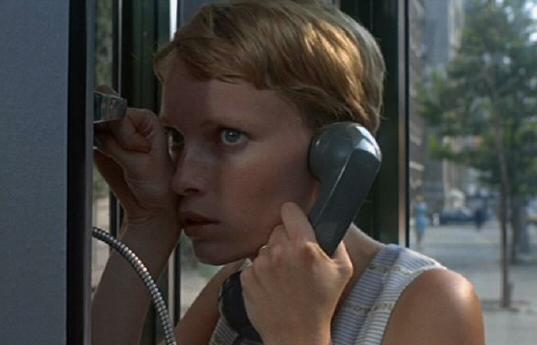
Rosemary’s control, autonomy and freedom of choice are slowly stripped away and as the truth tightens its grip upon her she finds all escapes are barred. Throughout the film, Rosemary can often be seen in a variety of tight and enclosed spaces, reflective of the entrapment of her situation. From the lift of her apartment, to taxis and multiple phone booths where she repeatedly attempts to call for support (but regrettably, is never successful), Rosemary finds herself cornered no matter which way she turns.


Space plays a significant part in creating the emotional fabric of the film and, crucially, in aligning us with Rosemary’s perspective. In addition to the confined spaces of the film which represent an internal conflict, Rosemary also contends with the invasion of her personal
space by the Casstavetes, who are reflective of an external threat. From hearing them through the wall, to drop in visits and interruptions of alone time, not only does the invasion persist, but it also builds in momentum and numbers. What begins as a friendly introduction by Minnie soon escalates into constant disturbances from the Casstavetes. Before long, Minnie’s friend Lara Lee also joins them on multiple occasions before finally, after Rosemary returns from Doctor Hill-the trio extends to a full out mob of confronting faces.
As an uncredited character in the film, the Bramford stands as a monument of the past in a city growing away from the roots of the old to instead look towards new ideologies. Both the city and the building are a reminder that we are always both isolated and suffocated. In her apartment, Rosemary is beset with interruptions and an enveloping alienation. Outside, she is no better off as we see when she arranges to meet her old friend Hutch. Waiting for a rendezvous that will never happen outside the Time and Life building, clusters of people gather jovially while Rosemary is shown alone, her literal distance reflecting her figurative remoteness.
Host To a Cyclical Fate
In the final scenes of the film however, Rosemary eschews the role of passive neighbour as she becomes the invader herself. Locating the closest space which connects her apartment to the Cassavetes, she springs her own surprise arrival upon the unsuspecting coven, complete with knife in hand. The question of whether or not her baby is the son of Satan, and if she will accept him as her own still stands upon the film’s conclusion. This ambiguity is extended further when any notion of the Black Bramford shedding its ability to play host to demonic activity is negated. In the final shot we see a couple enter the building, their future is sealed and the deadly cycle is fated to continue forevermore.

Rebecca McCallum (@PendlePumpkin) is a northern-based writer, editor, podcaster and speaker. As assistant editor of Ghouls Magazine, she writes extensively about the genre, and boasts by-lines with Grim Journal, Rue Morgue, and MovieJawn.
 Whitlock&Pope