


★★★
Beetlejuice Beetlejuice marks the long-awaited return to the bizarre and darkly comedic world created by Tim Burton in his 1988 classic, Beetlejuice – but sadly the results are decidedly middling in this overstuffed, undercooked, but still fitfully amusing legacy sequel.
On one hand, the love for the material shines through, and this is certainly the first somewhat-engaging film that Burton has made in many years. But it crams too many plot-lines into its modest 104 minute runtime, and fails to develop many of them beyond mere sketches of ideas.
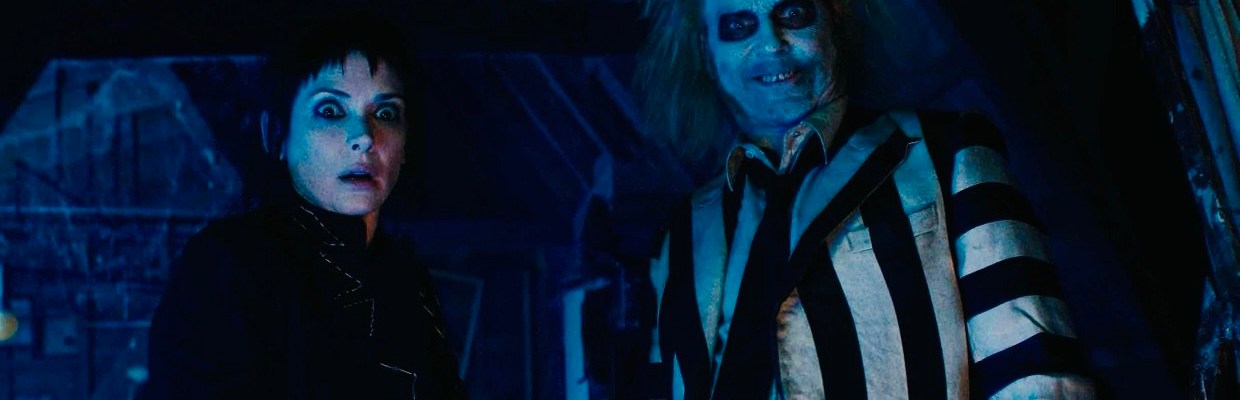
Beetlejuice Beetlejuice picks up decades after the events of the first film, and aims to blend the nostalgia of the original with fresh twists and characters, all while maintaining the practical effects and whimsical picture-book proto-emo style that made Beetlejuice a classic and spawned an animated series, a stage musical, and decades of fan enthusiasm. Winona Ryder returns as Lydia Deetz, unexpectedly revealed here as having Mario Bava’s Kill Baby Kill as her favourite movie. Michael Keaton manages to re-summon some of the old magic as the titular bio-exorcist Betelgeuse, and Catherine O’Hara is a joy as Lydia’s stepmother Delia Deetz. To this we add quirky goth-girl Jenna Ortega as Astrid Deetz, Lydia’s daughter.
At first the focus is on Lydia’s visions of Betelgeuse as he appears to be on his way back to the living, to trap Lydia in marriage once more. But then there’s Betelgeuse’s incubus ex-wife (Monica Bellucci), resurrected and ready to suck out his soul for unclear reasons. There’s an undead cop (Willem Dafoe), who’s really an actor who once played a cop, and wants to hunt Beetlejuice down for his various transgressions. There’s Lydia’s shady manager-cum-fiancé (Justin Theroux) with a nefarious scheme of his own. There’s a cute boy-next-door love interest for Lydia’s daughter. There’s not one but two dead father figures to ponder… the list goes on. But from this supporting cast only Theroux succeeds in giving his character any real shape. Dafoe is a gag character, striking poses and being silly, Bellucci has good makeup, and the rest just fade into the background, victims of a chronic lack of focus.
As for that main cast – Ryder lacks much spark, and Ortega, a talented actor, simply delivers us her stock persona, reheated and undeveloped. She was so good in The Fallout, but I feel we’re rapidly getting to the point where she’ll need to decide if she’s going to be an artist or a product. Fortunately, Keaton still delivers as the titular spook: rude, twitchy and letchy, always ready with a prop gag and a theatrical bit of throat clearing. And O’Hara is even better than she was in the original, despite the script being unsure how much emotional depth to give her – a goofy narcissist one moment, an empathetic mother figure the next. Alec Baldwin and Geena Davis, both central to the original, are written out here in the laziest way possible. “They found a loophole” – that’s it.
The other big casting decision is what to do with Jeffrey Jones’s character – Lydia’s father, Charles Deetz. Jailed for some of the most deeply unsavory activities one could imagine, there’s no way the actor was coming back. Yet instead of simply writing him out as having divorced Lydia’s step-mom, they instead kill him off in a claymation plane crash, then have him eaten by a shark, then they keep the character around, missing his head yet still able to talk to people. True to form, after all that effort they don’t do anything interesting with the character whatsoever, meaning that you are being constantly reminded that Jones isn’t in the film – with no narrative benefit at all.
On the upside, the director’s trademark aesthetic is back, combining darkly offbeat humour, goofy visuals and inventive practical effects – although its rhythms feel vaguely muted, and it doesn’t quite match the snap and crackle of the original. There are decent gags, strong visuals, and Keaton, O’Hara and Theroux do enough to carry things through to a messy ending in which the various narrative strands converge on yet another wedding, in a way that feels messy yet perfunctory.
The main plot-line in the original Beetlejuice had a classic fairy-tale structure – a young princess figuratively “imprisoned in a castle” is forcibly betrothed to a trickster demon and must creatively cheat her way out of the pact. The Brothers Grimm would’ve recognised Beetlejuice. They would not recognise this scattershot sequel, which, though it pains me to say it, should’ve been a TV show.
Beetlejuice Beetlejuice premiered at the Venice Film Festival, ahead of a September release in theatres on September 6.
 Whitlock&Pope