


★★★★★
Kiyoshi Kurosawa will take you on the road to hell in this absurdist action-thriller masterpiece.
Renowned Japanese director Kiyoshi Kurosawa is having one hell of a 2024 resurgence. His excellent 45-minute chiller Chime played at the Berlin film festival, and despite a tricksy NFT-related release is quietly gathering a reputation as the secret best horror of the year. His French-language remake of his own crime drama Serpent’s Path had its Japanese release in June, ahead of an appearance at the San Sebastián Film Festival. And his absurdist action-thriller Cloud has been officially selected as Japan’s 2025 Oscar entry, on the day it premiered at Venice… and it’s fantastic.
Cloud, which has been in development since 2018, is a suspenseful thriller that explores the dark undercurrents of modern society – particularly the malevolent forces that can be amplified through the internet.
From Cure to Pulse to Chime, Kurosawa has long been interested in the ways in which social malaise, depression and existential psychopathy can be transmitted through groups of people, with his ghost story Pulse in particular covering the use of the early internet as a vector for transmission. But as the internet has evolved, Kurosawa has returned to it as a subject, with a very different genre spin.
Cloud revolves around Ryosuke Yoshii, played by Masaki Suda, a small-time reseller who profits by flipping goods – never knowingly breaking the law, but coercing people into bulk-selling him items that he can then sell online for eye-watering markups under his pseudonym ‘Ratel’. As his activities make him the target of widespread resentment, the animosity he unknowingly generates online begins to manifest in increasingly dangerous ways, first through a furious doxxing on a dark web forum dedicated to hating on him, and then culminating in a physical and terrifying confrontation with an bizarre mob.
Kurosawa describes the film as an exploration of how petty grudges and frustrations, when magnified by the internet, can spiral into real-life violence. While the film begins as a suspenseful drama, it evolves into a commentary on all kinds of modern-day wars, drawing parallels between personal vendettas and larger conflicts, with a cast of characters driven by resentment, psychopathy, entitlement, delusion, and sheer wanton selfishness. This crew are a ridiculous yet terrifying bunch, and as the narrative moves to include them the tone of the film becomes brutally absurd. My personal favourite mob member was the one guy who insists on wearing a mask, who then blunders around a series of environments with a crowbar while wearing a huge puffa-jacket with the single word AQUATICS ludicrously blazoned across the back.
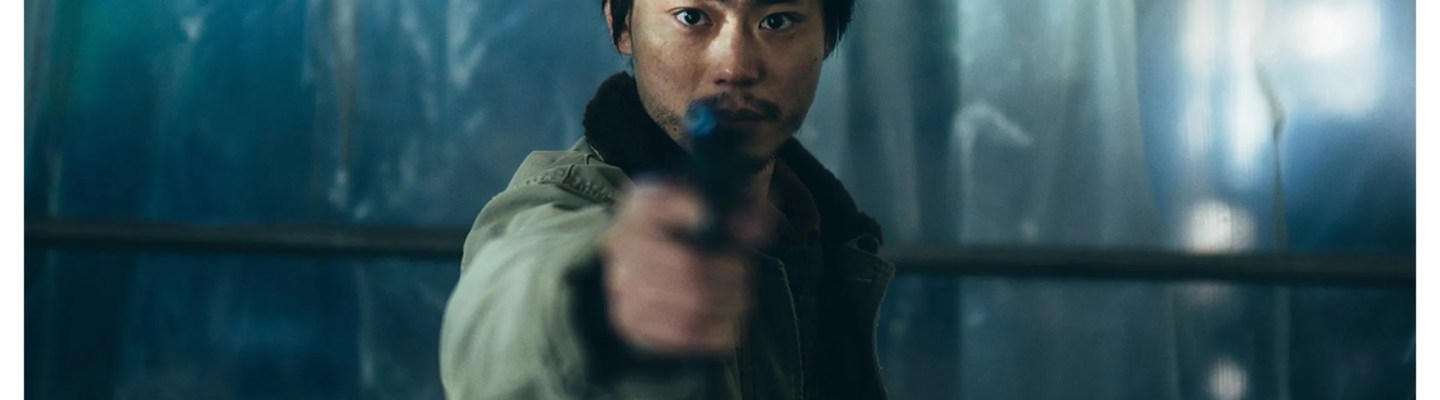
Kurosawa’s direction, strongly crafted as ever, brings a layered and unsettling depth to the film. This is much more than just a typical action thriller. The sound direction alone is masterful – Kurosawa put microphones on everything in the environment that might make a noise, and then carefully mixed the results to develop a soundscape that orchestrates tension and dread as needed. As Yoshii discusses a potential joint venture with an old school senior of his, the steady throb of the air conditioner slowly builds in the background. As a stranger suddenly brushes past him on a bus, the sound drops out to nothing. And when the mob finally comes for him, in a third act that resembles a better version of Ben Weatley’s Freefire, every bullet ricochet sounds like a high-velocity rivet slamming into cast iron beside your ears.
The editing and blocking are likewise delivered with a degree of skill and control that puts most other festival films to shame, and while this is all mostly subtle, un-showy work, Kurosawa isn’t afraid to drop in a flourish here and there – including one of his trademark back-projection shots during an ominous car journey.
The cast are excellent, especially Masaki who delivers a wonderful, enigmatic performance as someone who may just be a focused guy with poor social skills, or perhaps a borderline sociopathic villain.
Cloud is not just an action-thriller; it’s a moral fable and a reflection on the dangers of modern discommunication, where glib digital interactions have real-world consequences, and on capitalism, where the spirit of “each man for himself” and “do your own thing” can metastasise and take a choke-hold on society. This is a world where the only moral codes left by the time you realise you might need one are utterly inhuman. In Cloud, rampant capitalism has devolved to become entirely value-free, and the road it takes you on is the road to hell itself. An absurdist masterpiece.
Cloud premiered at the Venice Film Festival, ahead of a theatrical release later this year.
 Whitlock&Pope