


★★★★★
Brady Corbet’s The Brutalist, which premiered today at Venice, is a monumental achievement. This towering epic of brushed concrete and broken dreams confirms Corbet as one of the great filmmakers of our time. He has constructed a cinematic ziggurat of love, death, power, control, and the search for the eternal.
Adrien Brody stars as László Tóth, a Jewish-Hungarian architect forced to leave his wife Erzsébet (played remarkably by Felicity Jones) and niece (Raffey Cassidy, excellent as she was in Corbet’s last film, Vox Lux) behind the Iron Curtain in Soviet-controlled Budapest. Arriving in America with anxious dreams of endless possibilities, he strives to reinvent himself, seizing the life so many of his fellow Jews were denied by the horrors of the Holocaust. Yet, from the outset, something is off. The temptations of sex and heroin abound, and his furniture-salesman cousin, Molnár, is now known as Miller (as in ‘Miller and Sons’, despite having no sons).
At the mercy of others’ kindness, Tóth accepts a job offer from the self-satisfied Harry Van Buren (Joe Alwyn) to redesign his father’s library. The father in question is Harrison Lee Van Buren (Guy Pearce), and Tóth’s relationship with this sometime patron drives the bulk of the film over its 215-minute runtime (including a 15-minute onscreen intermission countdown). Yet, like the best Brutalist architecture, The Brutalist never feels oppressive despite its length. The film is dynamic and engaging enough that I could’ve gone another round.
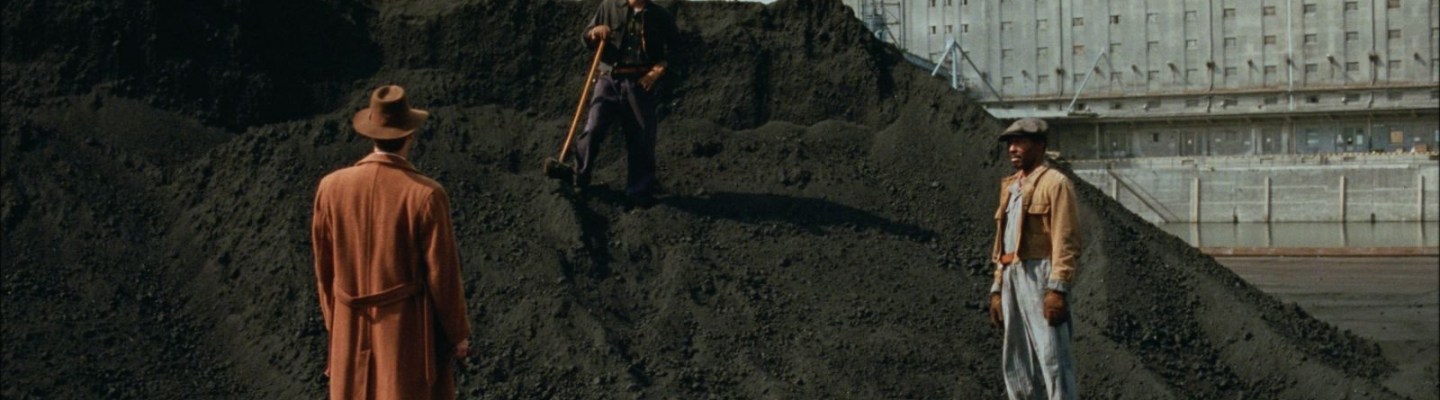
As Tóth is drawn into the questionable orbit of the Van Buren family, with all their Freudian rot, he receives an offer he cannot refuse: to build a monumental community center of his own design, in honor of Van Buren’s deceased mother. The choice between that and shoveling coal on a building site seems obvious. However, as the years unfold, and Tóth struggles both to realize his vision and to bring his wife to America, things decidedly do not go as planned.
Brody delivers an excellent performance throughout, giving a purposefully guarded yet always compelling portrayal of Tóth in a story that spans from the late 1940s through to 1960 (and, in an epilogue, on to 1980). Alwyn is wonderfully unsettling, Jones is utterly transformed as a wife who proves both more and less than Tóth remembered her, and there is strong support from Corbet favorite Stacey Martin (completing a trio of Corbet films) as the daughter of the Van Buren family, and Issach De Bankolé as the laborer Tóth meets in a bread queue during his destitute phase.
Yet it is Guy Pearce who steals the show as Tóth’s benefactor and antagonist, Harrison Lee Van Buren. Pearce’s portrayal of this industrial titan is by turns ludicrous and terrifying, embodying a true American grotesque. His character oscillates wildly, capturing Tóth in a dangerous embrace. Pearce’s bizarre affectations and inflated ego lead to some remarkable line readings, reminiscent of There Will Be Blood – particularly his strange habit of ending discussions with Tóth by saying, “I have found this conversation to be… intellectually stimulating.”
At another point, he pompously declares, “As a man of unique privilege, I have always believed it is my duty to nurture the great talents of our epoch.” Van Buren is clearly desperate to be seen as a certain type of person. But over the years (or, for us, hours), Tóth discovers what truly lies beneath that persona.
This is, among other things, an immigrant story, and it’s fascinating to see how waves of ethnic immigration are woven into the narrative, through the diverse surnames. Tóth arrives with his name, accent and all. His cousin smoothly adopts an Anglo name along with Catholicism. The Van Burens are archetypal Pennsylvania Dutch. The community that Van Buren dedicates his center to is Doylestown – as Irish as they come. One might fleetingly wonder: who was Mr. Doyle? Another benefactor of years past, slapping his name on things, grasping hungrily for the eternal?
Following The Childhood of a Leader and Vox Lux, the soundscape in The Brutalist is phenomenal. The orchestration of classical, jazz, atonal, and pop music ebbs and flows, crashing around us and soaring to the heavens. (The film is dedicated to the memory of Scott Walker, who scored Corbet’s previous two films). Dialogue is sometimes a fog of overlapping murmurs, spiraling into half-vocalized thoughts, and then a monologue of such bracing directness that it takes your breath away.
Thematically the film serves as a riposte to Ayn Rand’s The Fountainhead, as adapted by King Vidor. But at times it reminded me more of Orson Welles – synthesising the snappy collage of his later works with the classical style of, say, The Magnificent Ambersons. Corbet varies his style throughout – sometimes employing tight handheld shots, jazzily edited, and at other times confident enough to let the action play out in long-take wide-shots – most notably when filming a train crash from high above, with the fire from the engine explosion glowing deep within cold, swirling clouds. In another sequence, set high in the Carrara mountains of Italy, where Tóth and Van Buren journey to select marble for the church altar, the mists and desolation impart a sense of the eternal utterly at odds with Van Buren’s go-getting self-aggrandizement, leaving him, for once, on the back foot. It is here, among the stillness, that a man might glimpse a sense of his place in the universe, and an architect might find that most important of tools – a sense of proportion.
Remaining mindful of proportion, I say this: Brady Corbet’s The Brutalist is the film of the year. It is a masterpiece shot in 70mm VistaVision. So do yourself a favor: see it in the cinema.
The Brutalist premiered at the Venice Film Festival, ahead of a theatrical release.
 Whitlock&Pope