


★★★★
Come as you are: Luca Guadagnino’s puckish rock and roll adaptation of William Burroughs’ Queer mixes Nirvana, Prince, Edward Hopper, Magritte, Dali, Futurist architecture and 2001: A Space Odyssey to take disembodied and discombobulated smack-and-sex addict Bill Lee on a journey to the heart of desire, and beyond.
Luca Guadagnino, fresh from his rave reviews for Challengers, has brought his vision to a puckish adaptation of Queer, a novel by William S. Burroughs that proved to be one of the Beat Generation’s most provocative and challenging works. Originally written in the early 1950s but not published until 1985 due to its controversial content (smack, men fucking each other), Burroughs’ Queer is a semi-autobiographical novel that follows the character of Bill Lee, a thinly veiled alter ego of Burroughs himself played by a phenomenal Daniel Craig.
Like the novel, Guadagnino’s Queer is a slippery exploration of identity, alienation, and the search for meaning in a world that feels both distant and oppressive.
Beginning in Mexico City, where Burrough’s usual self-insert William Lee has taken refuge from an American society that his criminalised his interests (shooting up heroin, sex with other guys). Lee, adrift in the cliquey, bitchy post-war gay expatriate community, and struggling with his dope habit, is a man caught between the past and a future that seems perpetually out of reach. The story chronicles Lee’s increasing obsession with the two fixations that Lee hopes will break him out of his spiral of existential despair.
The first of these is a young American named Eugene Allerton. As Lee eventually pulls Allerton into a personal quest through the rainforests of South America, the novel delves into themes of unrequited desire, loneliness, and the existential despair that defines Lee’s existence. As Lee grapples with his identity, addiction, and deep desire to transcend the physical, he introduces Allerton to the second of his fixations – the naturally occurring hallucinogenic sedative yage, better known to many today as ayahuasca, that he has heard can be located deep within the jungle.
Bringing an intense focus on character and atmosphere, Guadagnino sets the early scenes in particular to brace of anachronistic rock tracks, starting with an acoustic Sinead O’Connor cover of Nirvana’s All Apologies before moving up through Come As You Are, various Prince tracks, and New Order. (The Nirvana-Burroughs connection is a real one: in 1992, Kurt Cobain collaborated with Burroughs on The Priest They Called Him, a spoken-word track where Burroughs narrated a dark short story about a junkie suckered with contaminated heroin, set to a Cobain guitar accompaniment – although it wasn’t until 1993 that these two sometime smack aficionados would actually meet.)
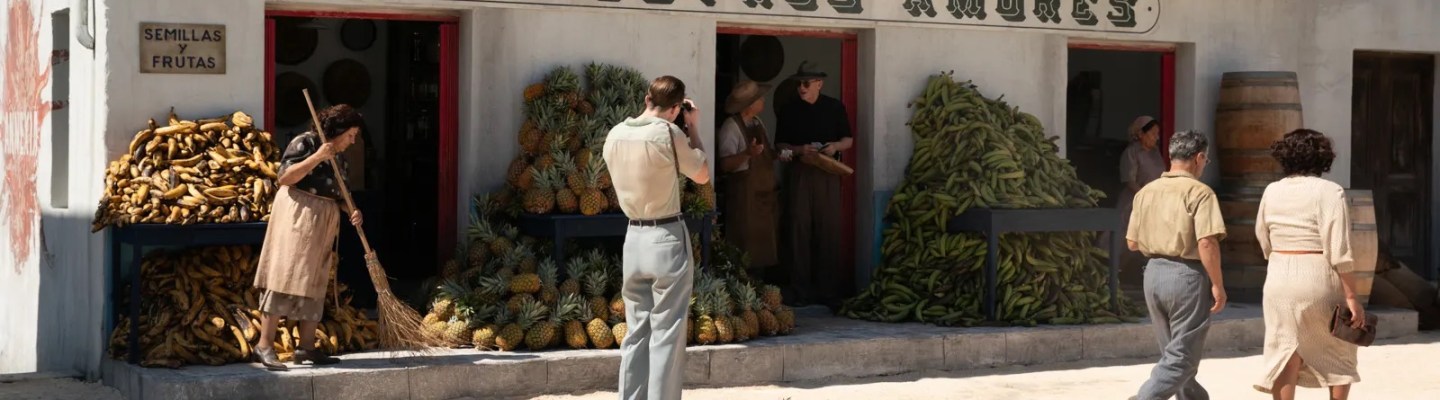
The visual compositions are breathtaking – streets seem to be lit with pools of cold fire, courtyards are bathed in blue despair, red hotel doors hover in the teal shadows of nighttime corridors, and the sky ruptures with the force of a burning peach thrown into a pool of writers’ ink. Exteriors and interiors alike evoke Hopper and Magritte – dreamlike and pleasantly alienated.
As the story progresses, Guadagnino increasingly explores not just the overtly queer themes of the novel but also the broader existential questions about identity, isolation, and the search for connection in a fragmented world. As the story moves from post-war Mexico City through Guatemala and Ecuador and into the haunting dreamlike interiority Lee’s inner self, bodies merging, embraces inside the skin, the tantalising promise of ego-death postponed… and finally a glimpse of the infinite, beyond our world and our selves.
Ultimately, though, this is Craig’s film. His performance is a masterclass in physicality – every manipulation of a cigarette, every fumbled re-application of his glasses, the theatrical flips of his fedora off and back onto his head, the flanneur-around-town strolling and the slamming of monies down as he barks for mezcal or tequila all speak to the life he has led. This is a fully-lived in performance even before we get to the rich, soaked-in-rum dialogue. Like the Wallace Administation,” Lee muses, “I am subsidising non-production.” In the novel, this is a promise to pay Allerton more than his salary not to go to work, but instead to hang out. In the film, it’s more of a complaint that he is already spending so much on Allerton, to diminishing returns. Either interpretation underlines the generation gap and power dynamic behind Lee’s romantic aspirations.
Drew Starkey as Allerton is also strong, bringing a difficult, unreadable sensuality to a part with which others would struggle, and Jason Schwartzman is wonderfully charming as loveable schlub bear Joe Guidry, perhaps Lee’s one true friend.
The film is packed with literary Burroughs references – more than once a character raises a gun to shoot a glass from atop other’s head. Burrough’s own William Tell routine led, of course, to his shooting his own wife through the forehead. Bugs writhe and ripple (no cats, though). Elsewhere, the mysterious organisation Annexia has wormed its way into South American tribal communities, offering guns in exchange for yage access. As Lee says, both the CIA and the Russians are interested in mind-control, after all. Annexia’s octopus logo adorns the streets of Quito – whatever quest you might embark on, the man is never far behind – until you make that one final journey.
Queer premiered at the Venice Film Festival, ahead of a theatrical release later this year.
 Whitlock&Pope