


★★★★
Joshua Oppenheimer’s The End is a boldly unsettling post-apocalyptic musical where privilege and denial collide in an opulent underground bunker. Tilda Swinton and Michael Shannon deliver gripping performances as members of a wealthy family hiding from the world they helped destroy, blurring the line between optimism and self-serving delusion.
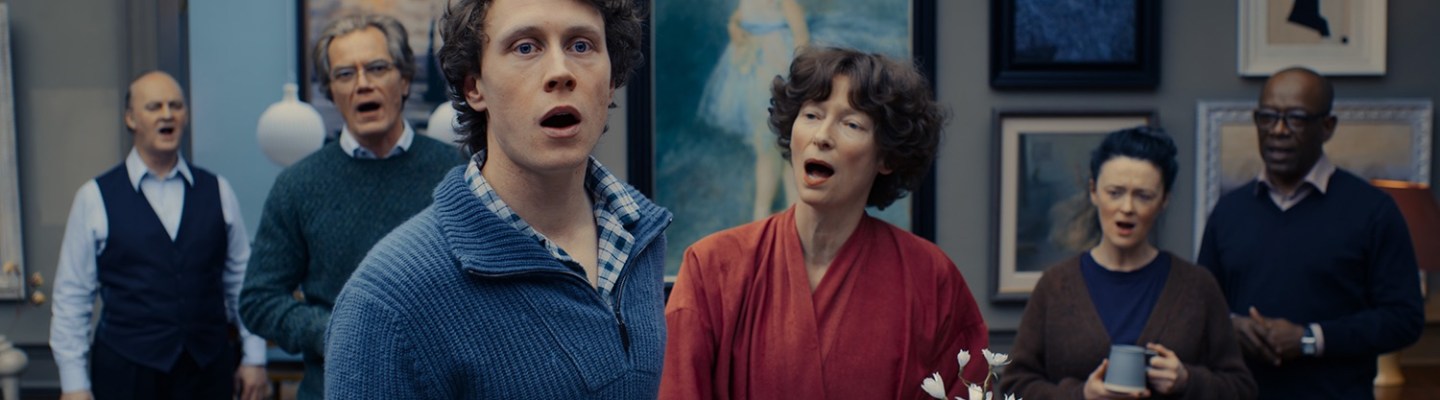
The End, Joshua Oppenheimer’s audacious narrative debut, is a post-apocalyptic musical that finds an unsettling harmony between denial and decay, drawing us into a surreal family bunker buried in both luxury and moral bankruptcy. Starring Tilda Swinton and Michael Shannon as heads of a wealthy family who live sealed off in a bunker following a catastrophe they helped create, The End uses the musical form to disturb rather than comfort, asking us to confront privilege, escapism, and the consequences of turning a blind eye. In the hands of a director renowned for his documentary insights into human cruelty, this genre-bending film presents a deranged, almost theatrical attempt by its characters to forget their culpability in the world’s collapse.
Oppenheimer’s The End stands apart from other recent end-of-the world stories by flipping familiar apocalyptic tropes on their head. Rather than focusing on survival or redemption, the film zeroes in on avoidance. The family occupies their time with cheerful musical numbers, rehearsed routines, and elaborate costumes—grasping at normalcy with a manic desperation. The End uses this genre-mixing as a way to probe the fractured human psyche in a time of crisis, where horror and surrealism increasingly serve as mirrors for real-world fears. Oppenheimer takes a Potteresque approach, presenting song and dance as tools of evasion that underscore the artificiality of these characters lives, as they engage in a simulacrum of normalcy.
As Swinton and Shannon’s characters dive deeper into these performances, their routines take on a manic edge, balancing on the precipice of breakdown. Their bunker, though lavishly adorned, becomes claustrophobic and haunting, a microcosm of privilege that has rotted from within. Oppenheimer’s visuals contrast starkly with the performances, with each polished song veiling an underlying desolation. This ironic interplay of opulence and emptiness places The End in conversation with other recent films critiquing the insularity of wealth and privilege – films that unearth the ugliness beneath the façade of modern comforts.
Swinton and Shannon bring haunting layers to their performances, each revealing moments where their carefully crafted personas falter. Swinton’s character is punctuated by barely concealed glances of dread, while Shannon’s brooding presence hints at an emotional fissure beneath his character’s efforts to maintain the illusion. The family’s refusal to acknowledge their complicity in the world’s downfall mirrors contemporary social critiques of privilege as an insulator against accountability. Oppenheimer’s focus here is clear: their wealth and comfort, while insulating, are also prisons of their own making, where guilt and self-delusion gradually corrode their humanity.
Oppenheimer makes the family both grotesque and human, rendering them neither pure villains nor sympathetic figures but symbols of a broader societal detachment. Rather than offer absolution or overt condemnation, The End becomes a darkly absurd fable about our culture’s obsession with escapism, revealing the hollowness of luxury in a world built on denial.
I was reminded, in fact, of the works of Lars von Trier, particularly in its thematic boldness, genre-blending approach, and unflinching exploration of human denial and self-deception. Much like von Trier’s Melancholia, which used an impending apocalypse to explore psychological breakdown and existential dread, The End turns the end of the world into an intimate examination of privilege and avoidance. Both films approach the apocalypse not as an external catastrophe, but as a mirror for inner, often suppressed fears and conflicts within their characters.
As the family in The End performed cheerful musical numbers as an act of willful denial, clinging to an illusion of happiness, it was Kiefer Sutherland who came to mind, absolutely convinced in Melancholia that everything was just fine. This use of irony to reveal the fragility of social norms—where melodrama and absurdity expose deeper, uncomfortable truths—echoes von Trier’s style, particularly his penchant for making the viewer complicit in the characters’ emotional descent.
All of this is, of course, very much in line with Oppenheimer’s own The Act of Killing. That documentary showed the alumni of Indonesian death squads using the tropes of genre cinema to process the murders they had committed. In both cases the tension that emerges between the stylistic form and the reality it’s attempting to convey – but also neutralise – provides the motor of the film, with viewers waiting to see at which point the rivets will start to burst.
Closing on a haunting, deeply ironic note, The End is less a warning of impending collapse and more a blistering satire on the refusal to acknowledge one. Oppenheimer’s film resonates with our era’s uneasy blend of entertainment and distraction, asking if we’re as blind as this family to the damage our comforts conceal. Bold and haunting, The End reflects the cultural climate of the 2020s, challenging audiences to confront the cost of ignoring the cracks in our own fortresses of privilege. It’s a film that won’t let you off the hook—a surreal musical nightmare that might make you laugh before making you flinch.
The End played at the London Film Festival, and will be released in cinemas by MUBI in 2025.
 Whitlock&Pope