


★★★
Robert Eggers is back with Nosferatu, his reimaging of F.W. Murnau’s 1922 masterpiece. The good news is that the film is gorgeous and Lily-Rose Depp delivers arguably the standout horror performance of the year. However, while the film excels in its visual richness and thematic ambition, it falters in uneven performances and a disappointingly anti-climactic conclusion. At its best, Nosferatu is a fascinating evocation of psychosexual tensions manifesting as supernatural events, centered on Depp’s commanding performance. At its worst, it succumbs to overblown theatrics and narrative inertia that undermine its lofty aims.
This version is set in 1838 as Thomas Hutter (Nicholas Hoult), a naive young estate agent, travels to Transylvania to broker a real estate deal with the reclusive Count Orlok (Bill Skarsgard), who seeks to relocate to Hutter’s own coastal German town of Wisberg. Hutter leaves his new bride, Ellen (Lily-Rose Depp), in the hands of his best friend Friedrich (Aaron Taylor-Johnson). Unbeknownst to either man, she is haunted by mysterious nightmares of a sinister figure. In Orlok’s decaying castle, Hutter discovers the Count’s vampiric nature, as Orlok departs for Wisborg bringing with him a plague of rats and death. As the town succumbs to chaos, it is Ellen who may prove instrumental in making a final stand against the darkness.
Eggers is no stranger to period settings and folkloric terror, as demonstrated in The Witch (2015) and The Lighthouse (2019). With Nosferatu, he pays direct homage to one of cinema’s foundational horror films, bringing his meticulous research and visual flair to the fore. Like The Witch, this film is suffused with historical authenticity: 1830s Wisborg is beautifully realised, its cobbled streets and flickering candlelight evoking the oppressive gloom of a town on the brink of ruin. Cinematographer Jarin Blaschke’s chiaroscuro images faintly recall Murnau’s expressionism. However, while Murnau’s images seemed to flicker with life, Eggers’ dedication to precision and control of his frame stifle that life from his own film. There’s only so many symmetrical compositions and 90-degree whip-pans one can take before it all just feels a little stilted.
This authenticity extends to Eggers’ treatment of Count Orlok, played by Bill Skarsgård with a demonic presence that’s quite different to Max Schreck’s insectile silhouette. Orlok’s grotesque features—his skeletal frame, hooked nose, and gnarly hands—are rendered with practical effects that avoid over-reliance on CGI, enhancing his otherworldly menace and leaving him looking like a hulking zombie hussar. It’s a great look, but under Eggers crushing directorial hand Skarsgård fails to imbues Orlok with more than simple monstrosity. While his appearance is compelling, it lacks the nuanced magnetism that made Klaus Kinski’s Dracula in Werner Herzog’s 1979 Nosferatu the Vampyre so unforgettable. There is pathos here, but it feels withheld rather than fully realized – and his endlessly drawn-out dialogue and Ottoman stew of an accent render him occasionally indecipherable and often tedious.
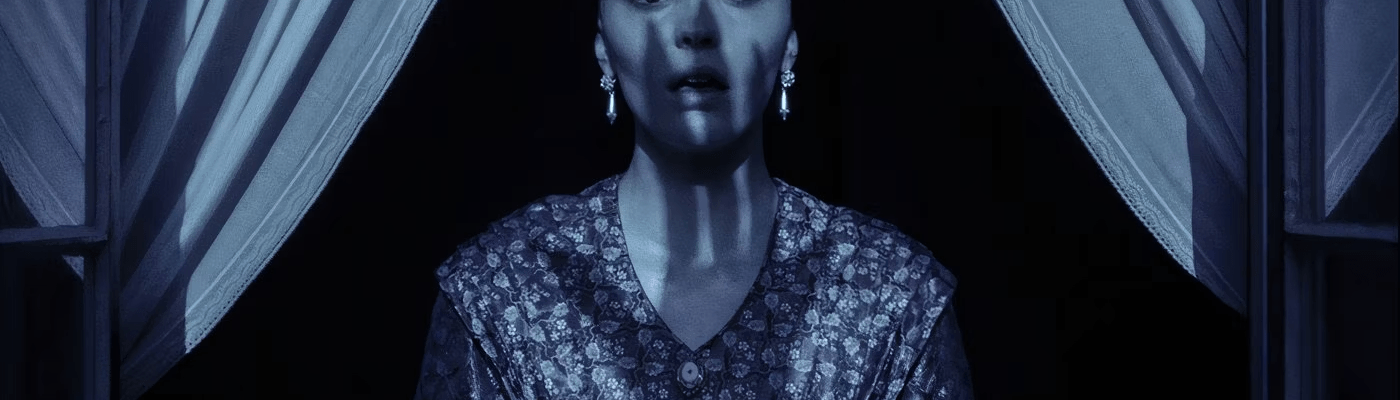
The film’s true revelation is Lily-Rose Depp as Ellen Hutter, the tragic figure at the heart of Orlok’s obsession. Depp’s Ellen is no mere victim but a woman haunted by forces both external and internal. Eggers suggests that her connection to Orlok predates their meeting, rooted in a kind of psychic nightmare forged in her youth. This idea—that Ellen has inhuman powers and that Orlok is perhaps a manifestation of her deepest fears and forbidden desires—is the most intriguing aspect of the narrative, hinting at the vampiric as something deeply personal rather than merely supernatural. Depp plays Ellen with a mix of fragility and ferocity, her wide, searching eyes conveying both terror and a yearning for something beyond the confines of her domestic life. Sadly her moments of agency are dulled by an unsatisfying denouement that fails to capitalize on the film’s psychological complexity.
Where Depp anchors the film with emotional truth, Aaron Taylor-Johnson’s Friedrich Harding derails it with a performance that veers into parody. Taylor-Johnson, playing a wealthy family friend tasked with protecting Ellen, seems to mistake exaggerated gesturing and over-enunciated line readings for gothic gravitas. His attempts at an upper-crust accent come across as affected rather than authentic, and his melodramatic delivery frequently clashes with the more restrained performances around him.
He may have been taking a cue from Willem Dafoe, who excels in a similarly flamboyant role as Professor Von Franz, a Van Helsing-like occult scholar. Dafoe’s cackling eccentricity is deeply entertaining, but it works because of his expert ability to modulate tone, balancing absurdity with gravitas. Dafoe leans into the campy elements of the character without sacrificing the film’s eerie atmosphere. Taylor-Johnson, by contrast, lacks this finesse, leaving his pantomime performance feeling jarring and misplaced.
Nicholas Hoult is in there too, in the Jonathan Harker analogue role of Thomas Hutter, and though he conveys a suitably nightmarish sense of anxious delirium, one never gets the sense that there’s much going on underneath. Even the great Ralph Ineson can find little to sink his teeth into as Dr. Sievers, who makes the first attempts to diagnose Ellen’s maladies. He hits his marks and gets the words in the right order – increasingly, one fears, that’s all Eggers requires from his actors. It’s one thing to say “directing is casting”, but it’s probably unwise to leave it at that, and focus on precision-crafting each moment from a technical standpoint while your troupe is left flailing.
Eggers attention to detail does succeed in creating a world that’s both mythic and immediate. The period design is delightful, from the crumbling corridors of Orlok’s Transylvanian castle to the plague-stricken streets of Wisborg, and the film’s soundscape is equally immersive, with an unsettling score that oscillates between mournful strings and jarring dissonance. These elements ground the story in a rich, sensory experience that is often more compelling than the narrative itself.
Despite these strengths, the film’s pacing and structure feel uneven. The first act, filled with atmospheric dread and lingering shots, builds tension masterfully as Ellen’s psychosis and , but the second half struggles to maintain momentum. Orlok’s journey to Wisborg, though beautifully rendered, feels overly drawn out, while the townspeople’s descent into plague-driven chaos lacks emotional weight. The staginess of the compositions – and the occasional obviousness of the CGI – mean that the town never feels entirely lived in, and thus the film fails to achieve the full-bloodied apocalyptic tone it needs.
In any version, Nosferatu is a story about the collision of desire and decay. Orlok’s vampirism is not merely a curse but a reflection of the human condition, a metaphor for insatiable hunger—whether for blood, connection, or transcendence. Ellen’s ultimate sacrifice suggests a tragic inevitability, a confrontation with the darkness within that offers no easy salvation. Yet the film’s failure to fully explore these themes, and its over-reliance on Eggers deadeningly meticulous control, leaves it feeling less profound than it could have been. Unforgivably, it never feels truly sexy, which – given the barely-subtextual themes and the explicitly sexual denouement – is a near-fatal flaw.
We are left, then, with a film of staggering ambition and visual artistry, but one whose narrative flaws, uneven performances, and crushing directorial presence prevent it from reaching the heights of Eggers’ earlier work. Lily-Rose Depp delivers a career-defining performance, and the film’s suggestion of Ellen’s lifelong connection to Orlok is a fascinating innovation. However, Aaron Taylor-Johnson’s hammy excesses, combined with a unengaging conclusion, diminish its impact. Despite its imperfections, Nosferatu is a compelling addition to Eggers’ filmography and an interesting counterpart to its cinematic ancestors, even if it doesn’t surpass them. For all its flaws, it remains an ambitious meditation on fear, desire, and the horrors that lurk in the shadows of the human psyche – but one hopes that in the future Eggers will let his material breathe a little.
Nosferatu is out in the US on Christmas Day, and in the UK on January 1st.
 Whitlock&Pope