


Director Leigh Whannell is back with Wolf Man, a reimagining of the classic Universal monster. Following his success with The Invisible Man, Whannell aims for a visceral tale of physical and emotional terror and transformation, delivering a film that leverages the terror of lycanthropy to explore generational trauma.
Blake Lovell (Christopher Abbott), is a husband and father grappling with his troubled childhood and a strained marriage to Charlotte (Julia Garner). When Blake’s long-missing father is finally pronounced dead the couple, along with their precocious daughter Ginger (Matilda Firth), moves to his remote Oregon farmhouse to take inventory and spend some much-needed family time. But their attempt at reconnection quickly spirals into chaos when a menacing creature attacks, forcing the family to barricade themselves inside. As Blake himself then begins to transform into something monstrous, the line between protector and predator blurs, forcing everyone to make life or death choices.
Whannell’s screenplay, co-written with Corbett Tuck, aims to mix the intimate struggles of a disintegrating marriage with the primal terror of a monster movie. The story explores themes of male violence, survival, and the lengths we go to save those we love.
Christopher Abbott does solid work as Blake, capturing the duality of a man struggling to hold onto his humanity while succumbing to an uncontrollable transformation. His nuanced portrayal ensures that even as he becomes more monstrous, the audience remains empathetic to his plight.
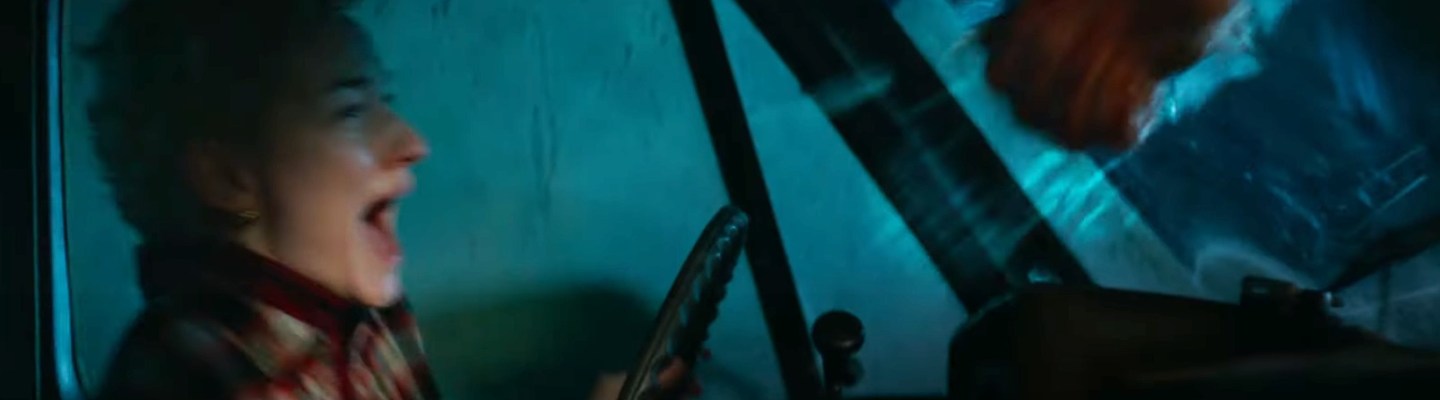
Julia Garner’s role is relatively thankless, as she is required to run, shriek, and gawp. Matilda Firth, as the young Ginger, is reasonably endearing, and her father-daughter relationship with Blake is probably the emotional heart of the film.
But it never feels like the family dynamics are really what the filmmakers are interested in. Dialogue about the state of the marriage feels undercooked and strictly functional, inserted to establish “stakes.” Instead, the film’s real strength lies in a handful of tense set pieces – not least of which is the opening sequence of a young Blake encountering a mysterious forest predator with his father, which sadly outstrips pretty much everything else in the movie.
Cinematographer Stefan Duscio, a frequent collaborator with Whannell, delivers “Wolf Vision,” which shows the world through Blake’s heightened senses, and has a distinctive, innovative look that suggests ultraviolet rays. Sadly this is under utilised – perhaps because by this point the focus has switched to Charlotte as protagonist, so any switch back to Blake’s POV to showcase the effect ends up killing the tension, with the film unable to pick between sticking with the monster or the heroine.
On a more positive note the transformation sequences, designed by prosthetic maestro Arjen Tuiten, are suitably gnarly – as Blake’s fingernails drop out it recalls the classic body horror of The Fly. The progression of Blake’s transformation—from subtle physical changes to full-blown monstrosity—is nicely worked with the use of animatronics and real-time effects creating a visceral authenticity that CGI often lacks.
Likewise, the sound design by P.K. Hooker and Will Files is strong. The first sign of Blake’s transformation comes as his senses heighten, and the audience is pulled into his world through amplified sounds of insects, breathing, and distant movements. Maybe the most disturbing moment in the film is the unsettling auditory experience of Blake hearing a crunching, straining sound, and turning the corner to find… a simple spider, crawling up the wall.
But all of this counts for little without a great story to support, and this is the film’s weakness. Whannell wants to use the werewolf mythos as a metaphor for grief, loss, and the fear of passing on your own trauma. But the concepts are rote, obvious, and barely fleshed out. At one point Blake says to his daughter “Daddies try to make sure their children aren’t scarred by anything. But sometimes they try so hard that they end up doing the scarring.” Whannell just can’t trust the audience to discern a subtext, he has to spell it out with crunching obviousness. Likewise some of the foregrounding is so heavy that before you’re halfway through the movie you can pretty much write the ending in your head and get it spot on.
With Wolf Man, Leigh Whannell falls short of his earlier success of reimagining a classic Universal horror. This is no Invisible Man. But it’s watchable enough, has a couple of great tense set pieces, and should pass the time – even if it ends up being pretty fur-gettable.
★★½
Wolf Man is in cinemas from Jan 17
 Whitlock&Pope