
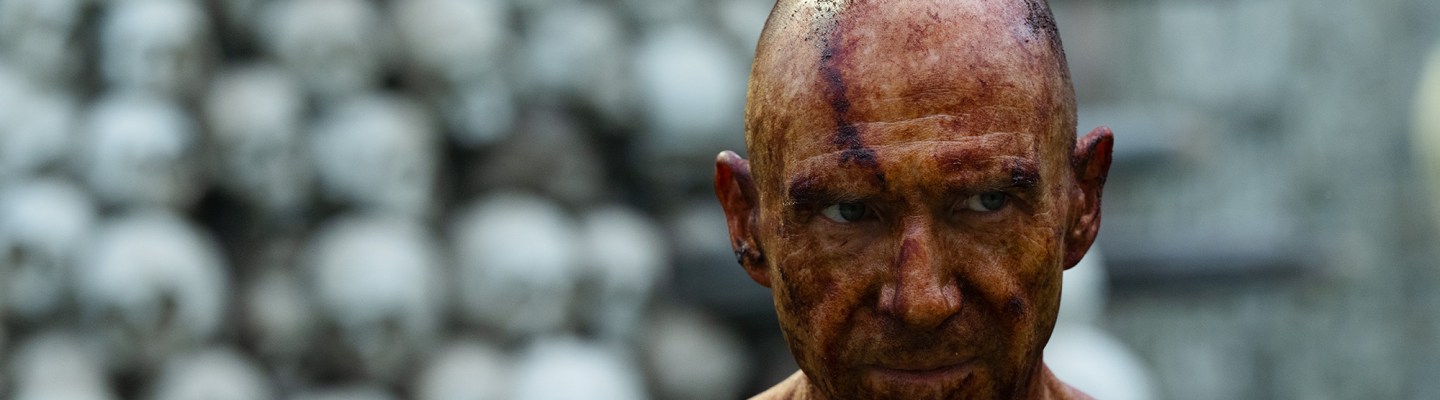


Danny Boyle returns with what feels like the most radical horror movie of the early noughties, made two decades late but twice as unhinged.
★★★★
Danny Boyle’s return to the 28 series opens with the kind of stylistic bravado that feels both dated and strangely refreshing: glitchy digital textures, hyperactive editing, and a restless camera that seems to revel in its own freedom. Call it millennium-core. The first act especially comes on like the most radical film of the year 2000, with bullet time, collage cutting, and a total disregard for restraint. It’s a jarring opening, throwing everything at the screen: zombie tropes, folk horror atmospherics, coming-of-age anxiety, and corrupted psychogeography are all thrust into a visual blender that recalls a grey, grimy Domino (2005) or a Natural Born Killers (1994) of Northumberland. Boyle embraced the flexibility of digital filmmaking as fast as anyone, gleefully shoving a camera into a glove compartment in Vacuuming Completely Nude in Paradise, and delivering the DV masterpiece that was the original 28 Days Later (2002) – here he combines with editor Jon Harris (Snatch, 2000) and 28 Days Later cinematographer Antony Dod Mantle in a bid to push past the experimentalism of that film and go as hard and far as they can.
That first act maximalism eventually recedes, but by then the film has achieved enough momentum to carry itself into orbit. In fact, what initially felt overdone is if anything somewhat missed once the film calms down a bit in the second half. Its energy lies not in precision but in the frantic clash of tones and styles, its refusal to settle. That formal unruliness mirrors the world it depicts: a fractured Britain, fragmented by isolation, regressed into the past and improvising a new kind of survival. Combined with the folk horror elements, one can see the influence of Boyle’s sometime mentor Alan Clarke – even if Clarke wouldn’t have chosen the bracing speed-freak editing. In terms of summer blockbusters, 28 Years Later makes most Marvel movies look like Merchant Ivory productions.
Set nearly three decades after the original outbreak, 28 Years Later follows 12-year-old Spike, a restless boy raised in isolation on Holy Island, one of the few remaining safe zones in a Britain still haunted by infection. When his mother falls gravely ill, Spike sets off alone across a now-quarantined mainland in search of medical help. What he finds instead is a landscape twisted by time: pockets of survivors hardened into zealots, mutated infected that hunt with eerie precision, and a rogue doctor with unclear motives and creepy designs. As Spike’s journey unfolds, so does a portrait of a country adrift – a twisted, re-wilded version of Britain, entirely transformed even as the pockets of survivors ritualise the remnants of the past. The film is steeped in a certain kind of British decay, with looted villages half-reclaimed by moss and fog, plaintive requests for Nurofen, and a strong love of the Teletubbies.
Spike’s bond with his mother forms the film’s emotional centre, grounding the chaos in something relatable as he battles to save her life while cycling through a succession of increasingly questionable father figures. Performances are unshowy and grounded, accents aren’t cleaned up for worldwide consumption, and cultural references are proudly local.
There’s a deliberate ambiguity about what the infected have become. Sometimes smarter, sometimes quieter, overall more coordinated, like pack animals – not quite zombies, not quite human. Their evolution is never over-explained, which lets their allegorical power breathe. The virus isn’t the only horror; there are also the things that have grown in its shadow – lies, distrust, madness and nostalgia.
Elsewhere, the Boyle/Garland pairing might be accused of having their blinkers on – aside from one Alpha zombie there are no noticeable people of colour, and the gender politics might be thought of as having calcified 28 years ago too. The film’s most divisive gesture is its ending. It introduces new characters, brings back the maximalism in a big way… then cuts to black. In the screening I attended, you could feel the air go out of the room, with the audience clearly not prepped to understand this was part one of a trilogy. It’s a bold move, but perhaps an ungenerous one when a simple “to be continued” card could’ve helped soften the blow. Despite that, the cliffhanger is one of the best things in the film (no spoilers!) and left me eager for more. It remains to be seen whether Nia DaCosta’s follow-up, The Bone Temple, will pick up directly from here or unfold as a parallel tale that eventually collides with this one (in the manner of Garland’s novel The Tesseract) before then leading into the planned trilogy capper.
For all that, though, 28 Years Later is a loud, chaotic, defiantly British horror epic that mutates the genre as much as it honours it. It blends digital chaos with folk horror unease, soaking its zombie tropes in grief, moss, and post-Brexit malaise. Bullet time and bodycams crash up against coastal rot and communal breakdown, and while it often threatens to come apart, the result is strangely coherent. Perhaps it shouldn’t work, and for some at least it won’t – but the more I sit with it, the more I love it.
 Whitlock&Pope