


Kim Soo-jin’s return to K-horror basics serves up pure dread, in the most haunting film of the year.
★★★★
Good news, K-horror fans – director Kim Soo-jin’s Noise is the most haunting horror film to emerge from South Korea this year. It’s also the most rigorously faithful to the spirit of early 2000s Japanese and Korean horror. More specifically, comparisons to Dark Water are unavoidable, not just for the surface similarities (a crumbling apartment building, a woman searching for someone lost) but for the pervading melancholia and the eerie sense of collapse. We are, indeed, so back.
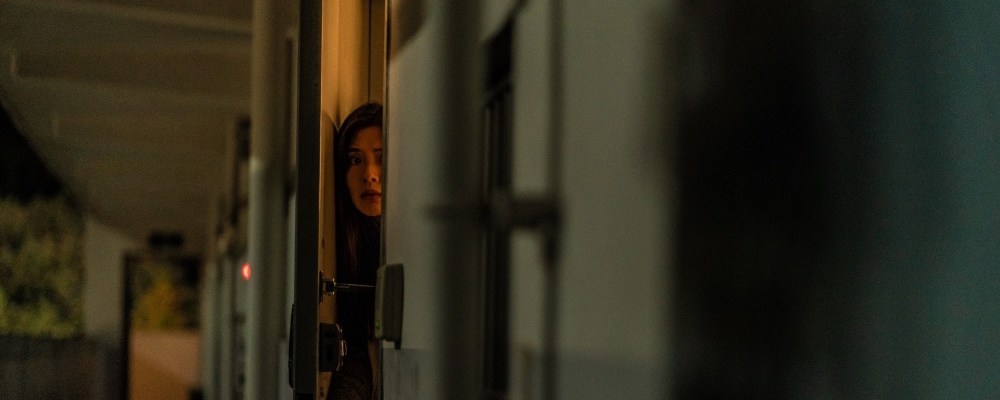
Ju-young, a hearing-impaired woman played by Lee Sun-bin, returns to apartment 607 after her younger sister Joo-hee disappears while investigating mysterious sounds coming through her ceiling. The building is barely holding together. The lights are unreliable, the air is stagnant, and most of the residents seem like they’ve already checked out. A building-high banner demands the government fund repairs, lest people die. Directly below, the man in 507 is quick to anger. Two floors up, the woman in 807 says just enough to be unsettling. In between, mysterious noises from 707 keep coming, but nobody answers the door. Everyone’s troubles are stacked one on top of another, but no-one is really willing to help.
The tenants’ association chairwoman, more concerned with preserving funding for a long-delayed redevelopment, does everything she can to deflect attention. The situation is quietly desperate, but the urgency is insidiously kept out of view – much like the locked basement, filled with a decade of other people’s abandoned junk, that sits underneath them all. Whether Ju-young’s investigation should lead upward or down becomes less important than the sense that she is circling something that no-one wants to name.
The haunted apartment complex has been neglected by every structure that was supposed to protect it. Government oversight has seemingly vanished, and the community has withdrawn into isolation. What remains is a kind of sealed system of denial. People disappear, and no one reacts. Ju-young wasn’t there when her sister went missing, and her guilt mirrors the building’s decay.
So Noise begins as a supernatural mystery, it unfolds into something bleaker. The horror isn’t confined to the possibility of a ghost; it’s in the indifference of the neighbours, the simmering aggression of the man downstairs, and the forsaken atmosphere. The social concerns recall recent K-horror films like Door Lock, but are here fused with classic ghost story minimalism.
Writer Lee Je-hui’s plot is torn from the headlines: uncanny transmission of ambient sounds through the concrete structures of apartment buildings is known as “floor noise” in South Korea, where the number of complaints related to this phenomenon has doubled in the recent years. Floor noises have led to a raft of legal disputes, with residents even being driven to murder by weird sounds that seem to come from nowhere.
Noise conveys that pressure by allowing everything to accumulate – the repetition of locations, the muting of colour, and the sense of physical and emotional enclosure. The sound design drives the escalating dread – creaks, alerts, footsteps, and mumbled voices are used sparingly but with precision. Ju-young’s phone and hearing aids pull in and distill things she may be better advised to avoid.
The film resists over-explaining, and allows some of its enigmas to survive right to the end credits. But the core is clear – the true horror is as much in the absence of a community as it is in the presence of an afterlife, and fear breeds where social ties are abandoned.
Rather than lean into the narrative maximalism of something like last year’s Exhuma, Noise returns to the classic J-horror/K-horror template of the 00s, and refines it – quiet, patient, and creepily exact. This is the kind of horror film that reminds you how little it takes to unsettle an audience if everything else is working. Its emotional weight, its auditory precision, and its depiction of abandonment at every level all serve the same effect – this film delivers pure dread.
Noise may be the best work of horror at Fantasia this year, and it’s certainly one of the most effective in recent memory. It doesn’t just echo the likes of classic films such as Dark Water – it carries that tradition forward into an era of smart apps and bluetooth-enabled wearables. But as the film makes clear, technology won’t save you. As long as there are abandoned buildings, decaying relationships and isolated people, there will be a gap for something eerie to sneak up on us – and a place for ghost stories like Noise. This is the most haunting film of the year – highly recommended.
Noise played the Fantasia International Film Festival on July 17.
 Whitlock&Pope