
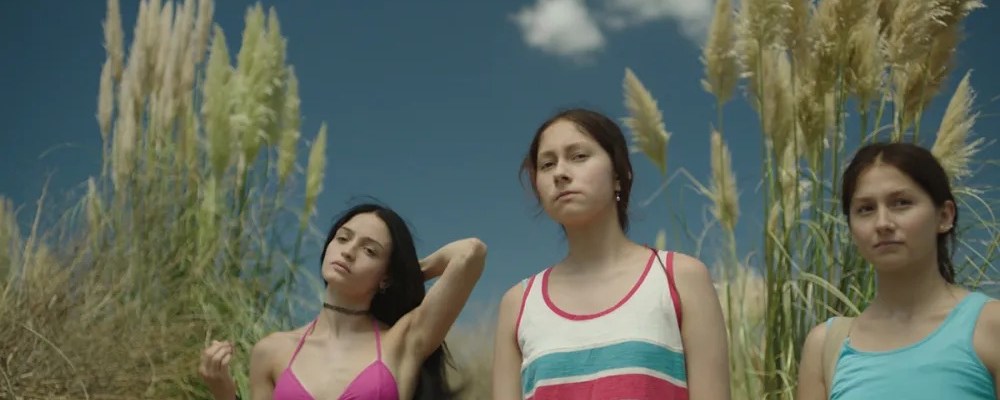


A slow-burn folk horror of adolescent rage that takes the idea of “one magical summer” to a sinister conclusion.
★★★★
Adapted from two short stories by Mariana Enríquez, one of Argentina’s most acclaimed voices in contemporary horror, The Virgin of the Quarry Lake fuses the personal and the subtly political into something jagged and hypnotic. Enríquez is best known for stories where poverty, violence, and the supernatural sit side by side without explanation or apology, and this film captures that spirit exactly. The screenplay, by Benjamín Naishtat, draws from her pieces “Green Red Orange” and “The Cart,” but rather than clumsily stitching them together, it lets these two tales of desperation subtly resonate together to produce a vision of occult rebellion.
Set in the summer of 2001, as Argentina’s economy unravels and whole communities teeter on the edge of collapse, the film follows sixteen-year-old Nati, played with eerie conviction by Dolores Oliverio. She’s stuck in a sweltering, crumbling town with no real future, watching the boy she quietly adores fall for Silvia (Fernanda Echevarría), an older woman who’s recently returned from London. That city hangs over the film like a symbol of imagined escape, glamour, and foreign control. As jealousy curdles into something stranger, and rumours of an ominous local shrine spread among the friend group, Nati turns to the folk magic passed down from her grandmother in order to shift fate in her favour.
This is the first screen adaptation of Enríquez’s work, and it doesn’t try to tame her voice. If anything, it doubles down on her core concerns: young women pushed to the margins, strange rituals hiding in plain sight, and violence that emerges from grief as much as rage.
Director Laura Casabé handles this with patience and precision. The film rarely declares itself outright as horror, but it grows steadily more uncanny. The camera lingers on heat-drunk afternoons, flickering televisions, and littered quarry paths. An abandoned shopping cart, loaded with something we’re never quite allowed to see, casts an ominous spell over the community, and there’s a creeping sense that the boundary between inner torment and external threat is wearing thin. The dread is mostly ambient, until it isn’t.
Oliverio is astonishing, giving Nati a presence that never feels performed. Her power primarily comes not from spells but from the way she watches, waits, and calculates. The supernatural elements are ambiguous, but they don’t need to be explained – like much of Enríquez’s writing, the horror at least partially lies in what’s accepted as normal. The emotional stakes are loaded even before we see Nati’s teenage angst, baked in the hot sun, harden into something closer to madness.
The Virgin of the Quarry Lake deftly it translates its literary source into something cinematic without losing the ambiguity and danger that make Enríquez’s work so resonant. This is the story of a girl who feels invisible, and chooses to make herself seen in the most terrifying way possible. Quiet, precise, and charged with fury, this is one of the greatest horrors of the year.
The Virgin Of The Quarry Lake played at the Fantasia International Film Festival
 Whitlock&Pope