


Ari Aster’s darkly dazzling vision of pandemic-era America is a gloriously cynical western satire, shot with bravura craft – but are its politics just an attempt to stay above the fray?
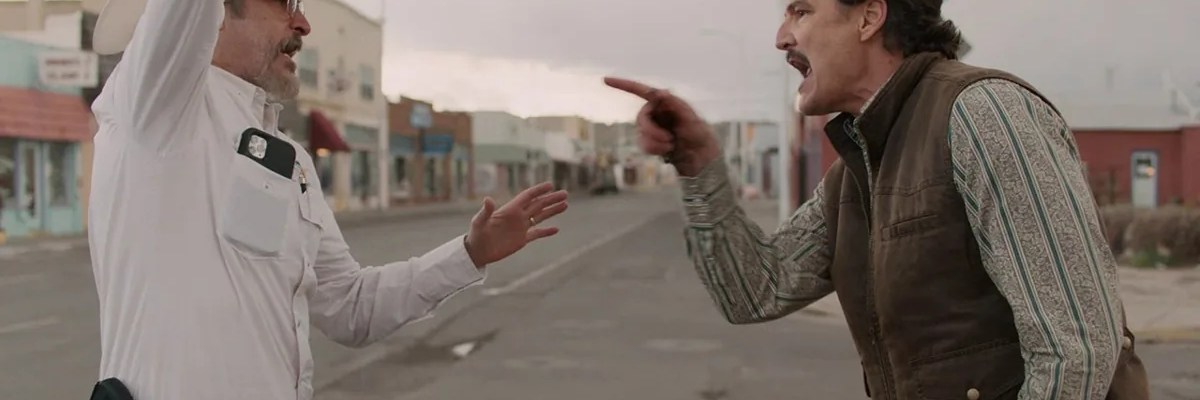
Eddington begins in May 2020, in a fictional New Mexico town straining under the first wave of COVID. Sheriff Joe Cross (Joaquin Phoenix) refuses to enforce mask orders, clinging to his own stubborn interpretation of the law. Mayor Ted Garcia (Pedro Pascal) coaxes the townsfolk towards community-minded compliance, while jazzing up a forthcoming shiny AI data centre he claims will save the town. But the pair have a secret, personal history, and as their conflict turns less-than-civil it leads to a personal, social, and civic fracture – where conspiracy talk, shifting normalities, and high-tech ambition produce a perfect storm of hysteria and violence.
Shot by Darius Khondji, the cinematography imbues the desert with grandeur and unease at once. The light shifts from deep crimson horizons of the New Mexico dusk to the harsh blue-green fluorescence of dive bars and supermarket interiors, always suggesting a world glowing with the potential for Armageddon. Screens intrude constantly, their glow flattening intimate moments into mere content and mediating human impulses into empty transactions. Aster and Khondji, together with editor Lucian Johnson, create images that are as unsettlingly precise as they are expansive, making Eddington one of the most visually commanding films of the year.
The acting keeps pace – the naturally imposing Phoenix collapses himself into a hollow man marked by defiance, getting tenser and tenser with each perceived emasculation. Pascal counters with an slick, superficial grace, a mayor selling unearned optimism with a paper-thin public persona. Their clash feels elemental, not just political but mythic, turning the town into a stage for competing worldviews, each built on a whole lot of not-very-much.
Their impasse is at the heart of the narrative, but a lot more swirls around it. Eddington has a Pynchonesque sprawl and density, weaving together too many stories and details to ever feel neat. Like Pynchon, Aster builds a world of paranoia and hidden systems, where absurd satire rubs against genuine menace and grotesque humor. Like Gravity’s Rainbow or Inherent Vice, it resists resolution, preferring digression and excess over true closure.
Things get so expansive in fact that some of the other players don’t quite get the focus they need to flesh their characters out. Emma Stone plays the Sheriff’s wife, closed off from intimacy for partially hidden reasons, and Austin Butler the new-age guru who claims he can save her – and everyone. Despite the 149 minute runtime, we don’t really get under either of their skins, Aster leaving the audience to fill in the blanks.
That means we must turn more to the bigger picture, and here Eddington bristles with cynicism. Aster sketches a panorama of America where every institution leaks trust and every protest looks like theatre. Livestreams, vigils, and town meetings amount to stagey ritual and spectacle, the social fabric dissolving into performance. Kids posture to attract girls, while in the streets adults act out. Slogans are everywhere, and the logic of clickbait headlines seeps into family conversations. It’s a portrait of How We Live Now – a world on the brink.
Yet here lies the film’s weakness. At a certain point, the death of George Floyd and the resulting Black Lives Matter movement start to impact on the plot. Up until now, Aster has played both men of his leading men as two sides of the same coin, and the townsfolk’s actions a general lunatic malaise driven by social media and an impulse towards empty grandstanding, puffed-up absolutism, and straight-up-narcissism. The intention seems to be to stand above it all, and say that this is all crazy – “can’t we all just get along?” Part of this approach already necessitates that the role of Donald Trump and his MAGA movement in fermenting this moment are simply ignored.
But to address BLM means having to address Black feelings and opinions, something Aster simply can’t do without taking sides – frankly, it would be too embarrassing, and possibly too revealing. So he has his one Black character (Michael Ward, doing well with little) shrug at the whole thing, then quickly narrows his focus onto white liberal protesters. These characters are rendered more cartoonishly than anyone else in the script, and delivered up as easy targets of satire, while Black perspectives remain almost invisible. That omission looks deliberate, a studied refusal to pick a side that leaves Aster wallowing in South Park-style “you’re all nuts” posturing, but the cost is clarity. By avoiding such a core part of the moment, Aster leaves part of his canvas conspicuously blank. The filmmaking is immaculate; the film itself has a big hole in it.
In other regards, Eddington is electric. The sprawl of ideas may make the film seem long to some, but for me its charged intensity meant it just flew by. Eddington is a movie that dares to provoke, to look straight at the contradictions of 2020 and shape them into feverish allegory, but it has significant flaws behind its force; giving the film its jagged and difficult outline. A bravura work of cynicism and spectacle, it is one of the boldest cinematic responses to the pandemic era, and a reminder that Aster remains one of the few decently-budgeted filmmakers able to deliver spectacle with a real voice. I only wish he’d said everything that needed to be said, and many will find themselves chewing over why he chose not to.
Eddington (Ari Aster, USA, 2025), with Joaquin Phoenix, Pedro Pascal, Emma Stone, is in UK cinemas from Friday.
 Whitlock&Pope