
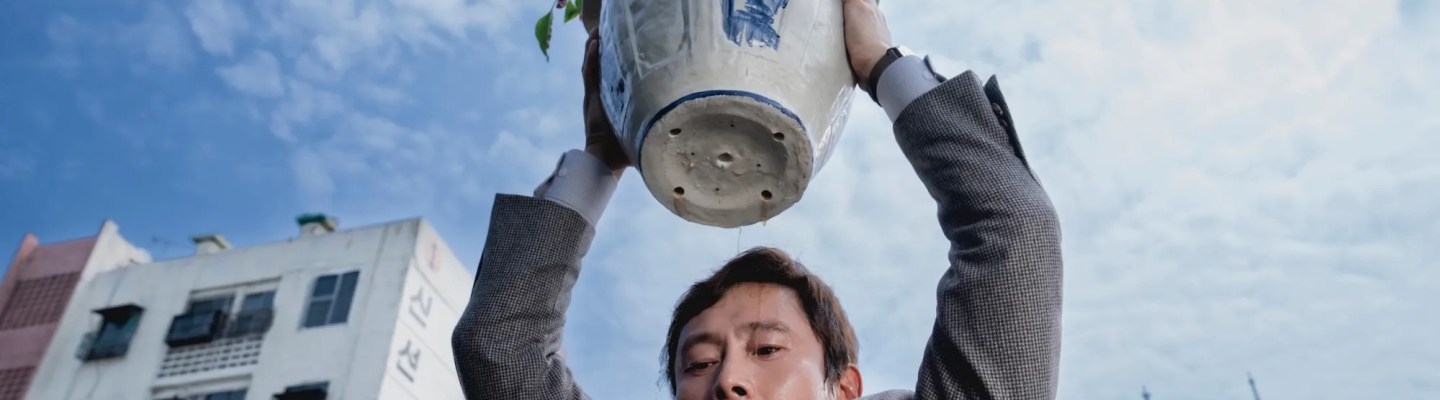


Park Chan-wook adapts Donald Westlake’s novel The Ax into a viciously funny black-comedy thriller about work, masculinity, and the absurd lengths people will go to to cling on to their dreams – carried by a riotous performance from Lee Byung-hun.
★★★★½
Man-su (Lee Byung-hun) has spent twenty-five years in paper manufacturing and believes he has built the perfect life: a steady job with Solar Paper, a family, two dogs, and a home he can finally call his own. He has even been crowned ‘Pulp Man of the Year’ by none other than ‘Pulp Man’ magazine, so you know he’s made it. But when his American head office push through a round of downsizing and lay him off, his sense of assurance implodes.
Man-su’s attempts to bounce back through ordinary means – job interviews, retail work, patience – only accelerate his decline. Soon, humiliation and desperation push him toward an unthinkable plan: if no one will make space for him, he will create his own space at rivals Moon Paper, and make himself a sure thing – by murdering all his potential competitors.
Park sketches a world that is both painfully ordinary and queasily heightened – a world of tidy suburban homes, fluorescent interview rooms, and family meals with Netflix on iPads. The everyday conceals a permanent hum of subtle menace. Each domestic detail feels complicit in Man-su’s unraveling, and each comic beat slides toward revealing this world’s implicit cruelty.
There’s plenty of wry fun in the keenly observed details – a ballroom dance party featuring an entire dental office dressed as Native Americans will remind audiences of Bong Joon-ho poking at that particular Korean fascination in Parasite. Everyone has the good taste to enjoy modern architecture, jazz, tennis, and expensive whiskey, and to shell out for cello lessons or a barbecue – or even better, a bonfire cauldron. It’s the fact that the family’s kids are named Ri-won and Si-won, while their dogs are amusingly titled Ri-tu and Si-tu, that drops perhaps the heaviest hint that these dreams of a perfect life are schematic. superficial, and not just a little bit Western. The question is, will Man-sun realise that, before he abandons all class solidarity and exterminates his similarly unemployed “rivals”?
Lee Byung-hun is extraordinary in charting that descent. His performance is tightly coiled, oscillating between meekness and explosive rage, always with a current of absurd humor. Lee gives the performance of his career – funny, furious, and frightening. Son Ye-jin, as his wife Miri, provides the film’s counterbalance – she is warm, loving and patient, but increasingly alarmed at what is slipping away. Meanwhile Park Hee-soon, Lee Sung-min, Yum Hye-ran, and Cha Seung-won inject volatile humor into the periphery.
Cinematographer Kim Woo-hyung uses tightly controlled compositions to render domestic and corporate spaces like traps, or as areas from which Man-su can be pushed to the periphery, to spy on others. The editing varies from dreamlike overlapping fades to razor-sharp slices. The blocking alone in the sequence the builds to Man-Su realising he’s been fired has a violence and sadism to it; vehicles and machine cut across the frame, blocking lines of sight and fracturing the geography. Park lets the murderous black comedy and heartfelt desperation swirl together in an increasingly demented tragi-farce, as Man-su’s journey from Solar Paper towards Moon Paper marks a dark journey of the soul.
As an adaptation of Westlake’s The Ax, No Other Choice is faithful to the premise yet distinctly Korean in its social anxieties. Westlake’s novel is hard-boiled and to the point, but Park is unafraid to get a little goofy, with a sure touch to ensure that he never derails the drama. Park leans into the ironies of modern masculinity: the belief that work is identity, that failure at work is failure at life, all played as a very human satire.
Park says it took him twenty years to make this film, and it feels sharpened by that wait. The result is not just a story of a man pushed to extremes, but a cultural critique of systems that leave no room for dignity. No Other Choice is a vicious comic triumph, showing that Park Chan-wook is at the peak of his powers. Recommended!
No Other Choice played at the Venice Film Festival on 29 August, ahead of opening the Busan International Film Festival and future releases in the US by Neon and in the UK by Mubi.
 Whitlock&Pope