
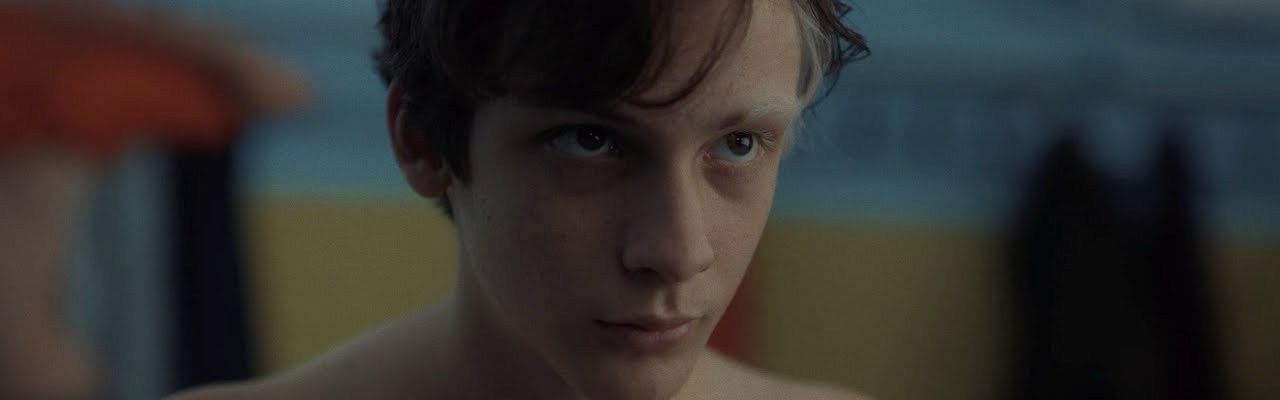


Paolo Strippoli delivers a saint-or-cryptid tale that plays like a Catholic Ari Aster, weaving confession, revelation, and the corrosive value of guilt and pain into a slow-burn horror allegory.
★★★½
In the Alpine village of Remis, self-styled as “the happiest town in Italy,” serenity is maintained through a secret ritual that borders on the grotesque: every night troubled townspeople line up to embrace Matteo, a withdrawn fifteen-year-old known to them as the Angel of Remis. Each hug strips away sorrow, leaving nothing but a small mark on the arms of the hugger. Matteo becomes the town’s living reliquary, both miracle and prisoner. Into this ritual steps Sergio (Michele Riondino), a PE teacher still grieving the loss of his son, who takes a posting in Remis to start anew. His attempt to “save” Matteo from exploitation has the feel of intrusion, and brings with it the danger of awakening a darkness in the community – and the boy.
Strippoli sets his story in a pointedly Catholic register, where guilt, confession, and miracle blur. The embraces resemble holy communion; the boy, an unwilling saint. What looks like healing becomes a system of repression, and the film circles the question of whether carrying pain is necessary for growth. As Captain James Kirk once said: “I don’t want my pain taken away… I need my pain!”
This is horror with an Ari Aster tone – it’s a mournful movie, where ritual is used to process grief but may also open the door to something horrific. Yet Strippoli’s approach is pared down and more direct, less baroque. The Holy Boy maintains an eerie restraint, letting its horror emerge quiet observation – though this doesn’t preclude an ultimate push towards a grand operatic collapse of the existing order. In its control and conviction, this is the best Italian horror in years, confidently re-staking the country’s claim to a tradition of terror.
Performances lock the allegory into human terms. Giulio Feltri makes Matteo a fragile but unreadable presence, neither saint nor monster, while Michele Riondino’s Sergio embodies both protector and violator. Their exchanges unsettle precisely because neither figure fits the role that the village seems to assign to them.
Visually, the mountains of Remis are both sublime and suffocating. Cinematographer Cristiano Di Nicola gives a nice desaturated look to the alpine town. Federico Palmerini’s editing brings out Sergio’s dislocation and confusion, while the score by Federico Bisozzi and Davide Tomat swells with liturgical overtones, giving events an ecclesiastical charge.
If there is a limitation, it lies in the familiar path the film treads: grief, ritual, and sacrificial innocence are well-worn motifs in contemporary horror. But it’s nice to see a grief-horror film that doesn’t simply manifest that grief as a ghostly monster that you defeat through a therapeutic breakthrough, and Strippoli’s control of mood, and his insistence on treating guilt and pain as inherently human rather than ailments to be treated, set the work apart.
The Holy Boy succeeds as a spiritual and bodily horror, and as a reminder that faith, community, and healing can conceal their opposites. Strippoli gives us a journey through a “valley of smiles” that is also a valley of repression and denial, where every embrace leaves its mark. Recommended!
The Holy Boy, aka La valle dei sorrisi (lit. The Valley of Smiles), played at the Venice Film Festival on 29 August 2025, and will play Fantastic Fest in September.
 Whitlock&Pope
Pingback: Venice Film Festival Rundown – best of the fest. | Whitlock&Pope