
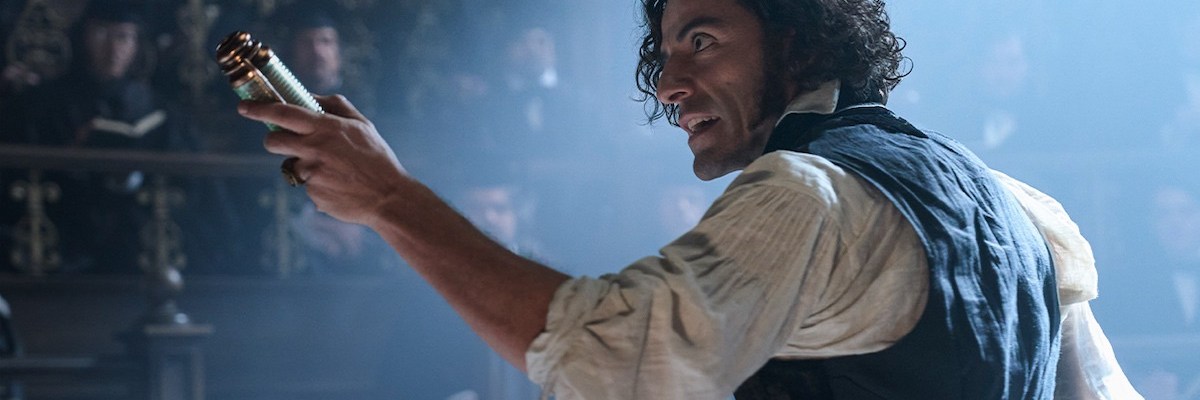


Guillermo del Toro’s Frankenstein is a sumptuous gothic spectacle, thick with atmosphere and design, yet weakened by unsubtle storytelling, heavy-handed voiceover, and pacing that tests patience.
★★★½
Frankenstein begins in the Arctic, 1857. The Royal Danish ship Horizon lies icebound, but with its captain insisting the crew push on to the North Pole if freed rather than turn back in shame. His monomania clearly mirrors Victor Frankenstein’s, but in case you didn’t get it don’t worry – Del Toro will spell out the parallel more than once, his tendancy to underline themes rather than trust his audience is clear from the start.
Soon the crew chance upon Baron Frankenstein, and face the wrath of his creation. The rampage that follows is one of the film’s most gripping moments, the monster scattering soldiers and shattering a man’s spine with a single uppercut. A bravura burst of gothic action, the kind of sequence only Del Toro could stage.
During a respite from the monster’s attacks Victor tells the captain his tale, saying “some of what i will tell you is fact, some is not – but it is all true,” a cute line that establishes the possibility of an unreliable narrator that sadly doesn’t really get much of a follow up, the endless voiceovers mirroring the action throughout without much contrast or irony.
Don’t get me wrong, Del Toro’s long-awaited dream project is full of wonderful moments and images. In particularly enjoyed a bravura scene showing Frankenstein’s expulsion from the Royal Medical College. He rigs up half a flayed corpse, in the style of a Body Worlds exhibit, and has it pant and groan and catch a ball. Ralph Ineson leads the tribunal, his Yorkshire boom cutting through the chamber with even more impact than the production design around him, as he announces that the devilish Frankenstein is now persona non grata.
Del Toro then leans into excess. Victor’s laboratory is a converted gothic water tower hewn in black stone and wrapped in vines. When various members of his family die, this film does for coffins what Coppola’s Dracula did for battle-armour. And there are many beautiful gowns – red for Victor’s mother, blue for his brother’s fiancé Elizabeth (Mia Goth).
This is gothic cinema at its most resplendent, but also at its most indulgent. The voiceover, intended to bind the story, ends up intruding again and again, flattening moments that might have spoken for themselves. At 149 minutes the film drags, with crescendos that overstay their welcome and dialogue that spells out what the imagery already makes plain. And I lost count of the times characters pointed out that, if you think about it, Victor is the monster. Whether engaging him in debate, storming out of the room, or even dying in his arms, Del Toro’s characters just love to draw that parallel and make sure you caught the subtext.
In fact, the greatest limitation of this film is that it refuses to let its Creature be anything less than a perfect little angel – a longstanding GDT tic that has now ossified into artistic limitation. Not every monster needs to be unimpeachable, yet we can imagine Del Toro reading Shelley’s novel and frantically tearing out every page where the Creature sheds innocent blood. What was once empathy for outsiders has hardened into rote sentimentality, and the director’s moral schema has grown so predictable it hobbles his imagination. The monsters are angels and the humans are monstrous, again and again and again.
Thankfully, the actors keep it alive. Oscar Isaac’s Victor is a man corroded by brilliance, seduced by an Oedipal desire to surpass his father. Christoph Waltz brings a subtle sinister edge to his role as Victor’s mentor, funder and enabler – channeling the proceeds Napoleonic armament sales in his direction. Mia Goth brings mercurial intelligence and emotional insight as Elizabeth, Victor’s prospective sister-in-law, the only character who seems to be truly his equal. But it is Jacob Elordi who defines the film. His creature, cursed with endless “merciless life,” laments the “murmur of my blood pumping through my constant heart” and begs for a companion so they “can be monsters together.” Elordi’s performance turns the monster into the film’s most human presence.
Del Toro has said that “I love monsters. If I go to a church, I’m more interested in the gargoyles than the saints…” and here he worships with fervour. Yet the liturgy stretches too long, and the sermon too often tells us what we already see. When the film lands, it lands with force. But the journey there is ornate, unsubtle, and padded with more narration than it needs. This Frankenstein has fairytale elements – Del Toro even squeezes in one of his dark fairies, a fiery angel of death. But a fairytale needs magic and despite moments of glorious grandeur this film’s literalism and handholding prevent it from being one of the greats.
Frankenstein played at the Venice Film Festival today, and will be coming to Netflix later this year.
 Whitlock&Pope
Pingback: Venice Film Festival Rundown – best of the fest. | Whitlock&Pope