


Olivier Assayas turns Giuliano da Empoli’s novel into a bloated, misjudged plod through Russian power, flattened by an intrusive voiceover and performances that never find the right register.
★★
Jeffrey Wright’s writer, in Russia on “a year’s sabbatical from Yale” comes to seek out Vadim Baranov, a longterm adviser to President Putin – not as a journalist chasing a scoop, but as a fellow reader. Both men share a reverence for Yevgeny Zamyatin’s We, that prophetic dystopia about control, surveillance and the erasure of individuality. It is this thin thread of literary kinship that grants Wright access, and sets the stage for a film-long interview in which Baranov narrates his journey through the construction of Putin’s Russia, from the fertile anarchy of the early 1990s to the seizure of Crimea, framed by Wright’s interview in some vaguely post-2014 present.
One central question nagged me throughout this film: if you invent Baranov, as a fictional guide through Russia’s corridors of power, with complete artistic licence… why give him that voice? Paul Dano whispers his way through nearly three hours, a papery hush that could conceivably suit a man of shadows, but in practice bores and irritates. It is like being read a soporific Wikipedia entry for two and a half hours, punctuated with “graphic design is my passion” chapter headings for each subsection.
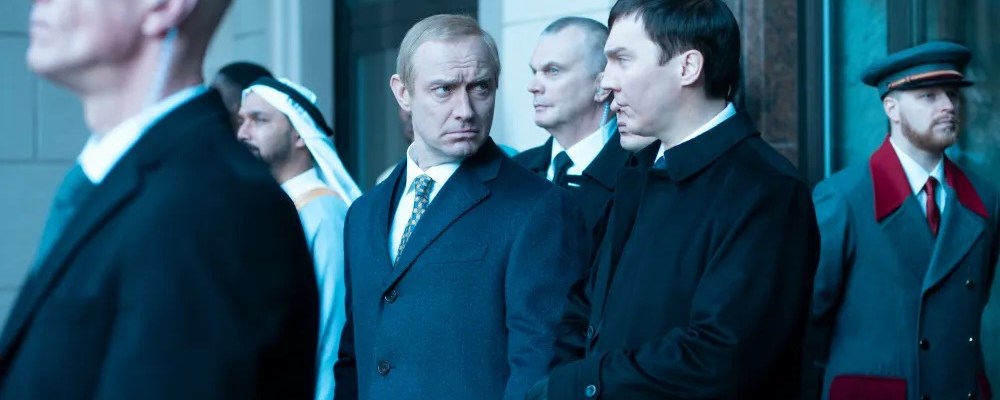
Jude Law fares little better. His frowning Putin is unremarkable, usually cloaked in blunt middle-England tones, but occasionally derailing into Essex wide-boy swagger when he gives an order. Maybe Law was channeling the spirit of the Daily Mail? Jeffrey Wright’s velvet baritone is enjoyable as ever, but he is left stranded in a framing device that reduces him to an interviewer with no perspective of his own.
The invented romance between Dano’s Baranov and Alicia Vikander’s Ksenia is another cul-de-sac. Vikander’s smug moralising posture is never integrated into the film’s architecture; she exists to scowl at oligarchs while spending their money, yet is signalled as the conscience of the piece. Her character feels pointless, and the romance is insipid.
There are flashes of electricity when Will Keen appears as Boris Berezovsky, sparring and scheming with other power brokers. He is the one performance that feels alive. Those sequences alone suggest the sharper political thriller this could have been, though taste falters badly with the inclusion of real footage of Berezovsky’s chauffeur’s death in a failed assassination, a choice that collapses the line between docudrama and exploitation. In such a heavily fictionalised film, I don’t believe we really needed to see this one person’s blown-open cranium.
Rather than bringing to life the story of how Russia manufactured a new theatre of power, the film kills off all interest with its plodding succession of false notes, hacks choices and historical box ticking. As Putin’s Internet Research Agency might say: it’s all FAKE NEWS, and it’s rendered in Baranov’s own artistic mode of choice: kitsch. But it’s a grey, lumpen kitsch that doesn’t even manage to achieve camp.
Watch a documentary instead of this weirdly pointless construction, and stay off the internet – because as every good counterspy knows, they’re watching you.
The Wizard of the Kremlin played at the Venice Film Festival, and after an over-optimistic awards-qualifying theatrical release will eventually emerge onto Disney+.
 Whitlock&Pope
Pingback: Venice Film Festival Rundown – best of the fest. | Whitlock&Pope