


Yanis Koussim’s brutal exorcism horror fractures faith and history, in a visceral reckoning with Algeria’s Black Decade.
★★★★
Roqia begins with chaos: a sickle-wielding mob moving through the night in a blur of rage, banging on a door in a Algerian city, pulling women and children out into the street, ready for slaughter. The only context is the inter-title that dates the killings to the 90s.
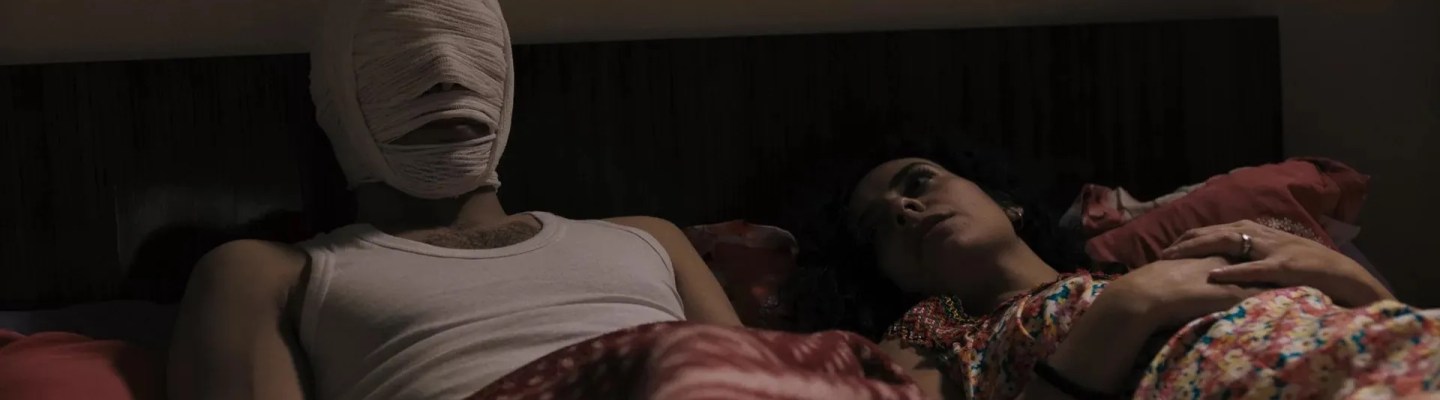
The massacre has the feel of a wound in history, and from this rupture the story divides into two. In one, an elderly raqi (a Muslim exorcist) slips into Alzheimer’s while his disciple fears for his safety and a series of killings plague the city. Years earlier, in 1993, a man named Ahmed emerges from a car crash without memory, returning to his family only to find himself estranged. His wife and children recoil; his youngest is terrified of his bandaged face. At night, strange presences chant in incomprehensible tongues. The two strands eventually collide, forcing the audience to reckon with how a hidden evil will lead back toward the violence that opened the film. The dread is less about jump scares than about waiting: when and why will the massacre erupt again?
What makes Roqia distinctive is how it links possession horror to Algeria’s “Black Decade,” the brutal Algerian civil war of the 1990s whose clashes between the military and Islamist insurgents left around 200,000 people dead and everyday life shrouded in fear. Koussim grew up in Sétif, a city he has says that had a “fog of terror” that settled over daily life. That lived memory shapes the film: exorcism is not just ritual but metaphor for reckoning with political and spiritual fractures. The film refuses to equate faith with fanaticism, insisting instead on Islam as a resource for resistance to terror. Horror, here, is the vessel for national trauma, a form that allows the unspeakable to be articulated.
Cinematographer Jean-Marie Delorme leans on a handheld camera and natural light, to give a tactile, immersive quality to this battle with darkness. The choice is effective, visceral, and immediate, though it also means some crucial scenes sink into darkness, their meaning partly obscured. That aesthetic strategy reinforces the theme – truth and evil alike being hidden dangers – but it may risks testing some viewers’ patience.
Horror lovers will also notice Koussim’s reference points. The narrative design, with its investigative pacing and elliptical hauntings, recalls The Exorcist III. It is a sharp choice: if you are going to pay homage to an Exorcist film, choose the best. That’s right, I said it – The Exorcist III aka Legion is the greatest there is. Like Blatty’s cult classic, Roqia finds horror in the erosion of memory and the return of what should remain buried.
This feature debut signals a filmmaker determined to bend horror to his own ends. Roqia lands like a gut punch; it is a film of fractured timelines, haunted voices, and erupting violence, one that will leave you deeply unsettled long after it ends. Koussim has created a possession film that is grounded, visceral, and furious, a work that insists horror can and must lay bare the wounds of a nation.
Credits: Directed by Yanis Koussim. Starring Ali Namous, Akram Djeghim, Mostefa Djadjam, and Hanaa Mansour. Cinematography by Jean-Marie Delorme. Produced by Supernova Films and Algeria’s 19, with support from Doha Film Institute, Red Sea Fund, CNC, and AFAC. Premiered at Venice International Critics’ Week 2025.
 Whitlock&Pope
Pingback: Venice Film Festival Rundown – best of the fest. | Whitlock&Pope