
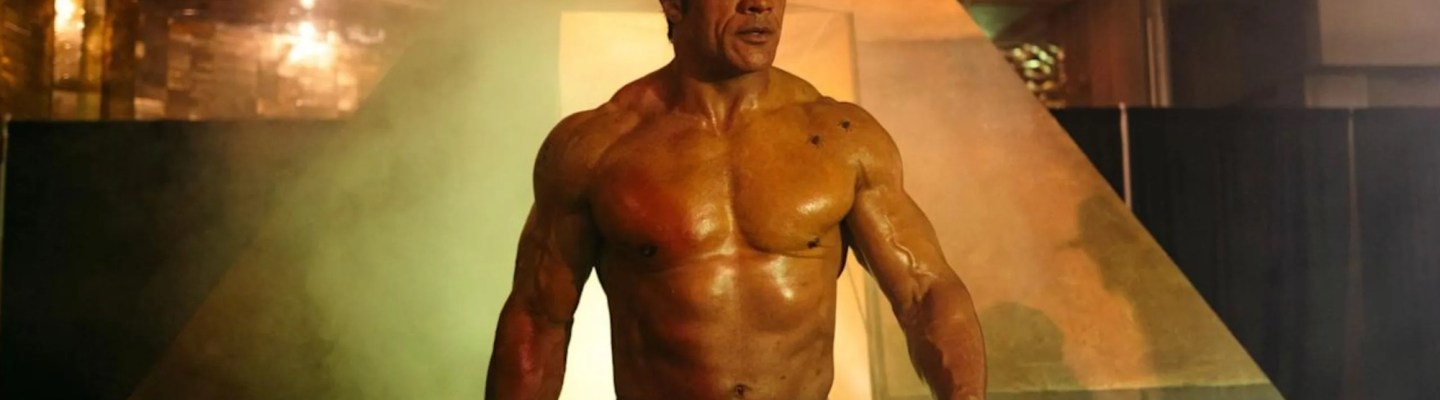


Benny Safdie’s bruising sports drama surges with visual energy, anchored by Dwayne Johnson’s rawest performance and Emily Blunt’s volatile turn as his partner.
★★★★
Benny Safdie’s The Smashing Machine follows a recognisable sports-biopic arc yet feels newly alive through sheer craft. Shot on 16mm and IMAX, and cut to move like a flurry of blows, the film never goes slack. The fights pulse with animal violence, the training passages bristle with unease, and even the quiet interludes carry a nervous charge, in this film about a man who would rather be in the ring getting beaten around by an opponent, than out of it getting “beaten around by my emotions.”
Delivering those words, and carrying the movie, is Dwayne Johnson, transformed into UFC pioneer Mark Kerr. His swole physique and facial prosthetics may grab attention at first, but what makes the performance land is the vulnerability he permits to seep through. Johnson has never looked more human or more fragile, even while projecting the aura of a man built to dominate. It is a committed and career-defining role that maths the most both of Johnson’s skills and of his remarkable, glistening physique. His Kerr is a juggernaut of a man, yet a quiet, conscientious puppy behind closed doors – until he isn’t.
The film does not shy away from Kerr’s dependence on opiates, showing how the same intensity that made him a champion left him vulnerable to a numbing escape. Johnson plays the addiction not as an externalised meltdown but as a creeping undertow that saps control. In one of the film’s most telling ideas, Kerr explains that to win he must focus “like a laser” rather than “like a flashlight,” which would allow his emotions to “go everywhere.” Safdie lingers on that metaphor, framing Kerr’s fight not just against opponents in the cage but against the risk of his own mind diffusing under pressure.
Emily Blunt is elemental as Dawn Staples, Kerr’s partner who is a pillar of strength when Kerr is at his lowest – but whose need to be noticed and loved gives her a perverse compulsion to centre herself and engineer confrontations just as Kerr enters crucial stretches of preparation. That toxic volatility and mutual emotional dysfunction drive the film’s domestic scenes and sharpen the film’s emotional edges.
The bond between Kerr and Mark Coleman also gives the drama weight. Coleman, both his closest friend and a rival for the title, is played by MMA fighter Ryan Bader. His acting is solid and understated, capturing the mix of camaraderie and competition that shaped their relationship and lending the film a credible sense of lived experience.
The script touches the usual notes of triumph, addiction, collapse, and attempted redemption. What keeps it compelling is Safdie’s instinct for rhythm and texture. The closing images of the real Kerr, muttering happily to a documentary crew, are unexpectedly tender after so much punishment. It did leave me wondering though how much the team had worked with Dawn, and whether there was any attempt to integrate her view of events into the film – the result certainly feels like we are seeing Kerr’s take on things.
The Smashing Machine also marks the first feature Benny Safdie has directed without his brother Josh, and it inevitably invites comparison. Together the Safdies specialised in pressure-cooker urban chaos, with characters trapped in schemes that spiral out of control. Without Josh, Benny’s pace is a little calmer. The chaos here lies in the body rather than the city, and the camera feels more deliberately attuned to rhythm and physical impact. A de-Joshed Safdie film, at least on this evidence, trades some of the brothers’ street-corner mania for a bruising formal control. It is less about mania and more about endurance of a quieter anxiety. But the core idea of a man relentlessly pursuing a goal despite personal chaos all around him remains in place.
The Smashing Machine does not rewrite the sports genre, but it shows how a sports drama can still feel urgent when directed with this kind of energy and empathy.
The Smashing Machine premiered at the Venice Film Festival.
 Whitlock&Pope