


The past and present overlap to unnerving effect in Mark Jenkin’s timeslip fishermen’s yarn, a Cornish folk horror whose very form seems haunted.
★★★★★
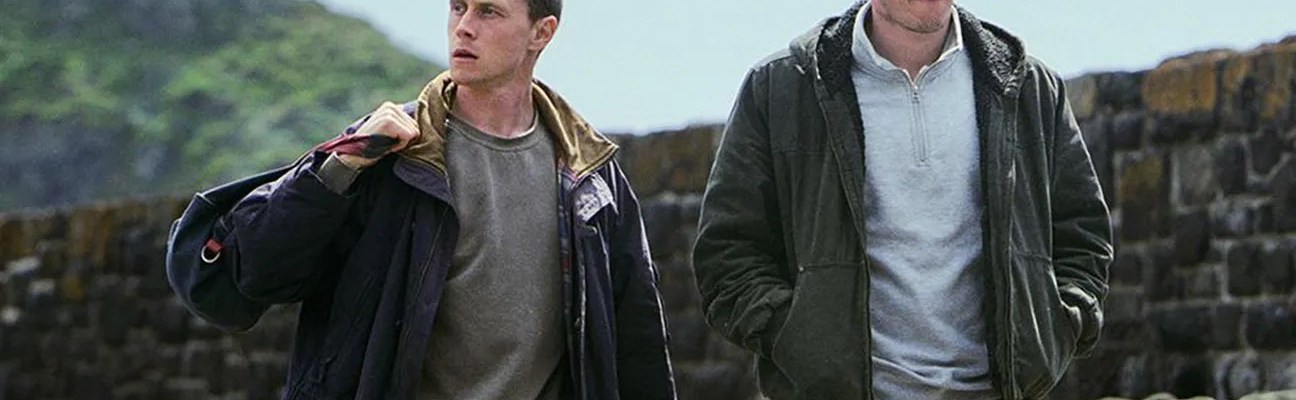
Fishing crewmen Nick (George MacKay) and Liam (Callum Turner) are pulled adrift in time when they sign onto the Rose of Nevada, a trawler that carries more than just fish back to harbour. What they are overlooking is that the vessel reappeared one recent morning, decades after vanishing, and its owner has quickly refitted it ready to go out fishing once more. But after a profitable first night at sea, Nick and Liam arrive back in their village to find that it’s 1993, and that the community believes them to be the original crew who disappeared years before. They have been ‘borne back ceaselessly into the past,’ now that the vessel has become unmoored from time – or perhaps the trawler has simply found its way home to its true port.
MacKay’s Nick, tethered by family responsibilities, resists the pull of this unwanted past, and is desperate to return to his young family. Turner’s Liam, rootless, is drawn to the promise of a stable life already written. The tension between them roots this eerie conceit in lived realities: sacrifice, identity, and Cornwall’s precarious economy.
MacKay and Turner both give superb, naturalistic performances, by turns fearful and accepting of the strange dream they have entered, each perfectly attuned to the rhythm of the film. Francis Magee is perfectly cast as their gruff skipper, taking a no-nonsense attitude to the surface irrationalities of the plot, and Rosalind Eleazar is a delight as Liam’s once-and-future lover. The Bolex loves each of them, the grain highlighting the angles and crags of their faces, and letting them become one with the texture of the piece – a vision of salt-corroded letterboxes, crumbling stone and sunlight bleeds.
The film treats its shift in eras less as a narrative twist to be resolved than as an atmosphere to sink into. After all, are we not each haunted by the past, and by the future? Jenkin’s Bolex cinematography, hand-processed textures, stuttering edits and disembodied ADR voices make the viewing experience itself uncanny, a cinema that feels genuinely haunted – a spellbinding triumph of eerie dread.
Rose of Nevada is a kind of ghost story told through texture, rhythm, and grain, but where it’s never quite clear if the characters are dead, alive – or if we are all already in the afterlife together. Perhaps it’s no accident that once Liam is chilling back in 1993 he spends his downtime watching the David Cronenberg adaptation of Stephen King’s The Dead Zone.
Some might say this is a folk horror without the overt horror – no cultists, witches or demons here. But the obligations of human ties, the irresistible pull of time, and the economic erosion of Cornwall all emerge as horrors in their own right.
As Jenkin said at the film’s Venice premiere: “The films that I like, the horror is in the form of the film. You know, if it’s a haunted film, I don’t want the characters to be haunted, because we can rationalise that. I want the film to be haunted. And if you’re involved in the film, you’ll become haunted by it, and I’m not claiming that this film does that, but that’s what I aspire to do.”
All of this builds upon the concerns of both Bait and Enys Men, with its depiction of a run-down town whose way of life is on the brink of extinction, only to be reborn through a supernatural timeslip that threatens to consume its two victims. Perhaps the film portrays a kind of harvest sacrifice, where the harvest is of fish and the sacrifice is of the personal lives and freedom of the fisherman who must bring them in.
Jenkin has said the project grew from a single image – a boat lost to memory returning – and was inflected by the solidarity he observed during the pandemic. That social grounding keeps the film from drifting into abstraction, as do the keenly observed details – shout out to the production designer who slipped a ‘Flowered Up’ cassette onto Nick’s bedroom desk.
Like Bait and Enys Men, Rose of Nevada builds its spell through material craft: grain, texture, light bleeds, and silence. But Rose of Nevada fuses the concerns of the two earlier films, and sublimates them into a kind of The Owl Service or Penda’s Fen of post-Brexit Cornwall, an oneiric folk horror of community, memory, and return. George MacKay and Callum Turner deliver their best performances yet, in the most poetic folk horror of the decade. I loved this film.
Rose of Nevada played at the Venice Film Festival, and will play at the London Film Festival in October.
 Whitlock&Pope
Pingback: Venice Film Festival Rundown – best of the fest. | Whitlock&Pope