
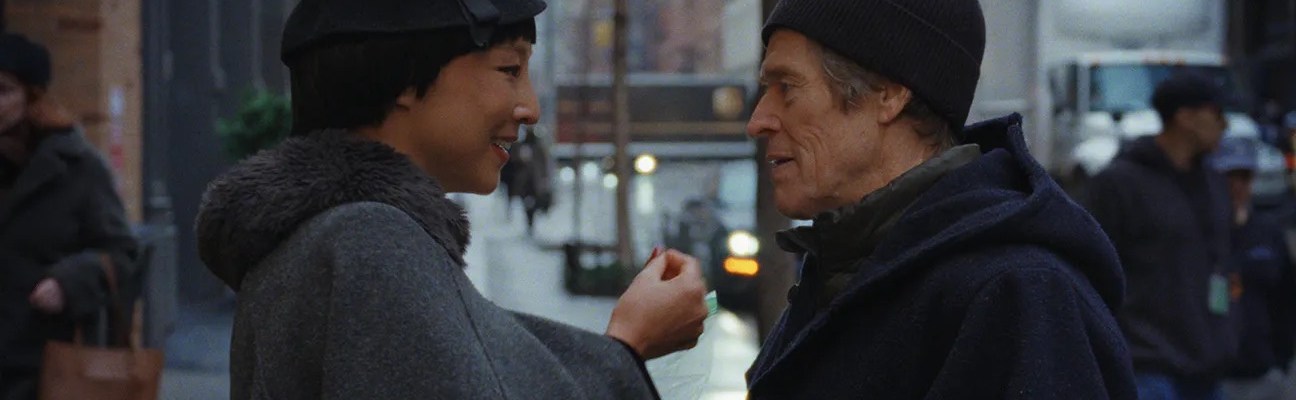


Kent Jones’s Late Fame is a quietly insightful portrait of vanity and yearning, where a superb Greta Lee eclipses even the excellent Willem Dafoe in a tragicomic look at authenticity and performance in modern New York.
★★★★
Ed Saxberger (Willem Dafoe), once a poet of modest renown, now works filling letters at the post office. His rediscovery one day by the ‘Enthusiasm Society’ – a group of Manhattan aesthetes desperate for a connection to a revered literary past – gives them not just a new cause but the thrill of a reference point they can all grasp. To them, the Bukowski parallel is excitingly obvious: the postal-worker “man of letters”, an authentic, blue-collar archetype. That feels like the stamp of realness. But is fame ever really real? Then as Saxberger is embraced by the group, at their centre he finds Gloria (Greta Lee), a tragic heroine with irresistible gravity. It is understandable, to put it mildly, to be drawn in by her.
Dafoe is magnificent, with every hesitation and glance freighted with irony. Meanwhile, Greta Lee proves herself one of the greats, not just going toe to toe with Dafoe but even surpasses him. She turns Gloria into a combination of muse and emotional executioner, and the fulcrum of the film. Is she intoxicating, or just toxic?
Jones shoots New York with a double vision: it’s present layered with the ghosts of vanished bohemias. His fascination with “retro-mania,” the contemporary hunger for new icons sculpted from old ones, courses through the film, which emerges as an acidic portrait of a New York obsessed with authenticity. The trajectory of Ed’s revival is familiar, almost inevitable, but as is so often the case with tragedy the predictability is part of the point.
All of this is adapted from Arthur Schnitzler’s novella of the same name, first published posthumously in 1912, a satire of the Viennese literary world. By relocating that tale of belated recognition from fin-de-siècle Vienna to present-day New York, and allowing the city’s vanished bohemias to shimmer through its glossy facades, Kent Jones places the film in dialogue with another landmark Schnitzler adaptation. Schnitzler also wrote Traumnovelle (1926), the source for Stanley Kubrick’s Eyes Wide Shut, another Viennese story transplanted to New York, about a man chasing a dream of imagined greatness – and pursuing the promise of a revitalising sexual adventure. In both works, the pursuit of the ideal slides into folly, the dream of glory colliding with the compromises of reality.
What Late Fame ultimately delivers is less a story of triumph than a mirror: a keenly observed fable about how we see each other, how we want to be seen, and how we mistake the surface of authenticity for the thing itself. Sometimes the quest for the authentic leads into a maze of symbols and simulacra, when all we really need is a beer and someone to rack up the pool table.
Late Fame premiered at the Venice Film Festival
 Whitlock&Pope
Pingback: Venice Film Festival Rundown – best of the fest. | Whitlock&Pope