
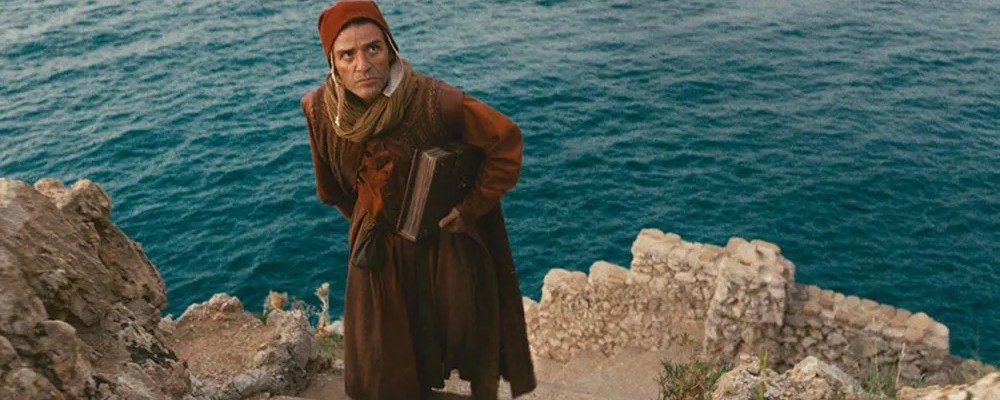


Julian Schnabel’s long-gestating Dante project collapses into a turgid dog’s dinner, with Oscar Isaac stranded, Gerard Butler the only source of fun, and Gal Gadot sending her career to the ninth circle of hell.
★½
In The Hand Of Dante was first set up by Johnny Depp, who secured the rights to Nick Tosches’ playful novel, brought in director Julian Schnabel, vacillated, then flaked completely – abandoning the director and the financiers. Maybe Depp got caught up in his personal troubles, or maybe he recognised what is obvious after watching the finished product: Tosches’ book is fundamentally literary, too resistant to screen translation. But once a project gathers enough momentum, even a misguided one, sometimes it barrels forward anyway. By the time it hit Venice, In the Hand of Dante listed thirty-one executive producers.
The pitch is arresting, at last. A manuscript surfaces in Sicily, claimed to be Dante’s Divine Comedy in the poet’s own hand. A New York mafia boss calls in Nick Tosches – played by Oscar Isaac as a flatteringly noirish version of the book’s author – to authenticate it. Fresh from personal grief and literary burnout, Tosches finds himself dragged into a violent journey with Louie (Gerard Butler), an assassin, as they scheme to steal, test, and redeem the relic. Running parallel is a 14th-century thread in which Dante himself, also played by Isaac, wrestles with faith, mortality, and the eternal pull of Beatrice (Gal Gadot). Time collapses. Modern and medieval violence rhyme. Schnabel wants to fuse crime thriller, theological meditation, and metafictional self-portrait into one vision of art and love as salvation.
Isaac gives Tosches a natural charm that goes a long way – although not far enough – but the film gives him little to play beyond posture. Butler, of all people, comes closest to saving things: first with his wonderfully hammy turn as the sadistic gangster Louie, dumb but just smart enough to be dangerous, then – brilliantly – as Pope Bonifacio in the 14th-century thread. Butler’s papal showstopper is a genuinely great gag, in a film that desperately needed more of them. Martin Scorsese delivers a strangely moving extended cameo as a priest, pontificating on the nature of the spiritual calling to art. In roles that don’t require them to get out of their chairs, Al Pacino turns up for one good scene, and Franco Nero radiates gravitas on command, but John Malkovich – misjudged, bratty and tiresome – proves less useful.
Further down the cast list things get a lot worse. Jason Momoa lumbers through, vacuously, as a Dante-obsessed gangster, while at the bottom of the pile is Gal Gadot, whom one can only assume is on some insane quest to annihilate her career, line reading by line reading.
There is a moment when Isaac puts on the Stones’ “Jumpin’ Jack Flash,” struts his room for a bit, and then turns it off again (this part is the present day). This brief promise of a ‘crossfire hurricane’ at least provides some energy, Sadly the only crossfire comes towards the end of the film, with a gunplay confrontation that’s as much a Mexican standoff of bad acting as of actual bullets.
Even those who treasure the spectacle of a true film maudit will not find enough to relish here. The film’s metaphysical pretensions smother the pulp energy, and the bloated remains are neither profound nor fully enjoyably trashy. This film’s actors should have been told to abandon all hope, ye who enter here, or – even better – the script should’ve simply been dropped into the inferno.
In The Hand Of Dante premiered at the Venice Film Festival
 Whitlock&Pope
Pingback: Venice Film Festival Rundown – best of the fest. | Whitlock&Pope