


★★★★★
A shipment of pure cinematic crack has arrived in the form of Paul Thomas Anderson’s biggest hit yet: a phenomenal fusion of paranoid thrills, propulsive action, and dark comedy. Gloriously funny, breathlessly exciting, and deeply moving – this is the film of the year, no contest.
For twenty years Paul Thomas Anderson toyed with fragments of this story: elements of Thomas Pynchon’s Vineland, with its paranoid elegy for revolution; a vision of a car chase ripping through the desert. Now he’s found the inspiration, cast, and, importantly, funding that he needed to bring his project into the light.
The result, One Battle After Another, is a post-hippy action crime comedy that refuses elegy, trading drift and regret for speed, humour, and spectacle. Where Inherent Vice (and its ancestors like Cutter’s Way) seemed to mourn the death of the counterculture, Anderson makes it run hot again. Every scene is a delight, as Anderson delivers one triumph after another. This film is pure joy from the first frame to the last.
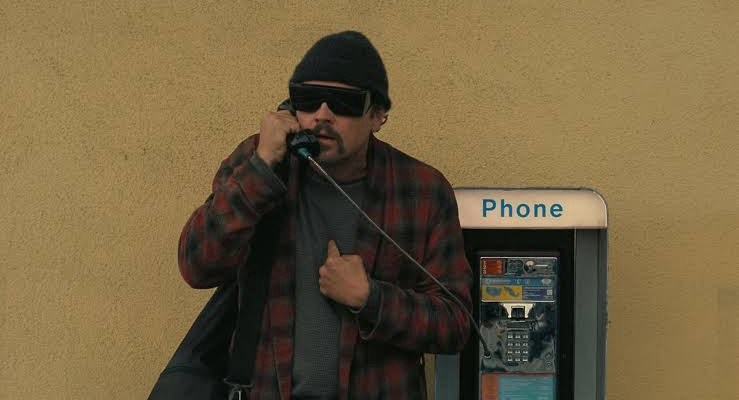
Bob Ferguson (Leonardo DiCaprio), once a fighter in the militant collective ‘French 75’, now lives off-grid with his teenage daughter Willa. Years earlier he fell for fellow revolutionary Perfidia Beverly Hills (Teyana Taylor, dominating), and their union produced Willa – along with a nemesis and rival for Perfidia’s affections in Colonel Steven J. Lockjaw (Sean Penn), a military officer humiliated in a raid.
Sixteen years later, with Perfidia gone and Lockjaw back, Bob is forced into a fight he thought finished. But the calculation has changed. Lockjaw is now associating with the “Christmas Adventurers,” a group of ridiculous and chilling avatars of white-supremacist fantasy – and their interest is less in Bob and more in his daughter.
DiCaprio dazzles, delivering a mix of messy charm and stoned idealism—paranoid, brittle, still clinging to half-broken ideals. Across from him, Sean Penn stomps through the film as a grotesque swaggering cartoon from hell, waddling in shoe lifts, chin jutting forward, his Popeye-on-roids torso crammed into a too-small T-shirt. It’s emasculation anxiety turned slapstick. Chase Infiniti is a revelation as Willa, and she commands every moment she’s on screen with breakout intensity. The supporting cast is a smorgasbord of talent; as a big fan of Support The Girls, it gives me endless delight to announce that after seven years we finally have another good role for Junglepussy.
Anderson’s set-pieces absolutely slap: the final chase, shot like the rest of the film in glorious VistaVision, straps cameras low to the desert asphalt so every dip and crest becomes a blind summit, the road bucking like a rollercoaster as paranoia builds. Even the bomb in a congressman’s office plays both as gag and genuine threat, and violence is never sleek: Penn pratfalls, DiCaprio stumbles, and the action lands with a weight stripped of glamour.
The soundtrack is immense, with Jonny Greenwood – Anderson’s partner since There Will Be Blood – layering a brooding, propulsive score that powers the action along and shapes the film’s rhythm as surely as the cutting. The needle drops explode against this backdrop, with Steely Dan’s “Dirty Work” a particular delight.
There is one wrinkle: Anderson’s time-shift from Pynchon leaves Bob’s chronology skewed. He says he’s 42, born in the 1980s, and has been at it “thirty years.” That suggests a radicalised xennial shaped by the Bush/Gore debacle or 9/11, not the ’60s idealism Vineland mourned. Yet Anderson still dresses him in Weatherman signifiers, so the film is shot through with a ripple of anachronism, as if the wreckage of one generation’s dream has been borrowed by another. This dissonance feeds the mood of people out of time, battling inside their own reality.
This film is a significant gamble by Warner Bros. At a rumoured $130–175 million, it dwarfs Anderson’s past budgets, which rarely broke $40m. His top grosser, There Will Be Blood, made just $76m in cinemas. For this to clear costs, it needs Wolf of Wall Street numbers. The world’s cinephiles will surely be urging it on – Anderson really does offer fresh spins on the best traditions of 1970s New Hollywood, and in an age of superhero formula and Sundance boilerplate, that is some rare oxygen.
One Battle After Another shows paranoia reframed as comedy, and absurdity sliding into tragedy. The central tension, underpinning even the machinations of the plot, is tonal. Lockjaw is Bob’s nemesis in the same way that Wile E Coyote is Roadrunner’s nemesis – he’s an inherently ludicrous figure. And yet he brings not just farce, but real, nightmarish danger and insanity into their lives. It’s this push-pull between pantomime slapstick and the annihilating logic of racist extermination that powers the film, and challenges the audience to formulate a reaction. Well, it certainly speaks to our times.
And yet, what begins in a world of moral ambiguity eventually crystallises into a story of love versus hate: the purity of a father’s devotion to his daughter set against the inhumanity of white supremacy. Anderson converts the post-hippie comedown-noir’s paranoid genre machinery into something clarifying, turning the autopsy into a resurrection. This is the director at his most freewheeling but also his most direct, delivering to us 2h40 of uncut cinematic crack.
Gloriously funny, breathlessly exciting, and deeply moving, One Battle After Another is not just his biggest film; it is his most exhilarating – a live grenade dropped into our cultural powder keg.
One Battle After Another is released in cinemas in the UK and US on 26 September.
 Whitlock&Pope