
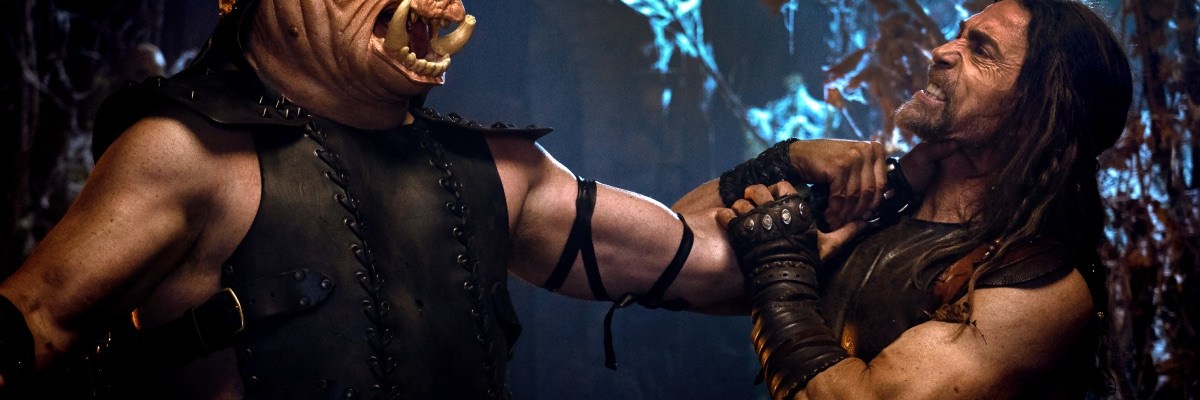


Deathstalker (2025) trades the original’s sleazy edges for rubber monsters, lashings of gore and an awkwardly juvenile semi-parodic tone, keeping it from claiming a true place in the sword-and-sorcery canon.
Steven Kostanski’s reboot of Roger Corman’s Deathstalker arrives with one big relief: it drops the sexual violence that marred the 1983 original. In place of exploitative sleaze, we get torrents of gore, foam latex creatures, and a steady stream of tongue-in-cheek humour. The problem is that the humour rarely lands. Too often the joke is simply the presence of an obvious puppet or a moment of modern slang thrown into a high-fantasy setting. A warrior muttering “oh shit!” when confronted with danger is meant as a wink, but when repeated it becomes a tic rather than a punchline.
The story opens on the war-torn kingdom of Abraxeon, where Deathstalker retrieves a cursed amulet from a battlefield strewn with corpses. Marked by its dark magic, he finds himself hunted by monstrous assassins while the cultish Dreadites plot to resurrect an ancient sorcerer. His path winds through skirmishes, betrayals, and grotesque encounters, each fight pushing him closer to breaking the curse before it consumes him entirely.
Kostanski leans into handheld camerawork and close-quarters immediacy, a style that suits his background in creature effects but undercuts the genre’s natural strength. Sword-and-sorcery is built on mythic compositions: monumental landscapes, wide frames that give battles a sense of destiny. Here the images feel cramped and mobile, more grindhouse than epic. The film’s creatures impress, but the world around them never feels mythic.
Bernhardt gives Deathstalker the right physical weight, his presence carrying the swordplay even when the script undercuts the character with throwaway gags. Around him, the supporting cast lean into the camp tone with mixed results. Patton Oswalt’s comic sidekick voicework lands a few laughs, but often feels like it belongs to a different film. Christina Orjalo is playfully winsome as a thief and fellow adventurer, and Nina Bergman brings energy to her role, though her characters are sketched thinly. The performances are somewhat fun, but they rarely elevate the material, keeping everything at the level of pastiche rather than drama.
The creature designs, courtesy of Action Pants FX, are tactile and inventive. The monsters are gloriously handmade, grotesque and gooey in the way fans of 80s fantasy crave. Yet even they sometimes feel less like threats than punchlines, their practical nature presented as a gag in itself. The result is a strange tonal mismatch: the violence is graphic enough to rule out younger audiences, but the humour and sensibility are pitched at an adolescent level.
There is still a certain pleasure in watching gore splatter from rubber beasts and swords clang against prosthetic foes. But the film leans so heavily on homage and adolescent parody that it rarely finds a rhythm of its own. Where earlier pulp landmarks like Excalibur, or the recent animated triumph The Spine of Night, aimed for grandeur, this version of Deathstalker plays smaller and cheekier. It works best as a curiosity, and might even rise to a more enjoyable level in the right midnight crowd, but on its own it never fully claims the mythic stature it reaches for.
Deathstalker played at Fantastic Fest in Austin, TX
 Whitlock&Pope