
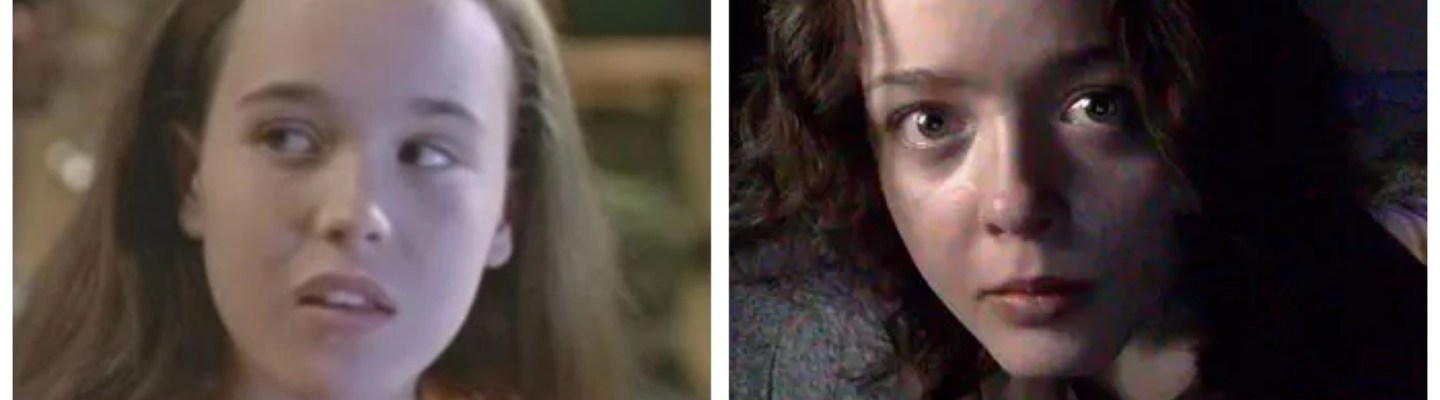


The internet is a bedroom mirror. For teenagers in particular, it offers a place to rehearse identity, to perform it, and sometimes to discover it. A click becomes an experiment in selfhood. Posting a video, entering a challenge, opening a forum window – each can summon something that feels larger and stranger than the self that set it in motion.
Two films, made nearly twenty years apart, share this logic. Kelly Sandefur’s I Downloaded a Ghost (2004) and Jane Schoenbrun’s We’re All Going to the World’s Fair (2021) follow uncanny rhymes: an adolescent sits at a computer, clicks into the wrong thing, and finds themselves haunted. Both hinge less on monsters than on what the intrusion reveals about their protagonist’s inner life. One shapes itself as Halloween comedy; the other as hushed, disorienting horror. Taken together, they show how the meaning of the digital has shifted, from novelty to dread.
In I Downloaded a Ghost, Stella Blackstone (Elliot Page) is building a haunted house for Halloween when she stumbles onto a suspicious website. With one click she summons Winston, a cab driver turned stand-up comic whose presence is more nuisance than nightmare. His bumbling haunting becomes a way for Stella to test her nerve and discover connection. In World’s Fair, Casey smears blood on her laptop screen and repeats an incantation into the dark. What follows is a slide into performance and dissociation: sleepwalking, sudden violence, moments where her body seems no longer her own. Both characters summon a ghost; both find it speaks to the unease of growing up.
Each film also turns on a fraught encounter with an older man. Stella finds herself shadowed by Winston, a middle-aged figure with unfinished business, clumsy but insistent. Casey is contacted by JLB, a man hiding behind an avatar, who warns her of danger and tries to steer her performance. In both cases, the adolescent protagonist defines themselves by how they react to this intrusive presence. For Stella, it means learning confidence and responsibility; for Casey, it means grasping at control in a situation where trust itself feels unsafe.
The echoes go further. Winston is ridiculous but also a figure of loneliness, a spirit who makes visible what Stella can’t articulate. Casey’s “World’s Fair” metamorphosis works the same way: a performance of isolation and dysphoria that blurs sincerity and game. At Sundance 2021, critics described Schoenbrun’s film as “a deep and disturbing experience that illuminates the dark side of humanity’s dependence on the Internet.” The same sentence could sit beneath …Ghost if you stripped away that film’s comic gloss. Where Winston’s business is neatly resolved, Casey’s story closes on ambiguity, no assurance that the haunting can be undone.
Page’s later transition gives I Downloaded a Ghost a resonance its makers could not have foreseen: a child disrupted by a downloaded ghost, negotiating something others cannot understand until it is finally acknowledged. That allegorical potential rhymes with what Schoenbrun makes explicit in World’s Fair, a horror film where dysphoria and digital haunting are inseparable.
Seen this way, the two films aren’t ancestors and descendants but uncanny rhymes: stories that summon the same shape across different decades. One ends with a wink; the other with a wound left open. And in both, the adolescent’s growth hinges on how they respond to the arrival of an older male presence with an ominous aspect – comic in one, potentially predatory in the other. The resonance comes not from direct lineage but from allegory: Page’s early role, reframed in hindsight, aligns with the terrain Schoenbrun maps consciously.
What once looked like disposable children’s TV now feels like a premonition of one of the most vital internet horrors of the decade. But both suggest you never know what forum for self-discovery might lurk behind that next click.
 Whitlock&Pope