


★★★★
Patrik Syversen’s Dawning filters a story of sisterhood, secrecy, and trauma through Bergmanesque austerity and Hanekean cruelty, for a slow, dark, and uncompromising hybrid of family drama and horror, of tragedy and transcendence: austere, brutal, and cosmic.
Honestly, sometimes the girlies just want to enact a Bergmanesque psychodrama, but if men aren’t ruining the vibe by arguing about Into The Spider-Verse they are swinging a pickaxe into your face.
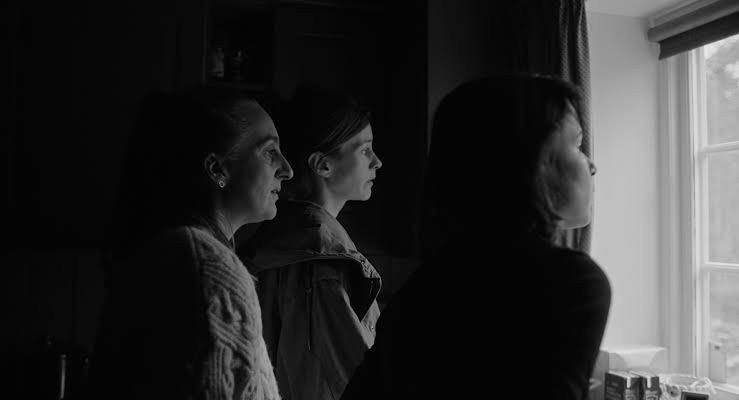
Three such sisters retreat to their family’s remote holiday house after the youngest survives a second suicide attempt. When news comes that their abusive mother has died, the older two conceal it from her. Their fragile balance fractures further when a stranger appears. Norwegian director Patrik Syversen builds from this simple premise an atmosphere of silence and dread; a creeping nightmare of sisterhood and dread that gnaws away scene by scene.
Producers SpectreVision have pitched the film as “a Scandinavian prestige drama filtered through a horror prism.” That framing is apt. Syversen has said he grew up on Bergman, Bresson, and Jarmusch, drawn to films that were “ascetic, understated and low-key.” His goal with Dawning was to bend that art-house austerity into horror form, to see what happens when high European restraint collides with genre dread.
The film’s black-and-white cinematography (Andreas Johannessen) signals its ascetic intentions immediately. It belongs to a lineage where monochrome sharpens psychological contrast rather than providing nostalgia. This starkness recalls Bergman’s Persona and Winter Light, but also Haneke’s The White Ribbon, in which black and white becomes a clinical, alienating device. Flashbacks shift from stark monochrome into a chilly colour register, marking breaks in time without breaking its austerity.
The horror dimension becomes clear in the second half, when the film folds in the grammar of survival ordeals. Here Dawning echoes the punishing attrition of Wolf Creek: escape attempts that collapse into recapture, bodies ground down by exhaustion, and the terrifying patience of an aggressor who stretches the night into a test of endurance. What would be sadistic spectacle in an exploitation film is transmuted by Syversen’s Scandinavian sensibility into something quieter and crueller: an austere, brutal, and unexpectedly cosmic study of how long terror can last when there is no clean escape.
Some critics at Fantastic Fest have described the film as “low-key” and “talky,” warning that it “takes too long to get going.” But that patience is the point. The film inherits from Bergman the conviction that silence, speech, and withheld expression are the crucibles of horror. In Cries and Whispers, the house becomes a chamber where sisters wound and comfort in equal measure. Dawning is unmistakably in that tradition: a story of women bound by care and cruelty, where even gestures of protection curdle into menace. Also, theres a psycho on the loose.
Syversen has said he grew up on Bresson as well as Bergman and Jarmusch, admiring the “ascetic, understated and low-key” qualities of their films. The performances here tend toward restraint, the affect pared back, so that emotion is carried less by outbursts than by rhythm, framing, and silence. That minimalism heightens ambiguity: the sisters’ concealment of their mother’s death is at once an act of care and an act of destruction.
I also see in this shades of Lars von Trier’s “depression films” (Antichrist, Melancholia). Dawning shares their unsparing focus on a depressive heroine, as well as a darkly playful prodding at religion and its hollow consolations. Syversen punctuates his film with crucifix-shaped inter-titles and the toll of a church bell to mark time shifts – gestures that feel both sacred and sardonic. Where von Trier leans into baroque provocation, Syversen holds back, but the tonal kinship is clear: grief as a force that corrodes both body and belief.
The spectre of Michael Haneke is impossible to miss. The arrival of the outsider destabilising the sisters is the precise mechanic of Funny Games or Time of the Wolf: intrusion as revelation of fractures already present. The tone is pitiless, forcing the audience to sit in dread until it becomes intolerable. Yet where Haneke offers only bleakness, Syversen allows the faint suggestion of deliverance, however strange or cosmic, to filter in at the edges.
In one combative dinner-table conversation, the sisters argue with two men about the spiritual implications of a multiverse, taking a reading of Into the Spider-Verse as the trigger. The name of Miles Morales acts as a pop-cultural shard piercing the film’s ascetic vibe. Nabokov is invoked in the same breath, and I can’t help but think that his endings – particularly the final cosmic shuffle of Bend Sinister or the dissolving world of Invitation to a Beheading – foreshadow the path the film itself begins to take. As Dawning draws to a close, its once-fixed realism gently becomes more fluid.
In fact, Syversen’s film commits to bracing existentialism while holding on to a cosmic sense of humanity. Horror tropes are folded into this framework without compromise, from the attrition of survival ordeal to sudden eruptions of dread. Even Lovecraft gets name-checked: the sisters’ mother owns a signed copy of At the Mountains of Madness, a sly nod to another key influence. Yet in this film, unlike in Lovecraft, the horror is grimly everyday, and dourly brutal. Syversen deals in the cruelty of family secrets and the raw attrition of survival. Rather, it is the possibility of deliverance that opens a door to the cosmic.
The score, by Øystein Greni (better known as the frontman of the Norwegian rock band Bigbang) is a sign of the film’s hybrid approach. Rather than imposing rock flourishes, Greni leans into atmosphere and restraint, sometimes pushing into abstraction so far it brushes against musique concrète. Scrapes, pulses, and fractured sounds slip between traditional scoring and noise, underscoring Syversen’s collision of prestige austerity with genre unease. The music breathes with the imagery, shaping tension without breaking its quiet.
Formally, Syversen keeps the camera and edit austere (edited by Erlend Mjømen Knudsen with Syversen himself), with Johannessen’s cinematography and Greni’s score tightening the rhythm of dread. At 109 minutes, the film is not unusually long for this kind of chamber piece, but its austerity makes the time stretch, which has already divided audiences: I know that at Fantastic Fest some found the pace inert, while others admired the uncompromising darkness. Sitges will likely provide a wider horror-specialist audience, where its hybrid genre form may resonate more clearly.
Dawning may not built to easily satisfy. But it is built to linger. Like Bergman, it finds horror in silence and family. Like Haneke, it makes the viewer complicit in cruelty and anticipation. Like Bresson, it pares emotion to the bone. Like von Trier, it treats depression and faith as unstable ground. And in its second half, it borrows the survival-horror language of attrition – the spirit of Wolf Creek – to show how genre tropes can be absorbed into arthouse restraint. Its reality loosens as it nears the end, Spider-Verse and Nabokov on its mind. And then, just when the ordeal seems endless, Syversen elides the human and returns to nature, before delivering a doozy of a final line. The result is simultaneously brutal and transcendent. For some Dawning will be tiring. For others it will be unforgettable. Count me in the latter group.
Dawning played Fantastic Fest in Austin, TX.
 Whitlock&Pope