


★★★½
Genki Kawamura’s Exit 8 turns a looping video game into a quiet, uncanny film about guilt and attention. It is a small, finely made gem, eerie in tone and exact in detail.
A man known only as The Lost Man takes a phone call in a tunnel. His estranged partner is calling from hospital to tell him she is pregnant. The line dies before he can reply. He walks on, down into the Tokyo subway, where time begins to fold in on itself.
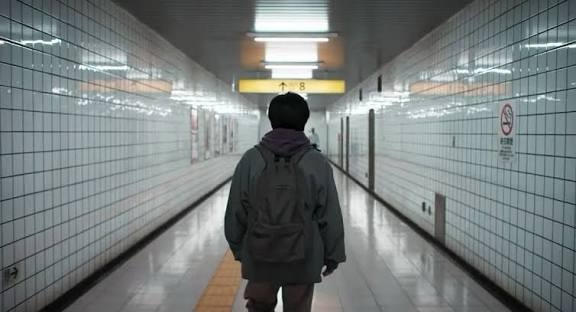
The corridor looks ordinary: white tiles, bright lights, and posters for local events. Commuters move with the same mechanical rhythm. But the corridors twists and turns just keep repeating, and he passes the sane man again and again. Then he sees a notice on the wall, setting out the rules of the world he has entered: if something feels wrong, turn back; if nothing does, keep going. Each circuit repeats the same sights until one small thing changes – a sign, a reflection, a sound that lands out of time. Spot it and he can move forward; miss it and he is thrown back to the beginning. The game’s central rule becomes the film’s narrative engine, turning both man and viewer into pattern-seekers.
Exit 8 is based on a 2023 indie game by Kotake Create, a minimalist “walking simulator” that became a viral hit for its endless corridor and its demand that players spot the difference between loops. Kawamura keeps that structure intact – so much so that even if you came to the film blind, you would sense the game behind it almost immediately. The clean geometry of the setting, the fixed rhythm of progress, and the sense that narrative is built from observation rather than action all give it away. What begins as story quickly feels like gameplay transposed into cinematic time.
For the audience the result is an experiment in active viewing; the camera trains the audience to scan for anomalies, and so the film feels more like an exercise than a story. Fear comes not from darkness or violence but from repetition, glare, and the disappearing background noise of ordinary life. Cinematographer Keisuke Imamura and sound designer Shohei Amimori turn the tunnel into a living space of hums, echoes, and fluorescent pressure. Every light flicker and footstep builds the sense of enclosure.
Kawamura never quite turns repetition into real momentum, but his discipline keeps the film taut. The experience becomes its own reward: a study in how precision and patience can generate unease. Exit 8 turns the act of watching into its own form of suspense, and then tests how long that can hold. The precision is impressive, but that same control risks fatigue.
Kawamura’s film, like the game it adapts, clearly inherits from P.T., Hideo Kojima’s cancelled Silent Hills demo whose looping corridor became a touchstone for modern horror design. Its influence runs through Exit 8 and a growing wave of shoegaze horror; films and games that fixate on liminal spaces, ambient sound, and emotional drift. In this mode, terror comes less from what happens than from how long we’re made to stand inside it.
Some effort is made to bolt on an emotional narrative: a very superficial “do I want to be a father” story gives our protagonist an emotional journey to match his looping, physical one, but it’s all just a bit too mechanical. The guilt behind the Lost Man’s silence is written across Ninomiya’s face from the opening scene, so later images – such as a slow-motion tsunami of dirty water that homages that other corridor horror, The Shining – feel like overstatement. The emotion is strongest when it stays quiet, when the character’s exhaustion mirrors the film’s own slow rhythm.
At sixty minutes it could have been perfect gem. At ninety the tension thins, though the mood remains. It feels like a short film expanded to feature length, fragile yet absorbing. I left thinking I would have been better off – and probably more scared – playing the game, but also that it stands as a thoughtful, well-crafted adaptation that’s powered by our careful attention, taking it as a source of suspense as we journey around and around a möbius strip of regret; a hypnotic loop of fear.
Exit 8 plays at the London Film Festival later this month.
 Whitlock&Pope