


★★★★
Shih-Ching Tsou’s radiant Taipei family drama turns the buzz of the night market into something tender and restless, a film about inheritance, labour, and the quiet ways people keep each other alive.
The superstition behind the title, that the left hand belongs to the devil, runs quietly through this affecting solo directorial debut from Shih-Ching Tsou. It is less folklore than feeling: the sense that from childhood we can be played by guilt. Drawing on childhood memory, Tsou builds a portrait of a working-class family balancing duty, pride, and fatigue. It becomes a study of how people hide what they need most.
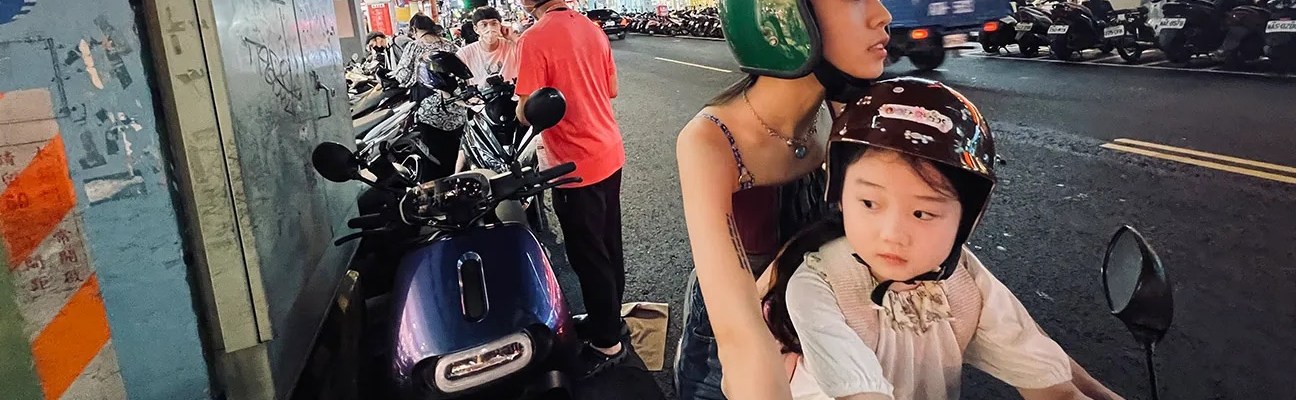
Shu-fen, a single mother, returns to Taipei with her two daughters I-Jing and I-Ann, hoping to start over by running a night-market stall. They squeeze into the grandmother’s flat, a place ruled by politeness and buried secrets, and wait for the return of a brother whose small hustles keep them afloat. When the girls’ estranged father dies, he leaves behind a live meerkat. Its nervous movements and bright eyes become a strange comfort to the younger daughter, I-Jing, a scrap of wildness that refuses to be tamed.
She also treasures her cheap toy kaleidoscope, turning it over and over in her hands. Tsou uses it not as a metaphor but as a mirror of her filmmaking – fragments of colour and movement constantly rearranging into new shapes, a child’s toy that quietly contains the film’s vision of unstable beauty.
If the younger girl gives the film its spark, the elder, I-Ann, carries its troubled heart. Shih-Yuan Ma, in her screen debut, plays her with extraordinary control: guarded, sharp, and perpetually on edge. Once a strong student, I-Ann had to abandon her education and take work at a roadside betel-nut stand, a job that trades in performance as much as service. Her affair with her married boss and the wary distance she keeps from her mother make her the story’s moral hinge, the one who sees the family’s contradictions most clearly but can do the least to change them. Ma’s movements are clipped and exact, her smile a kind of shield. Only around her sister does she allow warmth to slip through. The camera often finds her pushed to the brink of the frame, as if she is already edging out of the world that formed her.
Five-year-old Nina Ye, also making her debut, provides the counterbalance. She is funny, curious, and entirely present, her gaze pulling the story forward. Janel Tsai, as the mother, gives the film a centre of gravity, her warmth constantly tested by fatigue. Together the three create a living portrait of female endurance: the mother’s weariness, the older girl’s bitterness, the younger’s untarnished hope.
Filmed entirely on iPhones, Left-Handed Girl feels immediate and alive, as though the camera had stumbled into the world rather than arranged it. Tsou and cinematographers Ko-Chin Chen and Tzu-Hao Kao keep their lens close to the children’s eye level, letting the market’s noise and movement dictate rhythm. Steam drifts, lights flicker, plastic curtains shift in the wind. Tsou has said she shot without blocking or control, allowing the location’s disorder to shape the image. That choice gives the film its grain and pulse, a mix of beauty and roughness that feels utterly unforced.
Tsou’s understanding of contradiction feels instinctive. Petty thefts, small lies, and improvised kindnesses are shown not as moral failings but as the fabric of daily survival. The humour is quiet, and the empathy comes without insistence. Even when the film touches on memories of abuse, it does so through gestures and atmosphere, leaving room for silence.
All this tension converges at a birthday dinner that collapses under its own pretence. The grandmother, once a people-smuggling mule and now obsessed with respectability, tries to preserve order as the evening dissolves into karaoke, alcohol, and long-suppressed truth. It begins as farce and ends in something close to tragedy, a sequence that shows Tsou’s grasp of how people betray themselves when they finally speak.
The film shares ground with Hirokazu Kore-eda’s Shoplifters. Both filmmakers understand how love bends under the weight of poverty and how it endures all the same. Tsou brings that same moral clarity to Taipei’s edges, finding grace in the struggle to hold a family together.
Long-time collaborator Sean Baker worked with Tsou as co-writer, editor, and producer. Their creative relationship, which began with co-directing Take Out, and led to Tsou producing Tangerine, The Florida Project and Red Rocket, has always been reciprocal. Baker’s later films carry traces of Tsou’s humanistic realism, and here she folds his precision into her own tenderness. While this is undoubtedly Tsou’s movie, the exchange feels symbiotic.
The result is a film that moves with the rhythm of real life: rough, luminous, and deeply humane. Tsou turns Taipei’s night lights into a moral kaleidoscope where family, hypocrisy, and endurance are seen through the clear eyes of one child and in the hard-won self-possession of her sister.
The Left-Handed Girl plays at the London Film Festival, before a limited theatrical release from 14 November 2025, then streaming on Netflix worldwide from 28 November 2025.
 Whitlock&Pope