


★★★★
Elegiac, angry, and loving: Akinola Davies Jr. transforms a single day in 1993 Lagos into a living portrait of memory and masculinity.
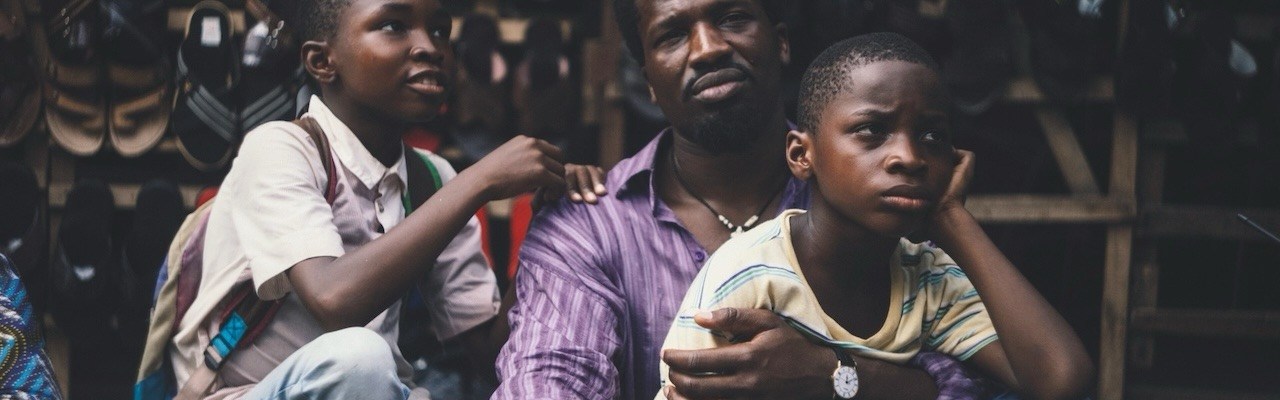
In My Father’s Shadow, Akinola Davies Jr. returns to the city of his youth to trace a father’s presence amid chaos and change. The story follows two young brothers (real-life siblings Godwin Egbo and Chibuike Marvellous Egbo) spending a day with their dad, Folarin (Ṣọpẹ́ Dìrísù), a shift worker navigating the tense streets of Lagos during the 1993 election – the first after a long period of military dictatorship. The political upheaval looms, but the film’s pulse lies in what happens between people: the small exchanges that reveal love, pride, and fatigue. Davies draws on the memory of his own father to explore how family connections endure, shaping a work that feels deeply personal and quietly universal.
Ṣọpẹ́ Dìrísù just has to be one of the best in the game right now. His other role this year, a minor part in the lacklustre The Gorge, gave him little to do. Here he is given full reign, and the result is magnetic. He plays a man who measures love in stern steadiness rather than grand gestures of affection, and Dìrísù makes restraint look effortless. Each gesture, the way he corrects, comforts, or simply keeps moving, becomes an act of insistence on his right to a place in this world, and a place for his family.
Davies builds the film as a road story through a city alive with contradiction. The camera by Jermaine Edwards moves with lyrical precision, framing the painted shopfronts and crumbling brick of Lagos, and the people who live there – whether the election results are accepted or not. The score by Duval Timothy and CJ Mirra keeps time with the city’s hum, low and rhythmic, and always human. The brothers, perhaps due to their real-life relationship, have an unforced chemistry that grounds every scene. Their presence gives the film its pulse, while Dìrísù as their father gives it gravity.
What distinguishes My Father’s Shadow from the familiar mould of historical drama is its refusal of distance. Davies does not reconstruct 1993 merely as a lesson in politics, but as an atmosphere: heat, noise, rumour, and tension. The election unrest haunts the film, visible in the anxious glances in a café, or in a sudden argument on a rickety bus. The personal and political are not competing forces. They coexist, each feeding the other. But as people greet Folarin as ‘Kapo!’ (leader), dread starts to creep in. What is the deal with this man, and what does it have to do with the rumours of a recent military slaughter of democratic protesters? It feels like the other shoe is about to drop, but how? And on whom?
Without spoilers, walking out of this screening I rushed to the Wikipedia page for Nigeria’s 1993 elections, before I even reached the street.
This film has patience and tenderness, and beneath that it has anger. It treats fatherhood not simply as a source of heroism or unearned authority, but as a daily practice of endurance. The pacing, insistent but steady, mirrors that endurance, slowly bringing tensions to the boil, and by the closing sequence Davies has built to a powerful, haunting catharsis without resorting to rote sentimentality. This film is the real deal, and its elegiac, angry, loving energy burns through every frame, transforming what starts as a family day out into something quietly monumental.
Dìrísù’s performance alone would make it essential viewing, while Davies’ direction lifts the film into poetry, confirming the arrival of a filmmaker with command, empathy, and vision. He is a major new voice in African cinema. Watch this film!
My Father’s Shadow plays at the London Film Festival this month.
 Whitlock&Pope
Pingback: Sight & Sound’s 2025 Top 50: What It Tells Us About Critics, Horror, and the Oscars | Whitlock&Pope