


★★★★
Julia Ducournau’s anxious study of broken bodies and family bonds may have a script that’s overstuffed and undercooked, but even when it loses shape it never loses force – thanks to superb performances and visionary direction.
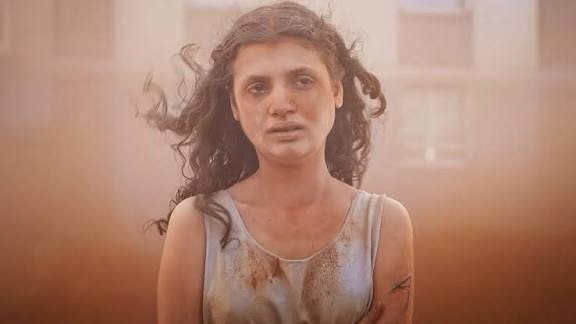
Set in the port city of Le Havre, whose fog once framed Carné’s Port of Shadows, Alpha follows thirteen-year-old Alpha (Mélissa Boros) and her mother (Golshifteh Farahani), a hospital nurse stretched to breaking point. The story unfolds – at least in part – in 1990, as a mysterious, never-named disease spreads through the city. It is a clear allegory for the HIV crisis, imagined here in fantastique form: the victims begin to marbleise, coughing up stone dust, and slowly turn into statues. The image is grotesque but strangely beautiful, recalling the “stone men” from Game of Thrones and turning contagion into a state of suspended transformation caught between punishment and preservation.
Within this atmosphere of dread, 13-year old Alpha’s own story takes shape. When her uncle Amin (Tahar Rahim), a heroin addict in steep decline, moves in, the fragile household begins to unravel. At a house party, Alpha lets a classmate tattoo her with a shared needle. The two possible infections, his blood and hers, mirror each other, binding them in secrecy and shame. As rumours spread at school, Alpha is bullied and isolated, and in her single mother’s long absences she turns to her uncle, looking for care in a place already bearing its own wounds.
Ducournau’s world feels half-dreamed, with forgotten images glimpsed and timeframes slipped. Beneath the infection story runs a deeper theme of regret and anger. Ducournau observes how affection can harden into control and how shame seeps quietly through the generations.
Midway through, Alpha and Amin watch The Adventures of Baron Munchausen (Gilliam, 1988) on VHS, the screen flickering in the darkened room. The moment barely registers, yet it distils everything the film is reaching for. Fantasy becomes a way to survive what cannot be faced, the irrational offering a kind of truth the real world withholds.
This is a visionary film, with Ducournau working with her collaborators to make several big swings. Ruben Impens’ cinematography stays close to skin, light tightening and softening with each change in feeling. Jim Williams’ score hums in the background, folding into the noises of the flat and the sea. Editor Jean-Christophe Bouzy gives the film its pulse, scenes drifting together with an irregular rhythm that feels like breathing. Ducournau builds emotion through image and sound, confident that meaning will surface on its own.
Traces of Ducournau’s 2011 short The Red Wind drift through the film, though the connection feels emotional more than structural. That earlier portrait of maternal closeness curdling into threat echoes here as background texture, a reminder of her long-standing fascination with the line between care and damage. Yet the theme of the Red Wind – an airborne demon force that strikes down those in its path – never fully integrates with the rest of the narrative.
In fact, Ducournau is unable to wrestle her overstuffed script into shape. The ideas squeeze up against each other and fail to entirely coalesce. But even as the writing falters, the direction and performances never do. Every image and every cut feels alive to the body’s tremors and the mind’s evasions. Alpha is uneven yet magnetic, a film that stumbles while reaching for something true and, at its best, achieves devastating clarity and power.
Boros is extraordinary, her quietness edged with fury. Farahani plays a mother driven by exhaustion as much as love, and Rahim gives Amin a brittle warmth, his self-destruction tempered by flashes of real tenderness. Their scenes together carry the film’s bruised heart, torn between care and confusion, and when the annihilating climax arrives the power is undeniable. This is a flawed film, but I see greatness in it.
Alpha plays at the London Film Festival this month.
 Whitlock&Pope