
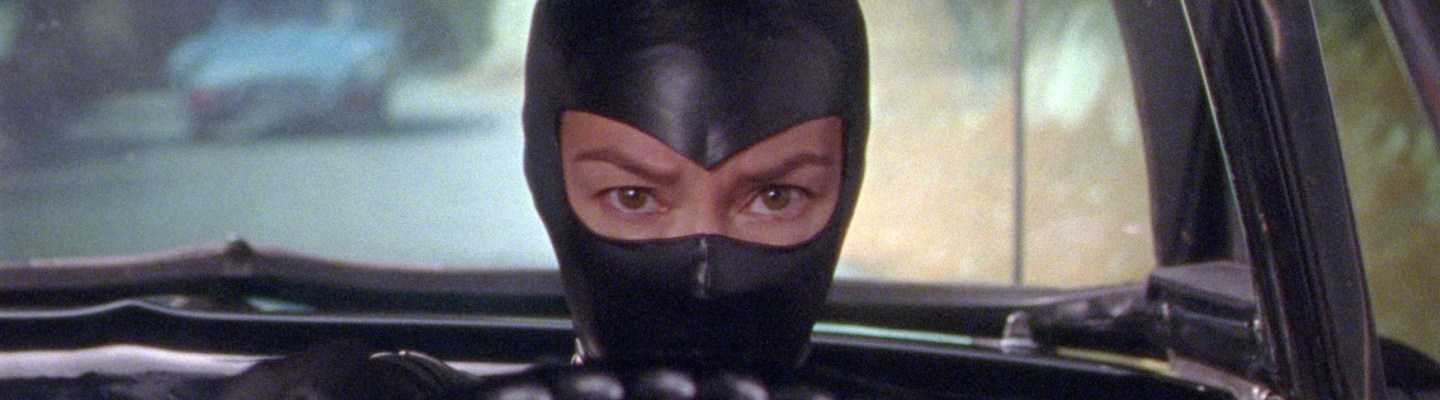


An aging spy drifts through a maze of memory, sex, and style in Hélène Cattet and Bruno Forzani’s Euro-pulp hallucination, a film so immaculate it forgets to breathe.
★★★
Hélène Cattet and Bruno Forzani return with another BDSM-ASMR pop-culture kaleidoscope, a fetish movie that’s a bit more stylish but a bit less interesting than the better examples of its chosen genre. This time their obsession turns to eurotrash spy pulp: tuxedos, mirrors, guns, and sighs, all gleaming to the point of self-erasure.
The pair have spent fifteen years turning pulp into atmosphere. Amer split giallo into three erotic states of fear. The Strange Colour of Your Body’s Tears turned an apartment block into a maze of sex and violence. Let the Corpses Tan restaged a heist as collage. Reflection in a Dead Diamond shifts to the 1960s spy world, closer to Danger: Diabolik than Bond, and finds a genre already made of mirrors. What could have been a reinvention plays instead like an echo.
John D. is a retired spy, or maybe an actor who once played one. The name itself is a clue, half Dick, half Diabolik, hinting that even he is a pastiche. He lives in a Côte D’Azur hotel that sometimes looks more like a movie set than a home. Across the corridor is a woman who might be Serpentik, the enemy he could never escape, or a co-star who replaced him in his final film, Mission: Serpentik. She vanishes, or maybe she never existed. From there the film breaks apart. John might be drugged, hypnotised, dying, or caught in a rerun of his own mythology. Near the end his mobile phone plays the first few notes of Monty Norman’s Bond theme, a quiet reminder that he’s still inside someone else’s story.
Cattet and Forzani call the film “structured like a diamond,” each facet reflecting another. Every shot feels placed by hand, every reflection measured. Cinematographer Manu Dacosse lights the film like machinery, every reflection tuned until the image feels weightless. He has spoken about the difficulty of shooting highly mirrored interiors without catching the crew, and that discipline defines the film. Nothing here is accidental.

The best scenes are the fights. One takes place in a casino where a woman in a chain-disc dress, a shimmer of linked silver circles, spins and fires pieces of her outfit like shrapnel into a band of ninja assassins. Another unravels in a bar where a foosball table becomes the centre of a brawl, the clicking of the rods turning into percussion. The most striking comes later, a ninja fight staged in an annihilating void where all reality has vanished into blackness. At points in those fights the film feels alive.
Cattet and Forzani still work like engineers of sensation. They build the film from cuts, noises and gestures rather than scenes; the look is intended to carry the action more than the plot does. Meanwhile Laurie Colson’s sets turn Op Art patterns into labyrinths. Euro-spy furniture, gunmetal accents and bursts of blood are treated as texture. The editing keeps it all in motion, so even when the story is chasing its own tail the film has a superficial dynamism. It’s the same principle that made Amer feel exploratory and Corpses feral, but repetition has dulled its edge. The editing hits on cue, the rhythm is precise, and the jolt arrives exactly when expected. What once felt dangerous now feels practiced.
The spy setting might have opened the door to irony or politics. It largely stays on the surface. Yet Fabio Testi’s casting adds a charge that the script itself doesn’t pursue. He was once a mainstay of the Italian genre cycle; half action hero, half erotic cipher. His face now carries the weight of that history. In Revolver, What Have You Done To Solange and countless others, he embodied the sleek masculinity this film keeps chasing. Here, those same features have stiffened with age. His presence alone makes the frame tremble with nostalgia, even when the story holds him at a distance. The film treats him as another surface, but he supplies the only trace of something human beneath the design.
There are still pleasures. Dacosse’s camera glides through rooms that seem to fold in on themselves. The sound design hums until it becomes a physical vibration. The closing collapse of mirrors into darkness lands with quiet self-awareness.
Yet the film never escapes its own restraint. Cattet and Forzani have always been more mannerist than the pulp they admire. Once, their obsession with film’s mechanics made the familiar strange. Now it makes the strange routine. What should shock has become almost schematic, a high-end ASMR chasing its own tail.
For all its control, Reflection in a Dead Diamond feels like a self-portrait in glass: beautiful, deliberate and airless. The fetish elements will land for anyone who can’t get enough of creaking leather, pierced nipples, musclebound ladies or facial scratches. Nonetheless, this is a diamond polished to death – dazzling but cold.
Reflection in a Dead Diamond plays at the London Film Festival this month.
 Whitlock&Pope