


Trier’s most personal film yet dissects the line between art and intimacy, tracing how families tell stories about themselves, and creation becomes another form of control.
★★★★
This is a movie in which Stellan Skarsgård pushes a DVD of Gasper Noe’s Irreversible into a seven-year-old’s hands and says “This one has Monica Bellucci,” followed up by Michael Haneke’s The Piano Teacher with the comment “this one will teach you about maternal bonds and instincts.” In other words it’s a love-letter to cinephilia.
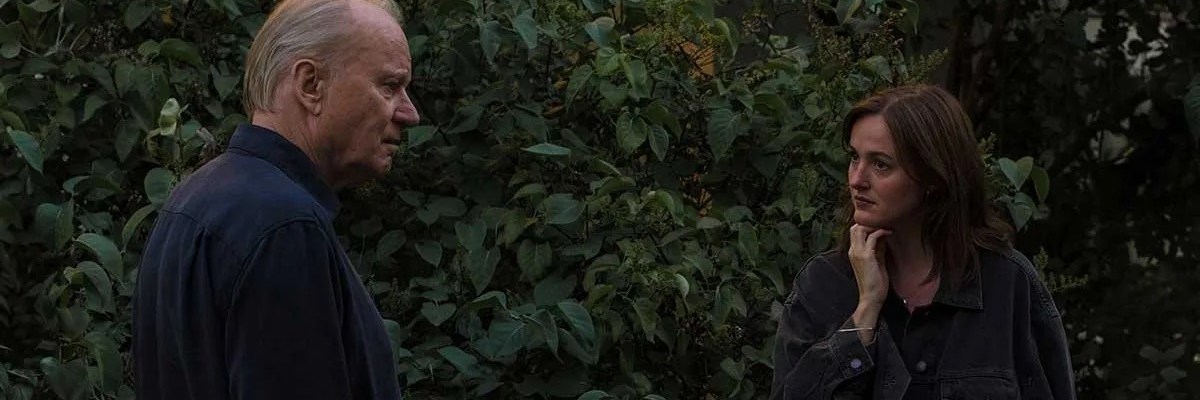
Before that, Joachim Trier’s most intimate film yet begins with a fragile reunion. Renate Reinsve plays Nora, an actor approached by her estranged father, Gustav (Skarsgård), a once-renowned filmmaker now planning his comeback with a film about their family. Nora’s sister, Agnes (Inga Ibsdotter Lilleaas), tries to keep the peace as an American star, Rachel Kemp (Elle Fanning), is brought in to play a version of Nora when she hesitates to take part. What follows is a study of how creation and control bleed into one another inside a family that never learned to speak plainly.
Trier and long-time collaborator Eskil Vogt write with their usual precision, turning everyday exchanges into small negotiations of power. The early passages are superbly judged, balancing the discomfort of domestic life with warmth that feels earned rather than imposed. Olivier Bugge Coutté’s editing allows memory to dictate the rhythm, letting one moment glide into the next. This is a tender reckoning with art and family, built from glances, silences, and the quiet panic of being seen too clearly.
The film loosens slightly in the middle, circling its questions of authorship and guilt rather than advancing them. Trier punctures the introspection with a scene that crystallises Gustav’s mix of arrogance and misplaced affection. At Agnes’s son’s birthday party, he proudly hands the boy those DVDs, while the family priest they do not even own a DVD player. It is a perfect bit of black comedy: cinema as provocation, or perhaps simply a portrait of a man who does not know how to care.
Reinsve gives a performance of immense tact, her restraint always readable, her silences charged with thought. Skarsgård carries the weary authority of a man acting his own myth. Together, Reinsve and Skarsgård are mesmerising: two people bound by history and divided by interpretation, each trying to reclaim the story before the other can.
Elle Fanning approaches Rachel with a kind of openness that disarms the film’s more guarded characters. Playing the American actor brought into Gustav’s project, she’s seen alone, earphones in, repeating Norwegian phrases to try and blend in with the native cast. The moment is simple, almost throwaway, yet Trier lingers just long enough for it to feel revealing. Her vulnerability reads as sincerity, the effort itself more telling than the accent. The contrast with Reinsve’s Nora – all inward tension and control – gives the film one of its gentlest emotional contrasts. Fanning’s openness underlines what everyone else is trying to hide.
Rachel’s participation allows Gustav to receive Netflix funding for the film, leading to a moment where he is told mid-interview that the film might therefore not receive a theatrical release. The laughs of horror in my audience confirmed that this is a film for true movie lovers.
Trier brings the film home by returning its title to its legal meaning: value measured not in money, but in the damage that remains. Even with its softened middle, Sentimental Value stands as one of Trier’s most searching works: a portrait of inheritance, confession, and the price of turning love into art.
Sentimental Value played at the London Film Festival ahead of a limited US theatrical release on 7 November and a UK cinema release on 26 December, to be followed by streaming on MUBI; Netflix be damned.
 Whitlock&Pope