


Richard Linklater turns a single night at Sardi’s into a quietly funny, acidic portrait of performance and denial in 1940’s New York, with superb performances from Ethan Hawke and Andrew Scott.
★★★★
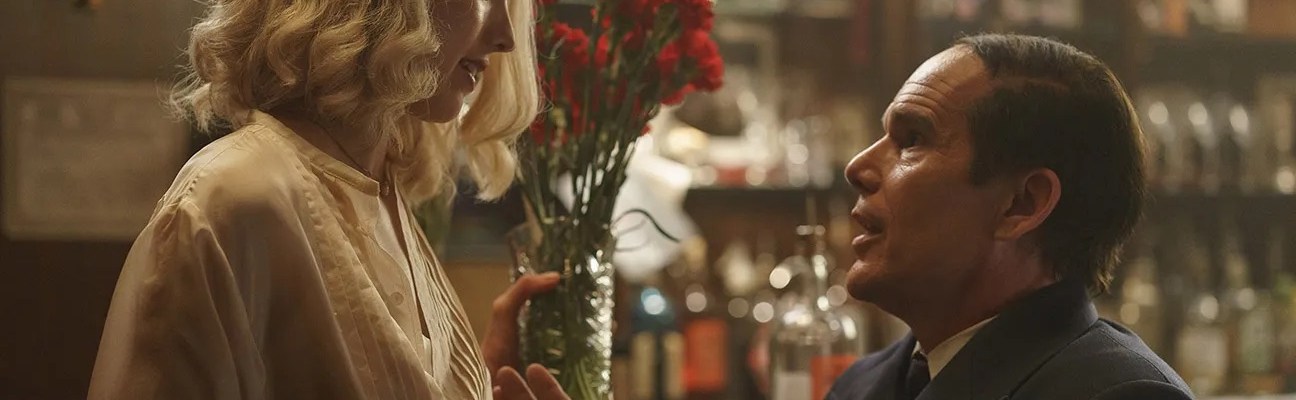
Blue Moon unfolds over one evening in 1943, on the night Rogers and Hammerstein’s Oklahoma! opened and Broadway changed overnight. In a corner of Sardi’s bar, Lorenz Hart (Ethan Hawke) drinks, jokes and deflects, waiting for an audience that no longer exists. Once the lyricist half of Rodgers and Hart, he’s now the leftover half of a legend. Once inside that bar the film never leaves it, its movement coming from talk alone, as friends and colleagues drifting in to celebrate the triumph of Richard Rogers new smash (lyrics by new partner Oscar Hammerstein II), while Hart keeps performing his own decline.
Hawke gives one of his finest performances. Jokes dry in his throat, the awkward charm giving way to fear. It’s the portrait of a man who can’t stop acting even after the curtain has fallen. Opposite him, Andrew Scott’s Rodgers keeps everything tightly controlled, his calm precision and measured sympathy a rebuke to Hart’s unravelling. Hawke and Scott bring down the curtain on this relationship with deflective tenderness and hard truths in equal measure. Their exchanges land with quiet devastation, as if this may be the last time they’ll look each other in the eye.
Linklater directs with deliberate simplicity, treating conversation as music and tempo as structure. He conducts conversation like a maestro, finding rhythm in repetition and harmony in hesitation. The camera moves through the recreated Sardi’s with soft precision, while the editing lets silences breathe before cutting away. The film’s staginess is more virtue than limitation, with Linklater using the bar as a kind of proscenium where Hart’s performance of self becomes a study of denial.
In fact, Hawke’s Hart is driven by self-hatred that bends back on itself. The film captures the twist of internalised homophobia and antisemitism that he can’t stop feeding. As he gets increasingly soused he mutters a cutting pun about Oklahoma!, “Okla-homo,” spat half as joke, half as confession, before teasing the piano player about his anglicised surname, “Nobody would ever know you’re Jewish.” Later, he slips into a bluntly stereotyped accent while mimicking another Jewish acquaintance. It’s more awkward than malicious, but revealing of how deeply he’s absorbed other people’s prejudice. Linklater never turns Hart’s Jewishness or queerness into a headline or a tragedy; each exists in the spaces between lines, in what he can’t bring himself to fully own. His pursuit of women reads as a refuge from the men who truly hold his attention. Margaret Qualley, luminous yet distant, plays the woman he can idealise but not truly see. Her bigger scenes arrive later and, for me, felt a little thinner, as though Linklater were chasing an emotional peak the film was already reaching elsewhere.
Hawke’s physical control is extraordinary. He compresses his posture, folds inward, and speaks half an octave higher, the voice pitched somewhere between bravado and fatigue. I found the forced-perspective shots and clearly oversized bar furniture to be charmingly artificial, although the unnecessary use of digital compositing for a few seconds here and there tipped the film too far into Lord Of The Rings territory. Nevertheless, the intent is clear – to make a man’s reduced stature more than just literal.
Bobby Cannavale’s Eddie, the bartender, listens without judgement, grounding the film in something human and unforced. Cannavale’s face (you could write a novel with that title) does the talking, wry, watchful, every pause a shop-worn grace note. His easy timing with Hawke brings a touch of comedy to the melancholy.
At the edge of the frame lingers Patrick Kennedy’s E. B. White, scribbling in a notebook like a man preparing an obituary. He gives the film its quietest tension, the sense that someone else is already writing the final word. His scribbling pencil is as the whisper of the damned; a reminder that legacy belongs to whoever tells the story last.
Those digital effects aide, the one big false note for me was the closing text, a “what happened next” that we don’t need to see spelt out. The opening scene has spelt out what’s coming down the track for the alcoholic Hart, and the story has already ended in the quiet between two men who once spoke in song. Blue Moon doesn’t need additional closure, it ends exactly where it means to, finished but unfinished, with fear that talent isn’t enough, and that the world keeps moving long after the spotlight fades. Even with its imperfections, this is great work – humane, finely judged, and deeply felt.
Blue Moon played at the London Film Festival.
 Whitlock&Pope