
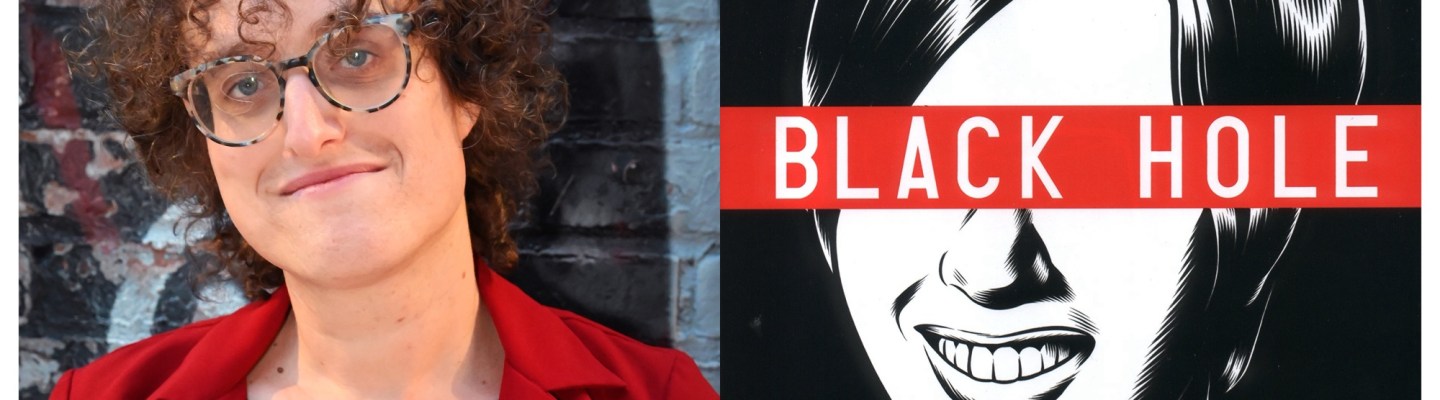


Netflix has ordered Jane Schoenbrun’s adaptation of Charles Burns’s Black Hole, in what promises to be a perfect collision of adolescent body horror and screen-age dysphoria.
Per trades, Netflix has commissioned a series based on Charles Burns’s cult graphic novel Black Hole, with Jane Schoenbrun writing and directing. Set in the Seattle suburbs of the 1970s, the story follows teenagers infected by a sexually transmitted “bug” that leaves each with a unique mutation. The project joins one of the most influential works in independent comics with a filmmaker whose sensibility is already attuned to bodily unease and identity in flux.
Schoenbrun’s films explore how people become trapped inside the images that define them. We’re All Going to the World’s Fair used the internet as both mirror, conduit for discovery and potential crime scene. I Saw the TV Glow turned cult television into a shared hallucination of gender and longing. Across their work, the screen is never neutral: it shapes the self, flattening or expanding it by turns. Burns’s graphic novel works from a similar logic. In Black Hole, adolescence itself is an infection, a passage that warps body and mind until neither feels recognisable.
Originally serialized from 1995 to 2005 and later collected by Pantheon, Burns’s plot-line develops like a slow fever. The infected teenagers drift through cul-de-sacs and forest clearings that seem to hum with contagion. Each metamorphosis (a tail, a new mouth, skin that peels away) stands in for isolation, desire, and shame. The Pacific Northwest setting amplifies the melancholy, its mist and firs enclosing a generation that has already slipped out of view.
Schoenbrun’s involvement promises a version that values mood and subjectivity over spectacle. Their interest has never been in neat allegory or transformation as gimmick, but in the small terrors of recognition: the instant when someone sees you or you see yourself – and perhaps wish you hadn’t. Black Hole gives that moment physical form. A Netflix series allows room for the story’s diffusion, for its shifting narrators and dreamlike tempo to play out without compression.
The novel’s history with Hollywood is long and unlucky. Attempts by directors like David Fincher and Neil Gaiman stalled for decades, perhaps undone by the material’s tone and structure. Television may finally offer the right frame: a space where mutation can feel lived-in.
Schoenbrun’s earlier work points toward how they might approach it. Before World’s Fair and TV Glow, they assembled A Self-Induced Hallucination, a found-footage study of Slenderman and the thin line between belief and invention. Each project examines how identity mutates through exposure: to stories, to the internet, and under other people’s gaze. Similarly, in Black Hole the infection spreads by contact, by curiosity, and by the need to be touched.
No casting or release details have been announced. For now, the pairing alone carries a rare symmetry: Burns’s mutations and Schoenbrun’s ghosts speak the same language of loneliness. If Netflix gives this project the space it needs, Black Hole could emerge as a defining work of twenty-first-century teen alienation.
More as we get it…
 Whitlock&Pope