


In Sophy Romvari’s transcendent Blue Heron, filmmaking becomes a way of facing what memory alone cannot contain.
★★★★
Blue Heron continues the line of thought that runs through Sophy Romvari’s work, from Nine Behind and Pumpkin Movie to Still Processing: how cinema can process private experience without mistaking that process for healing. Those earliest films were small and immediate. This one widens the frame but keeps the same question at its centre, asking what happens when the act of looking becomes a way to live with what has already happened. With Blue Heron Romvari delivers a quietly devastating study of loss and its afterlife.
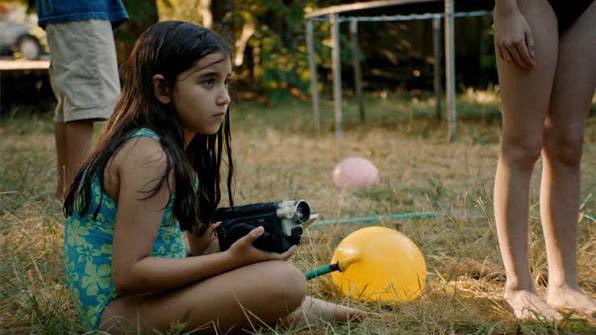
The story follows a Hungarian-Canadian family newly arrived on Vancouver Island in the late 1990s, and seen mostly through their youngest daughter, Sasha. Her older half-brother Jeremy begins to slip away, emotionally and behaviourally, and his potential future absence starts to shape the house around him. Years later, an adult Sasha, now a filmmaker, tries to understand that loss. She records interviews, restages fragments of memory, and studies old footage as if testing its truth. The film unfolds less as a conventional narrative than as a pattern of remembering.
Romvari calls the project “emotional time travel” The second half of the film does not jump forward so much as wander, distracted, into the present. The past and the present share the same tone and light, as if no time had passed at all. The effect recalls Celine Sciama’s Petite Maman, which also treats memory as a space one can enter, to probe unresolved family trauma. Romvari reaches the same idea through quasi-realism rather than fantasy. The ‘past’ occupies an unstable space – the performers on screen could be the family, or just the actors portraying them in a film-within-the film. When Sasha comes face to face with her younger self, is it self-recognition, or a filmmaker admiring her young actor? Is it imagination, or the fantastique? Or filmmaking?
Although Blue Heron looks natural, it is carefully built. Romvari has said she wanted viewers to notice the construction from the start, and so scene feels deliberate, yet the design never overwhelms the people inside it. The realism of what we see holds steady, but the structure keeps questioning what can be trusted in memory.
The result is precise and haunting. The emotion gathers in pauses and understatements, in doors left half open, in rooms where people struggle to express themselves. When adult Sasha visits those spaces again, the silence carries a new weight, and those rooms seem to hold what she cannot say.
Romvari has said that making the film was “less about healing and more about accepting,” and that honesty defines its tone. Blue Heron does not promise recovery. It allows pain to exist and gives it form. The control is careful, but not cold, and respectful of how people live with what they cannot fix.
Eylul Güven plays the young Sasha as a child with open curiosity, and a secret but incomplete level of awareness, while Amy Zimmer, as the adult Sasha, turns that curiosity into quiet obsession. Zimmer’s calm is steady until it breaks – the smallest slip in her voice can shift the mood of an entire scene.
Cinematographer Maya Bankovic works in a tight 4:3 ratio, which pens the family close together. Editor Kurt Walker lets shots run long enough for a change of feeling to register. The pacing is deceptive – seemingly slow, but every pause earns its place and the film leaps forward, chronologically and stylistically, in ways that catch you off-balance.
Romvari has said the film draws on her family history but is not a memoir, and she invents as much as she recalls. What matters is how the invention feels true, and how fiction can hold what fact alone cannot. And so the film ends with partial revelations but no grand resolution. It returns to the impressionistic landscapes from near the beginning, closing the circle between looking and remembering. What remains is not an answer but an incomplete sense of acceptance. Romvari finishes where she started, only now the shape of what she has made explains itself. The wound is cleaned and dressed but not healed.
Blue Heron is one of the great debut features of the year.
Blue Heron played at the London Film Festival
 Whitlock&Pope