


Chris Stuckmann’s hybrid horror pulls itself apart faster than it can scare.
★★
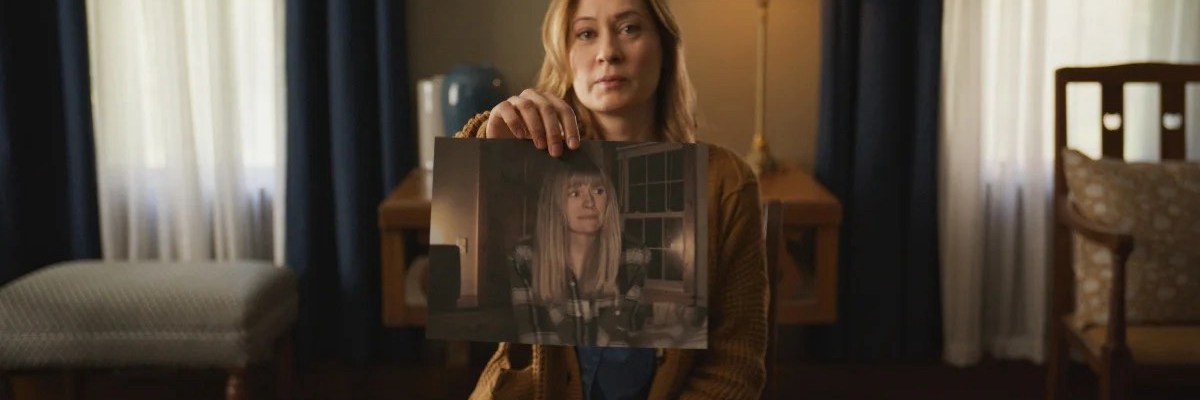
When her sister and the rest of the Paranormal Paranoids ghost-hunting crew vanish without trace, podcaster Mia (Camille Sullivan) tries to piece together what really happened. Her investigation drags her through old tapes, online archives, and the faded folklore of Ohio demonology, until after 12 years she gets a breakthrough – and begins to suspect she’s being drawn into the same darkness that consumed them.
The thing that makes Shelby Oaks interesting is also what sinks it: its restless hybrid form. Found footage, mock-doc, and conventional narrative jostle for control, each disrupting the other until the film comes apart. There’s so much formal clashing that dread never has time to settle into the bones.
What’s more, distributor NEON picked up Shelby Oaks after an initial festival run, and by all reports spent significant money on reworking it. As a result, it’s impossible not to play spot the reshoot. One moment we’re in camcorder crackle, the next we’re gliding toward a huge gothic CGI prison wreathed in digital rot, as if Mia had taken a wrong turn and driven to Crimson Peak by mistake. The clash between these registers is disorienting – not “good,” but at least the jarring juxtaposition was pleasingly disorientating.
The film was she’s trying to harness multiple styles and the reshoots did not fully unify them; instead they layered additional spectacle on top of a hybrid form that already had tension between its registers. What began as a scrappy, lo-fi idea has been pulled toward prestige horror sheen, leaving multiple aesthetics to grind awkwardly against each other.
Performances vary from solid to painful, sometimes from the same actor. The finale depends on hospital and social-services decisions so implausible they border on parody, a classic idiot-plot contrivance that dissolves what little credibility remains and had me muttering “Shelby Nopes”
You sense there’s a stronger, simpler film buried inside this sprawl – something that might have worked had it stayed fully in found-footage mode instead of trying to bridge multiple horror registers at once. Still, one scene lands perfectly: the protagonist’s visit to an elderly woman (Robin Bartlett) in her mould-blackened cabin. It’s quiet, tense, human – a glimpse of the eerie intimacy the rest of Shelby Oaks keeps chasing and never finds.
Shelby Oaks is now in cinemas in the UK, Ireland and US.
 Whitlock&Pope