


A muscular, high-gloss survival thriller that moves fast and looks good, even as it softens the anger that made King’s story bite.
★★★
Edgar Wright’s The Running Man offers serviceable entertainment: a chase movie disguised as social satire, big enough to fill IMAX screens and smart enough to hint at deeper things but not to interrogate them. It’s his most conventional project: a studio-scale adaptation that swaps his usual genre playfulness for something closer to controlled efficiency. The result is solid, occasionally thrilling, and strangely impersonal; a functional bit of Hollywood product that makes you hope Wright gets his mojo back soon.
Set in a near-future America that looks a bit like 80s/90s London with bigger skyscrapers, where the proles are addicted to televised violence and sub-Kardashian slap-fights, it imagines the poor literally hunted for gameshow prizes and corporate profit. It’s a straight(ish) adaptation of one of Stephen King’s early “Richard Bachman” novellas, and while the premise still has bite the film’s rhythm favours exciting spectacle over true despair. The Long Walk, the other Bachman adaptation out this year, internalised King’s cruelty with a slow burn of exhaustion and fatalism. Wright takes another route: instead of dread, velocity. One film measures human endurance; the other rides momentum. Wright has made a chase film that never had anything particularly insightful to say about what the chase means – just that it has a stultifying effect on the masses, who would be much better off “waking up,” Rage Against The Machine style with a Molotov or two.
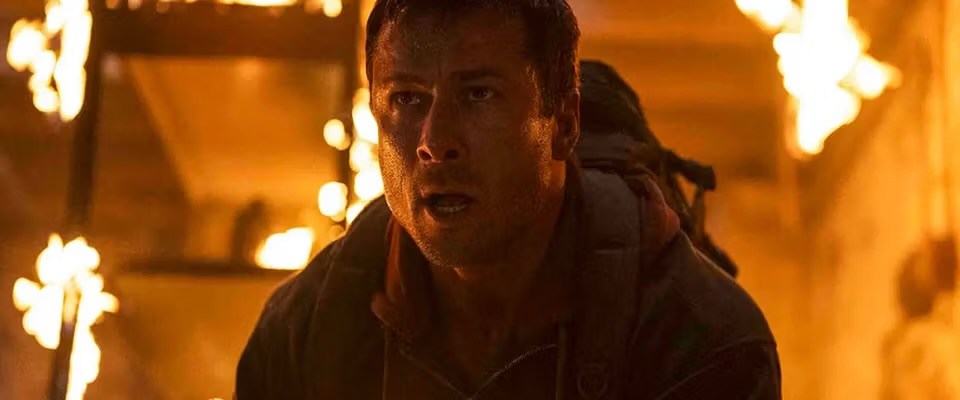
Glen Powell’s Ben Richards has an oddly unconvincing desperation: Powell’s earlier Hit Man remains the better showcase for his talents. Josh Brolin, as the game’s manipulative showrunner, coasts through his scenes. But the film lights up when the supporting players collide: fellow contestant Katy O’Brian, show host Colman Domingo, and radical militant Michael Cera. Cera is hunkered in a booby-trapped house that turns into a twisted “home-alone” interlude, delivering the film’s most energetic twenty minutes.
Wright delivers nothing that feels like his usual propulsive camera moves or playful choreography. The direction feels constrained and schematic. The ending, heavily reworked by the look of it, has an empty, focus-grouped feel that lands without much zing, but there’s enough craft and momentum before that to keep things engaging.
The Running Man doesn’t have The Long Walk’s quiet devastation, but it’s a robust, watchable piece of sci-fi pulp. It entertains more than it provokes: a survival spectacle that, like Glen Powell, runs long, looks good, and keeps moving.
The Running Man is in cinemas now.
 Whitlock&Pope