


Charlie Polinger’s stunning debut examines how a tween community produces outsiders, then builds its own remorseless logic around their exclusion.
★★★★
Has anybody checked on our boys? Set in an early-2000s American water-polo camp, The Plague is horror-drama that picks at social and biological contagion, watching as its tween cast turn on each other like lymphocytes expelling toxic substances.
Writer-Director Charlie Polinger quickly establishes the camp as a place where belonging is provisional. The routines are strict, the spaces are confined, and the boys imitate one another closely, as if membership depends on staying in step. Polinger films the pool, the bunks and the walkways with a steady, unforced rhythm that allows us to observe this small society, shaped less by formal rules than by the children’s own sense of who counts and who does not. The adults occupy the edges of the frame, and their authority feels secondary to the systems that form among the boys.
Gangly newcomer Ben arrives at the camp with no secure place. Everett Blunck plays him with a reserved attentiveness that suggests he is mapping the hierarchy in real time, frantically working out how to safely fit in – especially when he sees how everyone scrambles not to sit with the outsider, Eli (Kenny Rasmussen). Eli, the boys tell him, has “the plague.”
But what is this plague? Eli certainly has a rash, and cream for it. Could it be ringworm? Rosacea? He’s clumsy, as teenage boys can be, a little doughy perhaps, and in his speech patterns and unexpected interests could be read as autistic. The boys cut to the point: Eli used to be normal, picked up “the plague” from hanging around with another boy who has since been committed to a mental health facility, and is now suffering the degenerative consequences – which will include progressive “loss of motor skills” and eventually insanity.
The function of this designation is immediate. It identifies Eli as outside the circle and it clarifies, for everyone else, what behaviour will protect their standing. The vibe-shift when an accusation of the plague is levelled is immediate: a shift in tone, a distance kept, a shared glance that confirms the new order. Polinger’s restraint allows these divisions to form without emphasis. The group descends into cruelty based on a total redistribution of social space. Eli’s isolation develops through small acts: who sits where, who speaks and who stays silent. Rasmussen plays him with a withdrawn presence that fits the film’s observational stance. His exclusion is neither dramatic nor symbolic. It simply accumulates, and the group adjusts around the absence.
When suspicion falls on Ben himself, he must find a way to counteract it. But as events develop, and elements of body horror creep in, he starts to worry that the plague could be surprisingly real.
The camp’s coach, “Daddy Wags”, (played by Joel Edgerton who also produces) provides a counterpoint. He expects discipline and tries to maintain order, yet his understanding of the group’s inner life is limited. His authority operates through encouragement and routine, while the boys’ authority operates through social alignment. Daddy Wags’s confidence creates a small, persistent disconnect between the adult version of the camp and the rules the boys enforce among themselves, giving the film several dry, understated moments, but it mainly serves to underline how little adult oversight shapes the real divisions in the group. Most of what matters happens in the spaces the adults, literally or figuratively, simply do not see.
This is the most European American horror film of recent years, and not just because it was shot in Romania. The Plague brings to mind Michael Haneke’s cool observations of sadism, and Lucile Hadzihalilovic’s fairytale absurdism; Julia Ducournau’s influence sits in the way the camera weaves body horror elements into the drama, and registers small bodily changes with forensic clarity.
Polinger also evokes the blank pubertal nihilism and destructive social dynamics of Larry Clark’s Bully, the contagious hysteria of The Fits or Falling, and the institutionalised hazing of Full Metal Jacket. There are echoes of Charles Burns’s graphic novel Black Hole, as the director reminds us how adolescence can turn a blemish into a stigma into an identity. These comparisons matter because they support the film’s core concern: the ease with which communities create in-groups and out-groups.
But The Plague sits in this lineage without leaning on any of these references for identity. It has its own tone: calm, faintly surreal, but quietly vicious. Boys move in clusters, copy each other’s gestures, as they learn the rhythms that let them stay out of trouble. Polinger’s visual language is precise. The glossy reflection of the pool, the chlorine-reddened faces, the cramped bunks, all are presented without over-emphasis, yet the repetition gives the camp the feel of a closed system.
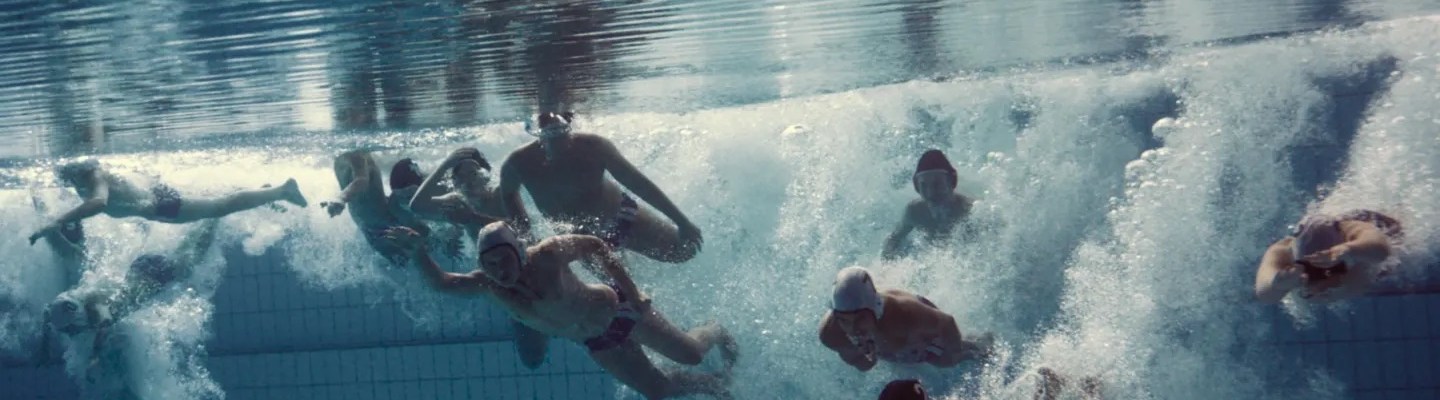
The water-polo sequences are especially gorgeously photographed, with slow motion and soft dissolves. Underwater shots show bodies intersecting, separating and contesting space with no dialogue. Polinger shoots these scenes with clarity, allowing the viewer to read movement as another form of negotiation within the group. The sport becomes another site where physical position is everything. And yet the sport provides the potential for relief from the suicidal dynamic, an escape into pure motion and physicality, and submission to a more easily comprehended set of rules – at least until the whistle blows and the showers beckon.
The Plague is clearest when showing how quickly children define insiders and outsiders, and how easily a rumour becomes a line of division. Polinger avoids overloading the symbolism and instead presents behaviour with the calm of someone recording a system rather than explaining it. The horror lies not just in bodily corruption, but in ordinary acts of categorisation, in the speed with which a community defends the sadistic logic it has created, and in the ways that logic becomes the dominant reality – whatever the adults might like to think.
The Plague is on limited release in US cinemas from December 24, and widens on January 2.
 Whitlock&Pope