
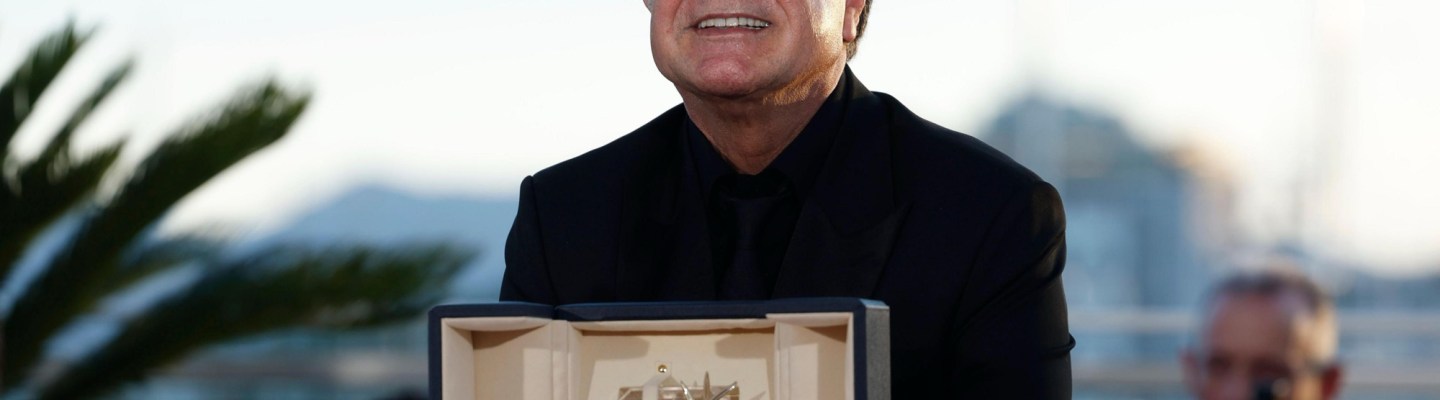


Iran has just sentenced Palme d’Or winning director Jafar Panahi to a year in prison for “propaganda against the regime” at the exact moment his clandestinely shot film It Was Just an Accident mounts a serious Oscar run for France. We unpack what this means for Iranian cinema, his international profile, and the regime’s attempt to silence him.
Human rights outlet HRANA has confirmed that Iranian filmmaker Jafar Panahi has been sentenced in absentia by Branch 26 of the Tehran Revolutionary Court to one year in prison, a two year travel ban, and a ban on membership in political and social groups, on the charge of “propaganda against the regime”. His lawyer Mostafa Nili says they will appeal within the legal deadline.
The verdict lands at a highly charged moment. Panahi’s new feature It Was Just an Accident was shot in secret in Iran, without a permit, and with actresses sometimes appearing without compulsory hijab. The film follows former political prisoners who may have found their past torturer, and it asks whether revenge or a different form of justice is possible.
The film had its world premiere in Competition at Cannes in May 2025 and won the Palme d’Or, making Panahi a “triple crown” director with top prizes from Cannes, Berlin and Venice.
Since then, It Was Just an Accident has been positioned at the centre of international cinephile attention. France has formally selected it as its submission for the 2026 Academy Award for Best International Feature Film. It has also appeared in lists such as IndieWire’s “100 Best Movies of the 2020s (So Far)” – here at Whitlock And Pope we loved it at the London Film Festival. Among Western cinephiles, It Was Just an Accident is broadly considered the big Iranian film of 2025.
Fifteen years of collision with the Islamic Republic
Panahi has previously faced arrest and judicial actions due to his activities. The background is well documented. In December 2010, the Islamic Revolutionary Court sentenced him to six years in prison and imposed a 20 year ban on making films, writing scripts, giving interviews or leaving Iran, after convicting him of charges including “propaganda against the Islamic Republic”.
Despite this, Panahi continued to make films illicitly, and several of those works were banned in Iran while winning awards abroad, shooting projects inside Iran with minimal crews and with the constant risk of raids.
In July 2022, Panahi was arrested again after going to Evin prison to enquire about fellow filmmakers Mohammad Rasoulof and Mostafa Aleahmad, who had been detained during a wider crackdown. His case became part of a larger campaign against artists during the period that led into the “Woman, Life, Freedom” protests.
Panahi was released on bail in early 2023 after a hunger strike and international pressure. His recent interviews confirm that he still feels bound to return to Iran, and that he believes he cannot truly create anywhere else.
A pattern, not an exception: Iran’s treatment of other directors
The new sentence for Panahi fits a pattern in which Iranian authorities have used broad speech and security charges against filmmakers and artists. Article 500 of the Islamic Penal Code, which criminalises “propaganda against the system”, has been repeatedly applied to directors, writers and musicians.
Mohammad Rasoulof is a clear parallel case. In 2024 he was sentenced to eight years in prison, flogging, a fine and confiscation of property in a case that his lawyer and supporters link directly to his films and perceived “propaganda against the system”. He later fled Iran to avoid imprisonment.
Repression of artists intensified after the 2022 killing of Jina Mahsa Amini and the ensuing protests, with travel bans, prison terms and flogging used against musicians, actors and filmmakers. Within that picture, Panahi’s new sentence looks to be one more attempt to assert control over a cultural figure whose work and visibility cut against official narratives.
What happens next, and why it may backfire
The sentence, issued in absentia, includes one year of imprisonment, a two year travel ban and a ban on membership in political and social groups. Panahi’s lawyer has already announced an appeal. But if Panahi returns to Iran before the appeal produces any change, he risks being taken into custody to serve that sentence.
At the same time, the film’s awards trajectory is well documented and continues to build, with trade publications listing the film among the leading contenders.
Panahi’s visa problems have so far been an intermittent obstacle to him appearing in person to publicise the film. Taken together with France’s submission and its Cannes win, this supports the view that the film is entering awards season as a serious candidate rather than a long shot.
In that context, the timing of the new sentence is hard to separate from the Oscar run. Rights groups and commentators have long noted that Iran often uses charges such as “propaganda against the system” to put pressure on visible dissidents, especially when their work gains traction abroad. The new ruling gives the authorities a legal instrument they can activate if he returns, while also sending a warning signal to other filmmakers.
However, coverage of Panahi’s Cannes win already shows how international attention can flip these moves into symbolic defeats for the regime. Fellow director Mohammad Rasoulof called the Palme a “powerful blow to the machinery of repression in the Islamic Republic”, while French officials publicly linked the prize to resistance against Iranian state oppression. Whether one agrees with that phrasing or not, it illustrates how awards success and state punishment are being read together outside Iran.
On the Oscar side, trade coverage and festival reporting already frame It Was Just an Accident as a film whose artistic power is inseparable from the conditions of its making. It was shot clandestinely, completed after a police raid and premiered while Iran continues to pursue the director. The new sentence feeds directly into that narrative, and on the available evidence it is more likely to heighten interest than to dampen it.
None of this guarantees an Oscar nomination or a win. That depends on Academy voters, on the strength of the wider field and on campaigns still unfolding. What can be said without speculation is that the combination of a Palme d’Or, strong critical reception, France’s backing and repeated description as a major contender have already placed It Was Just an Accident at the centre of this year’s international film conversation. This new sentence effectively ensures that any further success for the film will also be read as a comment on Iran’s treatment of its artists.
If the goal in Tehran was to sideline Jafar Panahi at the very moment his film reaches a global audience, the record of how such cases have played out suggests the opposite is more likely. The regime has added another entry to his charge sheet. The world has been given another reason to look directly at his work.
It Was Just An Accident Is Now On General Release, much like the director, whether Iran likes it or not.
 Whitlock&Pope