
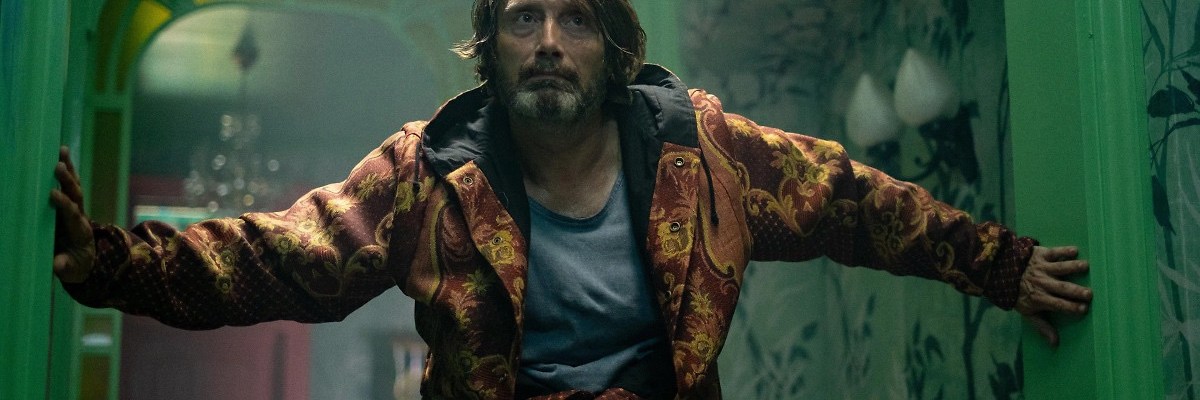


Mads Mikkelsen and Sophie Sloan carry Fuller’s twisted bedtime fable through a Jeunet-tinted storybook city where hitmen walk the alleys of the night and a monster waits under the bed.
★★★★
Bryan Fuller sets his debut feature in a fairytale-beautiful apartment complex, where eight-year-old Aurora (Sophie Sloan, perfect) believes a monster living under her bed has swallowed her parents. She turns to the one adult who seems capable of dealing with creatures that lurk in the dark: her neighbour, a taciturn hitman played by Mads Mikkelsen (reuniting with Fuller from their much-missed Hannibal). What begins as a simple plea for help becomes a pact between two damaged people. As Aurora pulls him into her private mythology, the film blurs the gap between childhood dread and adult violence, folding fairy-tale logic around a crime plot that slowly reveals the truth of what happened in that house. What transpired is like The Fisher King meets Léon: The Professional, filtered through the visual world of Amélie.
The apartment block is a triumph of glorious storybook excess. The influence of Jeunet and Caro is immediate in the saturated palette and skewed geometry, with Fuller pushing toward heightened realism in the immaculate production design. Every corridor looks measured, every surface composed for effect. Cinematographer Nicole Whitaker works with a lush gothic fairy-tale sensibility that gives the film a hypnotic pull, and the extremely wide 3:1 aspect ratio becomes part of that spell. Seen on a big screen, the width stretches the apartment into a landscape and turns Aurora’s bedroom into a stage where dream and dread overlap. In a world where the theatrical experience seems under constant threat, I beg you to see Dust Bunny on the biggest screen you can.
The emotional core is the bond between Aurora and her neighbour, a professional killer who moves through the world with bruised precision. Mikkelsen plays him with stillness and empathy, giving Sloan the room to define the emotional logic of each scene. She brings Aurora a passionate earnestness that keeps the film firmly aligned with her perspective, even as the plot introduces rival assassins and double-crosses. Their scenes together build trust through small recognitions and shared pauses in the mayhem. The film relies on this pairing to hold the film’s shifting registers in place, and it succeeds.
Fuller’s direction is raucous and joyful, proof that a film shot through with darkness and rooted in trauma can still find pleasure in ludicrous, violent release – Dust Bunny is both euphoric and deranged. Its visual imagination takes its cues from not only Jean-Pierre Jeunet but also Tim Burton’s dark fable of pastel domesticity, Edward Scissorhands, while its conceptual line builds from Terry Gilliam’s train of thought, the one that ran not only through The Fisher King but also Time Bandits, The Adventures of Baron Munchausen and Tideland. In those films an imagination does not merely tint the world; it reconfigures it.
Dust Bunny follows those principles with conviction. Aurora’s room is full of bright pastels, almost cloyingly so, yet every detail hints at unease. Floral wallpaper seems to pulse, and parquet floorboards channel tension. The visual noise serves as Aurora’s inner weather, a grammar for a child who cannot fully voice her fears. The film becomes a visual feast of handcrafted imagination that stands apart from the flat digital sheen common to too much contemporary genre work. Every minute feels heightened to match the way a child registers the world, its colours and designs pushing toward the unreal.
The cast commits to this vision without hesitation. The tone hovers just above naturalism, a mode in which absurdity becomes the baseline rather than the exception. Fuller understands how stories of the monster under the bed lodge themselves in the imagination and how easily they follow us into adulthood. He respects the intensity of those fears and allows that emotional clarity to steer the film.
The commitment to this bizarre, almost gonzo logic is what gives Dust Bunny its charge long before the narrative reaches its exuberant final stretch, as tye madness draws in a John-Wick style coterie of stylised assassins, including twitchy David Dastmalchian, suave Shelia Atim, and a very game Sigourney Weaver. As the action ramps up, the screen bursts with pop-mythic energy that feels drawn straight from the 1990s French wave of kinetic comic-book cinema. The credits even announce, with wry confidence, that this is “un film de Bryan Fuller.”
As for the creature, the Dust Bunny itself: Legacy Effects built a large-scale practical model, and the glimpses of real weight and texture are thrilling. These moments reveal how potent the monster becomes when the film trusts the puppetry. Yet this is also where the film’s only substantial flaw appears. It leans more heavily on CG augmentation than it needs to, and the digital layers occasionally soften the physical presence achieved by the practical build. The creature remains expressive, but the contrast between the tactile shots and the CG-rendered ones is noticeable.
The mid-section relaxes its grip for a moment, and the reliance on CGI occasionally blunts the creature’s presence, but the film never loses its footing. It is immaculately designed, beautifully shot and built for the theatrical experience. I do wonder who will watch it. It would be a smash with tweens, but the occasional blast of violence (gunplay; an electric toothbrush tomahawking into someone’s eye) has led to an R rating. Yes, there is the occasional glimpse of the monster feeding, but this is a very bloodless endeavour. In a just world, children will talk their parents into letting them watch this one way or another, but in any case adults should check it out themselves and make the most of that glorious 3:1 aspect ratio on the biggest screen they can find.
Fuller caps it all with a wink, as ABBA’s “Tiger” roars over the credits: “The city is a nightmare, a horrible dream / Some of us will dream it forever / Look around the corner, and try not to scream,” serving as both punchline and prophecy. Call it le cinéma du look out.
Dust Bunny is in US cinemas from December 12.
 Whitlock&Pope