


The United States in 2025 is living through what feels like a third wave of post-WW2 political violence. The first was the era of assassinations, when the murders of Kennedy, King, and Malcolm X punctuated the turbulence of the postwar decades. The second was the long shadow of mass shootings, stretching from Columbine to Uvalde, where schools, malls, and churches became the stages of American horror. The third, now unfolding, is a hybrid: assassinations of political figures, school shootings, stochastic terror, and home invasions aimed at public officials. This is violence less concerned with ideology than with posture, performed through irony and spectacle.
The year’s events capture this shift with brutal clarity. Charlie Kirk was shot in Arizona after enthusiastically framing a question on the danger of gun violence towards the ‘real’ twin threats of “transgender shooters” and “gang violence,” rather than the typical spree shooter profile. In this reading, the people Kirk’s audience really needed to be worried about were LGBTIA+ activists and people of colour. He stood beneath a banner that demanded “Prove Me Wrong.” Seconds later, someone did.
That same day, multiple children were killed in a school shooting in Kentucky. When added to the steady drumbeat of school killings, and political violence such as the hammer attack on Paul Pelosi, and armed intrusions into the homes of other Democrats, the pattern becomes undeniable.
Violence has become a juvenile assertion of power. Perpetrators now sometimes posture that they are above politics, or obscure their motivations behind layers of memes and insincerity, yet their targets are predictable: people of colour, women, and those who would reduce their ability to dominate the first two categories, and thus fail to protect their position in the social hierarchy: liberals, leftists, and even those fellow right wingers who ‘let the side down’ by failing to sufficiently embrace whatever incel revolution they envisage.
Three films released this year capture this climate with eerie precision: Paul Thomas Anderson’s One Battle After Another, Ari Aster’s Eddington, and Zach Cregger’s Weapons. They approach the subject from different directions but share a common stance. Each refuses to dignify violence with ideological clarity, and each employs absurdity to interrogate its crazed logic and strip it of the grandeur or moral seriousness it craves. In each case the violence lands like a bad joke, absurd and idiotic.
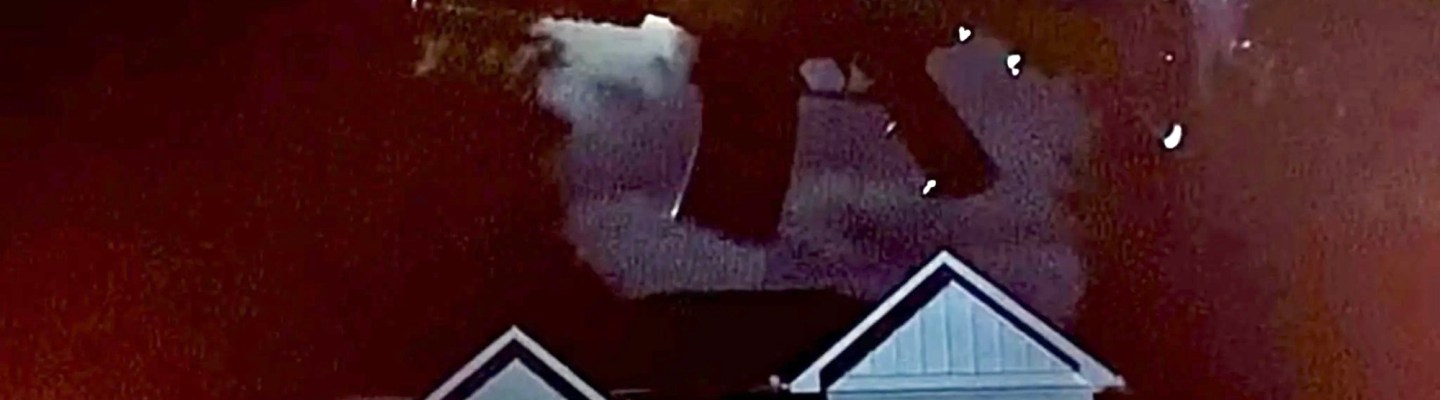
In Weapons, a rifle floats above a suburban house, a digital clock glowing on its body. The image is surreal and faintly ludicrous, yet morbid and ominous. It renders visible what American children already know: that shootings have become scheduled events, disasters hanging over them like bad weather that never ends. Cregger pushes the absurdity further in a town-hall assembly where parents and teachers shout over one another, demanding vengeance, promising to take the law into their own hands. The noise is overwhelming, and the scene deliberately collapses into chaos. Rather than producing catharsis, it reveals how the adult urge to reclaim control reproduces the very narcissism of the shooters. There is no manifesto here, no perpetrator’s psychology offered up to be parsed. The refusal is deliberate. In a culture where killers inscribe tongue-in-cheek slogans on bullets and lace their online posts with memes, motive is itself performance, and incoherence is baked in. Children have taken from their families and turned into instruments of violence, not just psychologically and socially but literally, physically – in this case through witchcraft, by a witch, rather than through TikTok by Andrew Tate. Cregger keeps his focus on the people forced to live in the shadow of unintelligible loss.
Aster chooses a different vantage. Eddington follows a small-town sheriff in 2020 whose resentment becomes the film’s motor. He refuses mask mandates, flirts with button-pushing slogans, and turns his badge and hat into campaign prop. The film dazzles with bravura spectacle and cynicism, but it skirts racial politics with a studied refusal to take a side. That equivocation becomes part of its point. The sheriff is a man built on projection, a figure who embodies what Richard Hofstadter called “heated exaggeration, suspiciousness, and conspiratorial fantasy.” His posturing is grotesque, a parody of personal sovereignty that is unsettling precisely because across the movie it inches from sympathetic to absurd. Aster refuses to provide ideological coherence, offering instead a portrait of a juvenile performance of power stretched to the point of farce.
Anderson extends the frame to the state itself. One Battle After Another is a chase film stitched from paranoid thriller, action spectacle, and absurdist comedy. Convoys of militarised police thunder through towns, false-flag raids descend into spectacle, and fugitives disappear into the woods. Violent clashes are punctured with comic beats, keeping the spectacle frightening but stripping it of grandeur. The authoritarian state emerges as a scaled-up version of the same narcissism seen in lone actors: obsessed with performance, allergic to accountability, hungry for domination as theatre. Anderson never allows the absurdity to take over completely, but he salts the terror with comic timing that punctures its pomposity. His refusal is not to grant perpetrators or systems dignity. By making repression both terrifying and faintly ridiculous, he denies it coherence and leaves only the image of a social machine powered by its own hollow spectacle.
The refusal to grant dignity extends to the film’s treatment of white supremacists. Anderson presents them as ridiculous, their rituals largely stripped of menace and exposed as juvenile pantomime. Their self-serious posturing sits with at least foot footed in dark farce, and they never allowed to fully settle into the fearful grandeur extremists often cultivate (yet always allowing that these ludicrous figures are genuinely dangerous). The Christmas Adventurers, with their greeting of “hail St. Nick,” are clubbable in every sense of the word, and their scenes are absurd – a parody of fascist ritual that makes the extremists look laughable even as the world they inhabit remains dangerous. Anderson’s satire works by refusing them the pure satisfaction of straightforward menace, exposing instead the childishness of their theatrics.
All these films use absurdity as a way of understanding the cultural moment. Cregger estranges violence into a dream-symbol, Aster inflates grievance into grotesque parody, Anderson threads comedy into terror until the police and supremacist groups look faintly ridiculous. None of them offer motives or neat explanations. Each refuses to give violence the coherence it craves. And in doing so, each makes clear that the absurdity is not theirs but ours. It is absurd that children should live under a scheduled countdown to slaughter. It is absurd that a sheriff should mistake his tantrum for politics. It is absurd that state power should stage its violence as spectacle.
Weapons fixes its gaze on aftermath, keeping the community in frame and refusing the killers the coherence they might seek. Eddington turns its eye to the perpetrator, inflating his performance of grievance until it collapses under its own grotesque weight. One Battle After Another broadens the frame to systems, satirising state power until it looks both terrifying and faintly absurd.
These films do not share a uniform diagnosis, but rather a joint refusal to grant violence dignity. Each strips away coherence in its own register, whether through surreal estrangement, grotesque parody, or tonal satire. The resonance with the present seems impossible to miss. Kirk’s death beneath his own rhetorical dare, the hammer attack on Pelosi, the ICE detainees shot by a man who marked his bullets “anti-ICE,” and the dozens of children lost to school shootings: all are casualties of the same cultural vortex. Together they sketch a fractured portrait of a country that has descended into a valley of violence, where cruelty is too often the organising principle, but where no single lens can fully explain how it operates.
If there’s a common gap, it’s the lingering question of whether white filmmakers are fully equipped to interrogate the reality of public violence when that concept is in practice so tightly bound to issues of race. While modern media and the attention economy may change the surface of these issues, drawing the attention of Anderson, Aster and Cregger, perhaps the underlying problem is a case of same-old same-old. If so, then for a fuller picture audiences should turn to Ryan Coogler’s Sinners, period piece though it is, and look for its modern resonances.
In any case, if the violence of 2025 speaks in irony, cinema’s answer is not uniform. Sometimes it exposes its fundamental irrationality, sometimes it parodies its costume psychology, and sometimes it stages the ludicrousness of power itself. What unites these approaches is an insistence on showing what the irony conceals: the human cost that continues to accumulate, almost unnoticed, in the background.
All the films mentioned are available in cinemas or via VOD now.
 Whitlock&Pope