
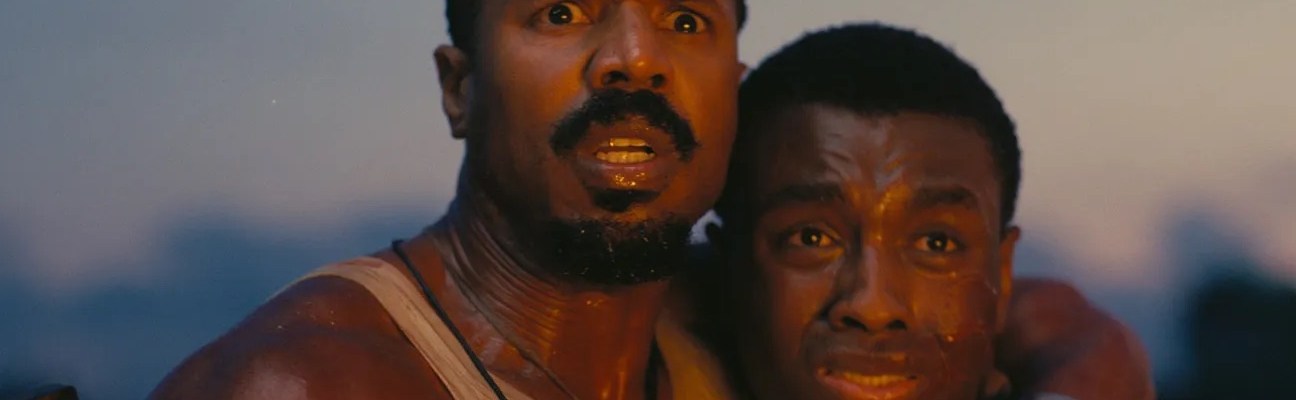


Why 52 best films? Isn’t that a lot? Well, yes, but there were simply a lot of great films this year. Plus there’s 52 weeks in a year, so why not one great film per week? Plus, ah… 52 is ’25 backwards. Also, we wanted Bi Gan in there. If you want a top ten, just scroll to the end! Also, eligibility is based on being a new film that we saw for the first time this year. AND WITH THAT…
- Resurrection (dir. Bi Gan). Bi Gan folds time, memory and grief into a hypnotic reverie, where narrative dislocation becomes the film’s primary emotional truth – this lacked the focus and emotional core of his first two features, but the grand one-shot vampire story that caps things is transcendent, and worth the wait to get there.
- The Ice Tower (Lucile Hadžihalilović). A glacial, tactile fairy tale whose sensuous austerity and bodily unease turn cold surfaces into a quietly perverse psychological labyrinth – plus you get to see Gasper Noé in a fright wig.
- Mother of Flies (John Adams, Zelda Adams & Toby Poser). The Adams family are back on form with this intimate, handmade folk-horror whose earthy textures give its coming-of-age meets coming-of-death narrative an unusual sincerity alongside the dread.
- Black Bag (Steven Soderbergh). A stripped-back espionage thriller chamber-piece that treats professional intimacy as its real battleground, in this precisely framed moral miasma of kaleidoscoping loyalties. In parts this is in the vein of Sleuth or Deathtrap, and there are few veins better.
- It Ends (Christopher Landon). Not the first high-concept existential horror to show people driving around (Carnival of Souls) or even driving down an endless road (Dead End), but this one subtly treats its philosophical questions seriously instead of just recoiling in horror or retreating into genre tropes. To that end, this is a minor absurdist masterpiece.
- The Voice of Hind Rajab (Kaouther Ben Hania). A devastating act of testimonial cinema that strips away rhetoric to confront historic extermination head-on. Yes, it should’ve won the Golden Lion at Venice.
- Blue Moon (Richard Linklater). Linklater turns a single night at Sardi’s into a quietly funny, acidic portrait of performance and denial in 1940’s New York, with superb performances from Ethan Hawke and a career-best Andrew Scott.
- Roqia (Saïd Belktibia). A brutal exorcism horror fractures faith and history, in a visceral reckoning with Algeria’s Black Decade – director Belktibia channels paranoia, faith and manipulation into a bleak portrait of moral contagion.
- $POSITIONS (Brandon Daley). The funniest film of the year, this is an anxious Midwestern descent into tragicomic crypto obsession. It plays like a trailer-park Uncut Gems, following the cover-your-eyes nightmare spiral of a blue-collar schmuck with big dreams but little impulse control.
- Superman (James Gunn). A wonderfully sincere, unapologetically goofy love-letter to the silver age of comics, Gunn’s Superman is a sci-fi fantasy blast with a heart; at its centre is a Superman for our times – unsure, overwhelmed, but never, ever giving up.
- The Surrender (Julia Max). This chamber-piece horror centres on a mother and daughter attempting an occult ritual to undo loss, led by Colby Minifie (who has a great face for this material.) and Kate Burton. Max renders grief as physical, ugly, and hard to shake; A Dark Song meets The Devil Rides Out in this descent into the spiritual abyss.
- The Secret Agent (Kleber Mendonça Filho). A politically charged genre hybrid that folds espionage into lived history, simmering with anger beneath its procedural calm, this elegiac 1977 Brazilian thriller threads pulp intrigue through haunted memory. As tense as it is digressive, The Secret Agent stands among the director’s best.
- The Piano Accident (Quentin Dupieux). A dark, deadpan spiral of absurd causality where cruelty and chance collapse into the same joke, this is the best Dupieux since Mandibles: an acidly absurdist satire of influencer culture, delivered deadpan as it builds into horror.
- Final Destination: Bloodlines (Zach Lipovsky & Adam B. Stein). A smart revival that understands fate as slapstick, staging Rube Goldberg deaths with cruel ingenuity and perverse wit, while giving Tony Todd a worthy sendoff, Bloodlines proves that this franchise’s scythe is as sharp as ever.
- The Smashing Machine (Benny Safdie). A bruising character study that treats masculinity as both spectacle and trap, anchored by Johnson’s raw physical presence. The Smashing Machine surges with visual energy, and human empathy.
- Sound of Falling (Mascha Schilinski). A sensory immersion into adolescent interiority, transcending time to explore texture, silence and unease as young women of all ages toil under the patriarchy, haunting each other and us through the history of one grand home.
- Warfare (Alex Garland & Ray Mendoza). A brutal expansion of the visceral procedural elements of something like The Hurt Locker into a feature-length bullet-ridden maelstrom, this unsparing combat film drains heroism from the battlefield, replacing it with moral and sensory disorientation. An audiovisual “show of force”, a wall of noise and terror that exterminates all rational thought, and one of the few must-see-in-IMAX films of the year. Rated 15 for Strong Injury Detail, and the BBFC were not lying.
- Dust Bunny (Bryan Fuller). Mads Mikkelsen and Sophie Sloan carry Fuller’s twisted bedtime fable through a Jeunet-et-Caro-tinted storybook city where hitmen walk the alleys of the night and a monster waits under the bed, in this heightened, stylised horror fable that blends camp excess with childhood terrors.
- The Ballad of Wallis Island (James Griffiths). A gently comic chamber piece about regret and creative compromise, carried by its performers’ warmth – a beautiful, charming, word-of-mouth hit.
- 28 Years Later (Danny Boyle). A ferocious return that reframes apocalypse as political stasis, marrying kinetic terror to bleak social insight, 28 Years Later is a loud, chaotic, defiantly British horror epic that mutates the genre as much as it honours it. It blends digital chaos with folk horror unease, soaking its zombie tropes in grief, moss, and post-Brexit malaise. Bullet time and bodycams crash up against coastal rot and communal breakdown, and while it often threatens to come apart, the more I sit with it, the more I love it.
- Buffet Infinity (Simon Glassman). The boldest horror of the year, Buffet Infinity a funny, freaky, cosmic nightmare that feels like it’s watching you back – a structural experiment whose recursive absurdity becomes an unexpectedly sharp critique of abundance and emptiness, and where “all you can eat” might just include your mind. Convenient parking out front!
- My Father’s Shadow (Akinola Davies Jr.). Elegiac, angry, and loving: Akinola Davies Jr. transforms a single day in 1993 Lagos into a living portrait of memory and masculinity. This lyrical quest-movie finds national history refracted through a child’s partial understanding; the sense of a hidden meaning unfolding just out of sight hangs like a spectre over the proceedings. One of the great child-in-the-city movies.
- Left-Handed Girl (Shih-Ching Tsou). The Left-Handed Girl moves with the rhythm of real life: rough, luminous, and deeply humane. Tsou turns Taipei’s night lights into a moral kaleidoscope where family, hypocrisy, and endurance are seen through the clear eyes of one child and in the hard-won self-possession of her sister.
- Late Fame (Kent Jones). A wry, humane meditation on artistic validation, missed timing, vanity and yearning, steeped in literary melancholy – watch this for the superb Greta Lee, eclipsing even the excellent Willem Dafoe in a tragicomic look at authenticity and performance in modern New York.
- Alpha (Julia Ducournau). Ducournau’s anxious study of broken bodies and family bonds boasts superb performances and visionary direction – a feral, bodily allegory that pushes maternal horror into operatic extremes without losing emotional coherence, and delivers an annihilating climax of raw emotional and thematic power.
- Companion (Drew Hancock). This twisting, turning horror-sci-fi romp boasts a darkly playful tone and sharp gender politics; a sleek, unsettling genre piece that toys with weaponising emotional labour and romantic expectation. A lot of fun.
- Sentimental Value (Joachim Trier). Trier’s most personal film yet dissects the line between art and intimacy, tracing how families tell stories about themselves, and creation becomes another form of control, in a quietly devastating family drama where emotional inheritance proves heavier than material wealth. See it for the superb performances from Skarsgård, Fanning, and especially Renate Reinsve.
- Sorry, Baby (Eva Victor). A razor-sharp debut whose humour cuts deepest when it brushes against vulnerability and fear, Eva Victor’s feature debut finds the dark absurd humour in the horror. Some may complain that the depiction of campus life and such-forth was unrealistic. Open the schools! Not every movie is 100% realism and the emotional truth of Sorry, Baby was like a freight train that rattled my windows.
- Boorman and the Devil (David Kittredge). Kittredge’s documentary reframes one of Hollywood’s greatest disasters into a hypnotic study of vision, collapse, and the strange beauty of failure. A reflective self-portrait that interrogates authorship, ego and artistic myth-making with surprising candour, Boorman and the Devil turns a financial disaster into a thoughtful, kind, and ultimately moving look into what it truly means to be creative. Begone, artless craftsmen. Let the visionaries return. Here’s to ‘bad art.’ It’s the second word that matters.
- The Ugly Stepsister (Emilie Blichfeldt). A corrosive fairy-tale revision that turns beauty into body horror and social punishment, Blichfeldt’s directorial debut makes The Substance look like a fairy tale – this is a gorgeous Cinderella fable that drips with blood and bile, and where everyone is both heroine and villain all at once.
- The Girl with the Needle (Magnus von Horn). Go in cold to this stark, morally punishing period film whose precision refuses consolation. Beautifully played and photographed – and between this and Azrael what a breakthrough year for Vic Carmen Sonne!
- The Mastermind (Kelly Reichardt). The anti-Ocean’s 11, Reichardt’s heist yarn begins in ironic key and ends in grace notes of nothingness, as her loose, jazzy crime film gradually unwinds into a chilly, deadpan moral tale. By the end, the dramatic tension has given way to a cosmic shrug, an unresolved note that leaves the audience to decide whether it reads as karma, nihilism, or just a very human mess. But unlike our protagonist, Reichardt always knows what she’s doing.
- If I Had Legs I’d Kick You (Mary Bronstein). A suffocating portrait of parental anxiety that traps the viewer inside relentless psychic noise, a horror-adjacent anxiety fever dream with fugue state jumps and hallucinatory elements lightly sprinkled in. Bronstein works in a similar register to her husband (writer and editor for the Safdies), but channels the nightmare energy towards depicting a woman just trying to hang on rather than a man-child trying to make their one big score. This is the best Rose Byrne has ever been.
- The Plague (Charlie Polinger). An allegorical contagion drama that treats adolescence itself as the outbreak; Polinger’s stunning debut examines how a tween community produces outsiders, then builds its own remorseless logic around their exclusion. The Plague’s horror lies not just in bodily corruption, but in ordinary acts of categorisation, in the speed with which a community defends the sadistic logic it has created, and in the ways that logic becomes the dominant reality – whatever the adults might like to think.
- The President’s Cake (Hasan Hadi). A deceptively simple childhood story that becomes a sharp parable of power, fear and survival, reminiscent of early Panahi, with a superb lead performance from young star Banin Ahmad Nayef.
- Mirrors No. 3 (Christian Petzold). A kind of hidden ghost story, where identity feels provisional, shelter is illusory, comforts are distractions and the honest step forward is the step into the void. Paula Beer is superb, and the final shot is may be my favourite of the year. Cannes critics said it was “minor” Petzold, but it is merely stripped-back and minor key – in its quiet power, it is nothing but major.
- Eddington (Ari Aster). A sun-blasted American psychodrama that reframes frontier mythology as civic nightmare, Ari Aster’s darkly dazzling vision of pandemic-era America is a gloriously cynical western satire, shot with bravura craft. A bravura work of cynicism and spectacle, it is one of the boldest cinematic responses to the pandemic era, and a reminder that Aster remains one of the few decently-budgeted filmmakers able to deliver spectacle with a real voice.
- The Things You Kill (Alireza Khatami). A stark moral puzzle that weaponises silence, implication and withheld violence. Alireza Khatami’s morally anxious thriller shows grief tipping into suspicion, violence, and the uncanny. Starring Ekin Koç and Ercan Kesal, The Things You Kill’s tense restraint and moral clarity make the dread linger. Initially this seems like a strong anti-patriarchy moral thriller, in the typical Iranian mould. But halfway through it becomes more than that, elegantly sliding into wtf dream logic, as if an Asghar Farhadi flick suddenly became laced with a strong dash of Lost Highway… and then it delivers a killer ending.
- Hallow Road (Babak Anvari). This pressure-cooker folk-horror-thriller follows a couple (Rosamund Pike and Matthew Rhys) racing through the night to conceal a terrible accident. Tension accumulates relentlessly, with no easy release, as Anvari serves up an all-timer annoying husband in this, his best film. Pike, meanwhile, is exceptional.
- Bring Her Back (Danny Philippou / Michael Philippou). Danny and Michael Philippou’s grief-horror follows a bereaved mother courting mysterious, dangerous rituals, played by the superb Sally Hawkins in one of the performances of the year. Emotional pain is pushed into physical extremity with disquieting effectiveness. (Ironically, we hear “bring her back” is what the producers of Paddington 4 are saying about Sally Hawkins.)
- Bugonia (Yorgos Lanthimos). Alongside the mix of humour and dread are some moments of brutality, and the closing images lift this remake beyond mere reenactment. Lanthimos stages them with stark grandeur, leaving behind a sense of awe. Bugonia is an absurd conspiracy thriller that’ll keep newcomers guessing right until the end. Though it may hew closely to the original (Korean genre gem Save The Green Planet), Bugonia surpasses it through sheer strength of craft and performance. This dark and deadly farce is a faithful retelling, speaking to our collective moment; a warped mirror held to a collapsing world.
- It Was Just an Accident (Jafar Panahi). A deceptively casual setup that detonates into a devastating indictment of power and moral evasion. Panahi’s latest film turns a revenge-thriller premise drawn from his own unjust imprisonment into a darkly funny, deeply humane exploration of trauma, moral uncertainty, and the blurry line between personal and systemic violence. By finding warmth, absurdity, and fragile community among victims debating whether to commit an unforgivable act, the film makes its ethical fury and grief even more devastating – especially in its extraordinary final act.
- Hamnet (Chloé Zhao). A hushed, elemental grief poem that finds transcendence in texture, labour and loss, this film really is THAT emotional juggernaut, for which you’ll be on board or not. Despite a slightly intrusive score and some over-egged face-acting from Buckley at the end, reader, I sobbed. And casting Noah Jupe as Hamlet and Jacobi Jupe as Hamnet? Chloe Zhao, you maniac.
- Kontinental ’25 (Radu Jude). A caustic, restless essay-film that treats Europe as a capitalist hallucination, Radu Jude turns guilt into farce and bureaucracy into tragedy; a moral trial conducted in real time, and one of the most exacting films of recent years. It is a hard, lucid reckoning with how the continent rationalises its own failures, and how easily it moves on; it confirms Jude as one of the essential filmmakers of our time, and the great moralist of modern Western cinema.
- No Other Choice (Park Chan-wook). In this late-career exercise in moral entrapment and elegant suspense, Park Chan-wook adapts Donald Westlake’s novel The Ax into a viciously funny black-comedy thriller about work, masculinity, and the absurd lengths people will go to to cling on to their dreams – all carried by a riotous performance from Lee Byung-hun.
- Train Dreams (Clint Bentley). A lyrical American elegy whose visual restraint deepens its emotional reach, Clint Bentley’s Train Dreams finds the vastness of America in the quietest of lives, turning Denis Johnson’s frontier novella into something quietly transcendent. The forest swallows people, until people swallow the forest – and then time swallows everything. There is no grand revelation, only acceptance. the knowledge that to live is to witness and that is blessing enough. Joel Edgerton’s greatest performance.
- Weapons (Zach Cregger). A sprawling, structurally daring horror that understands fear as communal rupture. There is no manifesto here, no perpetrator’s psychology offered up to be parsed. The refusal is deliberate. In a culture where killers inscribe tongue-in-cheek slogans on bullets and lace their online posts with memes, motive is itself performance, and incoherence is baked in. Children have taken from their families and turned into instruments of violence, not just psychologically and socially but literally, physically – in this case through witchcraft, by a witch, rather than through TikTok by Andrew Tate. Cregger keeps his focus on the people forced to live in the shadow of unintelligible loss. A film for our times, but hopefully not for our children’s times.
- Fucktoys (Annapurna Sriram). I have seen the future of trash, and her name is Annapurna Sriram. Fucktoys is a ferociously original midnight movie whose abrasive humour masks real emotional intelligence. This is a phenomenal start for Sriram, who has emerged with a strong voice, a transgressive impulse and a heartfelt vision of drop-outs, fuckups, lovers, ne’er-do-wells and dreamers who live on the edge of a dream. There’s no doubt that the likes of A24 and Neon will now be falling over themselves to give her a first-look deal. But in her journey to get this far, Sriram has talked about the financing meetings that were really dates, the producers who hit on her, and the notes telling her to change the title, tone it down, or hire someone else to direct. Yet she stayed true to herself, and we can only hope she continues to do so, because Fucktoys is the most exciting film debut of the year – and certainly the best film to still not have distribution in place.
- Rose of Nevada (Mark Jenkin). The past and present overlap to unnerving effect in Mark Jenkin’s timeslip fishermen’s yarn, a Cornish folk horror whose very form seems haunted. A formally restless, regionally haunted work that turns landscape into psychic trap. The film treats its shift in eras less as a narrative twist to be resolved than as an atmosphere to sink into. After all, are we not each haunted by the past, and by the future? Jenkin’s Bolex cinematography, hand-processed textures, stuttering edits and disembodied ADR voices make the viewing experience itself uncanny, a cinema that feels genuinely haunted – a spellbinding triumph of eerie dread. Some might say this is a folk horror without the overt horror – no cultists, witches or demons here. But the obligations of human ties, the irresistible pull of time, and the economic erosion of Cornwall all emerge as horrors in their own right. George MacKay and Callum Turner deliver their best performances yet, in the most poetic folk horror of the decade. I loved this film.
- Marty Supreme (Josh Safdie). A manic character study where ambition becomes indistinguishable from self-destruction, and where Inside Llewyn Davis meets The Brutalist meets The Small World of Sammy Lee – with the most unexpectedly 80s soundtrack of the year. When the Safdies split to pursue their individual projects, Josh kept writer-editor Ronald Bronstein, the secret Safdie sauce – and that’s why Marty Supreme is up at number three, while Benny Safdie’s (strong!) The Smashing Machine was down at 38.
- One Battle After Another (Paul Thomas Anderson). A vast, nervy political epic that treats American history as recursive farce and tragedy, this shipment of pure cinematic crack is a phenomenal fusion of paranoid thrills, propulsive action, and dark comedy. Gloriously funny, breathlessly exciting, and deeply moving, One Battle After Another is not just Paul Thomas Anderson’s biggest film; it is his most exhilarating – a live grenade dropped into our cultural powder keg.
- Sinners (Ryan Coogler). A muscular, mythic horror film that fuses genre spectacle with historical reckoning and moral fury, Ryan Coogler’s Mississippi-set vampire epic follows twin brothers confronting both supernatural and human violence, with Michael B. Jordan in dual roles. Blues legends, muscular filmmaking, and cultural specificity fuse into a horror film that feels fully alive, with a shifting aspect ratio that makes the most of its IMAX dimensions. We called it a blood-soaked Southern Gothic fable where juke-joint blues and Black mythology do barnstorming battle with vampiric threats… in blood, fire, and song. Sinners is not only the horror of the year, but also the film of the year. Academy, are you listening?
And with that… here’s to 2026!
 Whitlock&Pope