
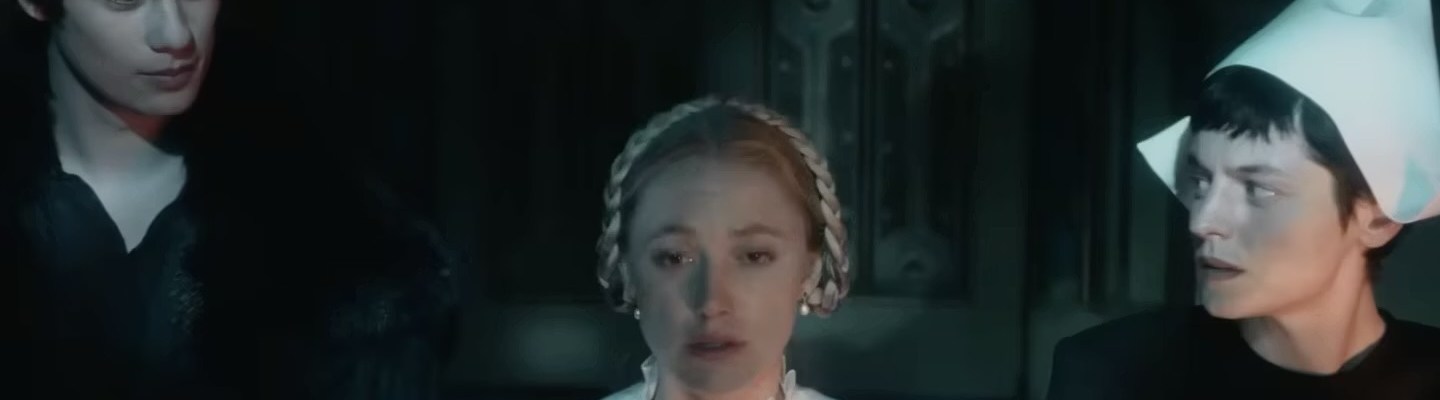


Like Orlando refracted through Peter Greenaway, this postmodern exercise in feminist myth-making tries to dazzle, but its centre is a little too hollow.
★★★½
From its earliest moments, 100 Nights of Hero lets us know that realism is not the point. Multiple moons hang in the sky. A god called Bird Man presides. History is not anchored to a specific period but more perched at the moment before enlightenment – although not necessarily The Enlightenment. This is fantasy meant to be appreciated as such – we are supposed to see the joins. Yes, we’re in the realm of the postmodern fairytale.
That sensibility places the film squarely in a European tradition – it’s like Orlando refracted through Peter Greenaway’s schematic cruelty, with traces of Sally Potter’s gender play, Derek Jarman’s queer mythmaking, the quiet observational instincts of Joanna Hogg, and just enough Wes Anderson playfulness to flatten affect without introducing too much whimsy. It borrows their grammar, but not always their depth.
Adapted from Isabel Greenberg’s graphic novel, the film is patchy in its fidelity. The book’s power lies in its anthological sprawl, its stories within stories, its sense of narrative as accumulation rather than propulsion. The film, by contrast, deliberately narrows its focus. That is a concession to medium, but also to budget. This is a production that moved from a long gestation to a sudden greenlight, and there’s a sense throughout of the cast and crew doing their best. To be fair, that best is pretty good, but the limits show.
The story reworks the concept of One Thousand and One Nights into a parable about authorship and survival. Cherry (Maika Monroe), abandoned by a husband willing to gamble her life on fidelity, is protected by Hero (Emma Corrin), whose nightly stories delay violence and slowly reframe the world. Overseeing it all is Bird Man (Richard E. Grant), a god who governs rather than creates. The crucial wrinkle is that his daughter made the world. Creation and authority are split. Women generate meaning; men administer it.
Characters choose, hesitate, betray, desire, but every decision carries cost because the system is hostile – particularly to the women. Although Cherry and Hero each attempt to fight or resist the patriarchy in their own ways, in the end their transcendence arrives as canonisation rather than liberation. Spoiler alert: women do not dismantle the structure. They pass beyond it, into myth, story, icon. The film understands this as both victory and loss. This is a sincere feminism, but may not be satisfying for some viewers.
100 Nights of Hero is an admirable, frustrating, often beautiful object. It looks good. The costumes are genuinely strong. The location scouting earns its keep. Its ideas are coherent, its influences worn openly, its ambition clear. It never quite reaches the strangeness or danger of its best references, and it occasionally mistakes clarity for depth, but it remains compelling on its own terms. It’s confident, and often striking. Costumes do real work. Locations are carefully chosen, allowed to carry texture rather than be overwritten. The multiple moons give the world a dream-logic tilt, a Magritte-like wrongness that pulls the film out of history and toward the eternal. Time layers rather than advances. Nights accumulate. Characters ponder also how much time has really passed. So far so dreamy, but this playful abstraction gives atmosphere over momentum, mythological charge over psychological depth.
For all its elegance, the film sometimes states its thesis aloud. Storytelling is power. Stories save lives. Stories reshape worlds. All true, but repetition blunts force, and it’s a thesis so worn through that even Doctor Who has suggested it multiple times. The explicit myth-making flattens things at moments when friction would have served it better, relying on the purity of the idea rather than the mess of its consequences.
The best part of the film is Hero and Cherry’s queer intimacy, which is built from small behavioural details: voice shifts, physical ease, the relief of being unperformed with another person. Desire is present but muted, channelled away rather than risked. This restraint feels intentional, aligned with a fairytale mode more interested in intimacy as refuge than transgression. Still, one senses that a little more contradiction, a little more heat, might have complicated the myth in productive ways.
100 Nights of Hero is in UK and Irish cinemas now
 Whitlock&Pope