


★★★½
Emerald Fennell turns “Wuthering Heights” (scare quotes hers, and intentional) into a moderately perverse and stylised spectacle, less adaptation than misremembered fever dream.
The best adaptations take their raw material and mould it, reconfigure it, slash away the parts that do not suit the new vision, warp the remains, and wield the imagery to new ends, mindful that the original sits where it always sat, safely untroubled by revisioning, available to be pulled from the shelf and re-enjoyed at any moment. So it goes for everything from Under The Skin to There Will Be Blood. The best response to Brontë’s novel so far has been Kate Bush’s song, which she based on catching the end of the BBC version on late-night television as a teenager and not quite knowing what was going on.
Likewise, at its best Emerald Fennell’s version of Wuthering Heights feels like Baz Luhrmann doing Gone To Earth by way of a 1980s Cadbury’s Flake advert (complementary). Between this and Frankenstein, Jacob Elordi certainly knows his way around a heightened reality filled with ruined buildings, opulent houses and beautiful gowns. Beautiful within the reality of the film, at least – gaudy as hell in reality (complimentary).
Yes, it’s true that this Heights is stylistically inconsistent, Margot Robbie is miscast, and Shazad Latif remains too much of a blank piece of paper. The film’s erotic charge is sufficient if not overwhelming. But Jacob Elordi is decent – certainly better here than in his deeply uninteresting turn as Frankenstein’s creature – and the real stars, Hong Chau, Alison Oliver, and the child actors, all have the space and time to shine.
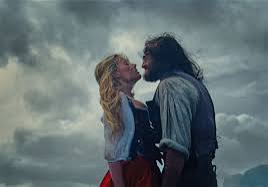
As for the novel’s treatment of class and race, such as it was… Brontë had characters describe Heathcliff as a “little Lascar,” marking him as racially othered within the world of the book. Fennell carries forward the class tensions but largely sidesteps the racial dimension, casting the white Elordi as Heathcliff while taking a Bridgerton-style approach elsewhere, with Shazad Latif, of mixed Pakistani and British heritage, as Edgar. Flipping that casting might therefore have satisfied those interested in that aspect of the book, although then you’d miss out on Elordi’s hulking, brooding, mud-caked sadism (he towers over his love rival, as he towers over his love).
In any case, her focus lies less in social structures than in abnormal psychology. Fennell’s interest is in perversity; everyone here seems to be wired up wrong. There have been more perverse films, certainly, but this one is calibrated to be just transgressive enough for mainstream audiences to want to buy a ticket. Between that and the Charli XCX soundtrack, Fennell appears to understand marketing at least as well as she understands Brontë.
On the whole, then, this comes recommended for anyone not wedded to their A-Level memories of A+ thematic analysis, looking for glossily stylised psychosexual shenanigans. It plays like a tween’s horny imagining of what the novel might be like, maybe, based on a quick skim of the back cover of a cheap 70s paperback, followed by a more thorough glance at the rippling muscles on the front.
Again, complementary. Fennell knows her audience, and she knows herself.
Wuthering Heights is in cinemas now.
 Whitlock&Pope