
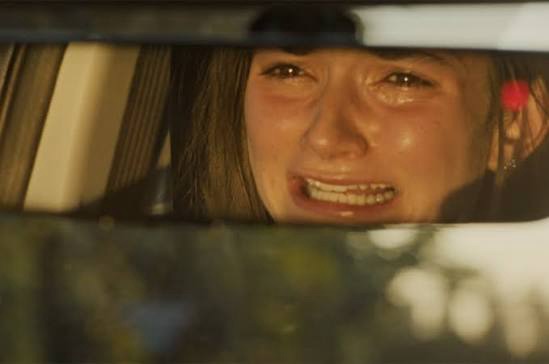


Emily Robinson’s debut sits on the brink of the current wave of intimate body horror but approaches it from an unusually grounded angle, turning a minor industry note into a full-blown psychological and physical meltdown.
★★★
The problem, as it is explained to young actress Delaney, is simple. She cries badly. Not badly in the sense of failing to produce emotion, but badly in the sense that her face does not cooperate with the camera. The muscles pull in the wrong places. What should read as winsome vulnerability instead looks… unappealing. In an industry built on the close-up, that becomes disqualifying. Ugly Cry is a queasy L.A. body-horror story about perfect tears.
Delaney, played by Robinson, takes the note at face value. If the issue lies in how she cries, then it can be fixed. The film follows that reasoning step by step. She studies her expressions, repeats exercises, and starts to think about her face as something that can be trained into compliance. Cosmetic intervention enters gradually. Botox is presented not as a drastic measure but as a practical adjustment, another tool in the same continuum as acting technique.
Robinson directs with a steady, almost procedural focus on these processes. Casting rooms, workshops and clinics are filmed without exaggeration, just insidious, suffocating presence. The emphasis stays on accumulation. One small correction leads to another, and the distance between them barely registers. That is where the film locates its horror. There is no violent rupture, just a slow narrowing of what the body is allowed to do. This perfectly captures the nightmare of living in La-La Land while having a perfectly normal face.
Robinson’s performance holds the centre because she keeps Delaney in a constant state of self-observation. She listens to herself, watches herself, and adjusts in real time. Even in conversation there is a sense that part of her attention is elsewhere, checking how each reaction might appear. We file her around that loop of feedback, comparison, rehearsal, adjustment, and back again. The ‘flaw’ itself is minor, but the response spirals into total war on the Self.
The great joy of this film is Robin Tunney, who brings a different kind of pressure to the film. As Delaney’s mother, she plays someone who is attentive, supportive and quietly exacting. Her focus on composure and discipline never reads as harsh, which makes it more difficult to push back against. She offers advice that sounds reasonable and encouraging, while reinforcing a narrow idea of how emotions should be expressed.
The character does not recognise the effect she has, but we can see that the connection between those domestic scenes and Delaney’s professional struggle is key. The impulse to manage feeling, to present it in an acceptable form, clearly has a longer history than the audition that sets the story in motion.
Anyone looking for outré horror here will feel that the film doesn’t press its premise as far as it could. Once Delaney’s control begins to falter, there are points where a harsher turn feels possible. Instead, the film sticks to realism. What remains is a film that understands how a small note can take over a life.
Ugly Cry played at SXSW in Austin TX, and will play later this month at the Overlook Film Festival in New Orleans.
 Whitlock&Pope