
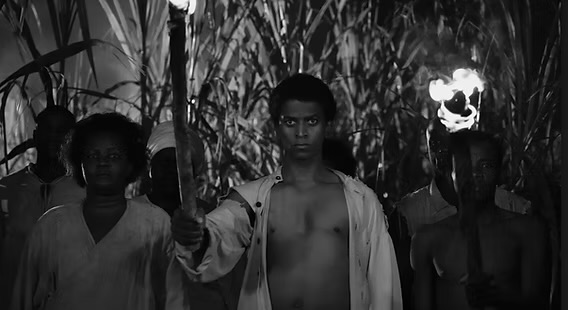


An engaging primer on the zombie’s Haitian origins that raises fascinating questions about colonialism and cultural theft, though it rarely digs too far beneath the surface.
★★★
The zombie has spent most of its cinematic life wandering far from the place that created it. Since Night of the Living Dead rewired the creature into a flesh-eating metaphor for American collapse, the earlier Caribbean mythology that shaped it has largely slipped from popular memory. Maya Annik Bedward’s directorial debut Black Zombie sets out to correct that historical drift, returning the zombi (no ‘e’ at its origin) to Haiti and to the Vodou traditions from which it emerged.
The documentary’s strongest passages come when it simply tells that story clearly. Through interviews with historians, cultural commentators and Vodou practitioners, the film traces how the zombie first appeared as a figure tied to slavery, colonial control and the fear of losing autonomy over one’s own body. The zombi, in this telling, is not a cannibalistic ghoul but a political metaphor: a worker stripped of will, forced to labour beyond death.
Those ideas are compelling, and Black Zombie works excellently as an accessible primer on the zombie’s true origins, particularly for viewers whose understanding of the creature begins and ends with Romero and the endless wave of post-apocalyptic imitators that followed him. The film patiently explains how Vodou cosmology intersects with Haitian history, how colonial anxieties shaped early folklore, and how American occupation and exploitation fed Western fascination with the island’s spiritual traditions. White “explorers” are picked over for their tendency to “discover” cultural practices and sell them as tales of intrigue. William Seabrook’s 1929 The Magic Island gets a far more of a bashing than the more sympathetic Wade Davis of The Serpent And the Rainbow, who is in turn keen to distance himself from Wes Craven’s schlocky 1988 film ‘inspired by’ his 1985 book.
Where the documentary begins to wobble is in how little it builds on those foundations. The themes it raises are rich, but they are rarely pursued with the depth they deserve. Too often the film feels content to outline ideas rather than interrogate them, circling around its subject rather than digging into it.
This becomes particularly noticeable in the film’s attitude towards the key films. The documentary correctly identifies early Hollywood as a major conduit through which the zombie myth travelled into Western culture, but its analysis rarely moves beyond a summary level. Films are introduced, contextualised briefly, and then left behind.
That approach leads to some curious gaps. White Zombie and The Serpent and the Rainbow are both given a decent dressing down – but when I Walked with a Zombie appears, as it almost inevitably must, the film’s extraordinary fusion of Caribbean spirituality, colonial guilt and Gothic melodrama is barely unpacked. Jacques Tourneur’s film is one of Hollywood’s defining engagements with Haitian folklore, and its flaws and power cry out for deeper examination than they receives here.
Even more striking is the absence of Zombi Child, a contemporary film that wrestles directly with the postcolonial implications of the zombie myth and its migration into European culture, and even features Baron Samedi. Given how closely Black Zombie positions itself around questions of cultural ownership and historical memory, the omission must have been a curatorial decision, but whatever one makes of the film its exclusion plays like a major blind spot. Mati Diop’s Atlantiques (2019) is Senegalese, but its use of zombie iconography to tell a story of race, migration and capitalism seems tailor-made for this film to dig into – alas it too is passed over. And while Jordan Peele’s Us (2019) might be stretching it, I think “stretching it” is exactly what this documentary needed to do.
Instead we get some thoughts about zombie walks, clips of Live And Let Die, and Tom Savini talking about horror makeup. Producer Slash (of Guns & Roses fame) turns up to discuss his mother’s Vodou heritage. I thought for a second he was going to link his trademark top hat to Baron Samedi. No. His contributions – such as they are – trail off, and sadly that’s that.
Absences like these leave the film feeling oddly unfinished. It raises the right questions about colonial appropriation, spiritual misunderstanding, the colonial punishment of Haiti for its revolution, and the commodification of Haitian culture, but rarely stays with those ideas long enough to uncover anything beyond the historical basics. It doesn’t seem to want to engage with modern-day interrogations or reclamations of zombie imagery, just its crass commodification – a good subject, but not the only one at play.
And yet there is still real value in the film. For viewers encountering these ideas for the first time, Black Zombie offers a lucid introduction to the origins of a monster that has been culturally repurposed almost beyond recognition. The film reminds us that the zombie was never just a Hollywood horror creature. It was a idea born from slavery, occupation and the threat of losing control over one’s own body, and in the right hands it remains a powerful metaphor for having your body appropriated by capital – or by whiteness.
That is a powerful story in itself. Black Zombie tells it engagingly, even if it rarely pushes beyond the introductory chapter.
Black Zombie is playing at SXSW in Austin, TX
 Whitlock&Pope